Is Oven the Same as Air Fryer? A Clear Comparison for Home Cooks
Compare ovens and air fryers to understand heating methods, texture outcomes, capacity, and energy use. This analytical guide helps home cooks decide when to use each appliance for best results.


Is oven the same as air fryer? Not quite. An oven (with or without convection) provides larger capacity and versatility, while an air fryer relies on rapid hot air circulation for crisp textures with less oil. For quick meals, an air fryer wins on speed; for roasting, baking, or big batches, a traditional oven shines.
Is oven the same as air fryer?
The quick answer starts with understanding that these are two distinct tools in most kitchens. While both can perform roasting and crisping tasks, they are built for different scales and textures. The keyword is central to this discussion: is oven the same as air fryer. In practice, ovens and air fryers share convection elements in some models, but they diverge in size, heat delivery, and the textures they create. This section lays out the essential differences so you can decide which tool best fits your cooking style and space constraints. You'll see that the choice often comes down to batch size, cooking speed, and how important a crisp crust is to you. Throughout this guide, Stove Recipe Hub's analysis helps frame practical decisions for home cooks.
Heating method and heat delivery: how they cook
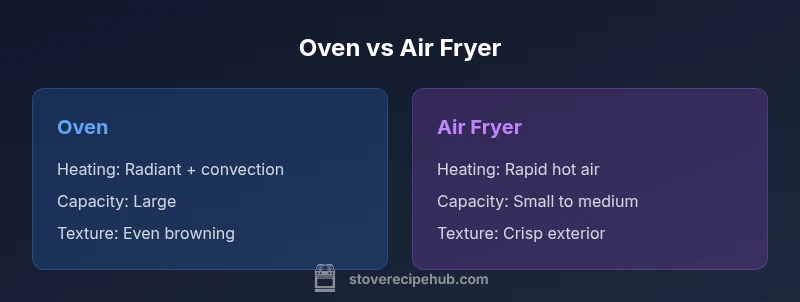
Ovens traditionally heat with radiant elements and, in convection models, a rear or fan-assisted system that moves hot air around the cavity. The heat is more uniform across a larger chamber, allowing for multi-dish roasts and sheet-pan meals. Air fryers, by contrast, use a compact chamber with a high-velocity fan that circulates hot air at very close range. This rapid air movement concentrates heat on the surface of foods, creating a brisk, crisp exterior while finishing the interior quickly. The core takeaway is that oven heat distribution is more volumetric; air fryers maximize surface browning with fast convection.
Texture, browning, and flavor outcomes: what to expect
Texture is the defining difference most cooks notice. Air fryers excel at a light, even crisp on smaller items—think French fries, chicken tenders, or roasted vegetables. The surface moisture is driven off efficiently, and fat use can be reduced without sacrificing crunch. Ovens, especially when used with convection, can achieve similar browning but tend to deliver a more varied texture across larger foods or multiple items simultaneously. For thicker cuts or bakes (like a casserole with a crust), the oven’s larger cavity supports consistent heat penetration and even browning from edge to center.
Capacity, footprint, and flexibility in the kitchen
A compact air fryer typically handles 1–4 servings and fits on a countertop, making it ideal for small kitchens or quick weekday meals. An oven, even standard-sized, accommodates whole-sheet pans, large roasts, and multiple dishes at once. If your kitchen prioritizes a single workhorse appliance that can bake, roast, and broil for family meals, the oven is often the better long-term fit. For apartments, dorms, or tight counter space, a high-quality air fryer can save a lot of room and still deliver crisp results for everyday snacks and sides.
Preheating, cook times, and recipe adaptation
Air fryers almost always preheat quickly and deliver shorter cook times for many small items due to rapid air circulation and proximity to the food. Ovens may require longer preheating, especially for large roasts or baking where even heating is crucial. When adapting recipes, reduce the air fryer temperature by about 25–30°F (14–16°C) and start checking early to avoid over-crisping. Conversely, oven-based recipes often require longer times, particularly for larger pieces or when multiple trays are used.
Energy use and long-term costs: what matters for budgets
Energy costs depend on power rating, duration, and frequency of use. Air fryers typically have lower power and shorter cook times for small portions, which can translate to lower energy use per serving. Ovens, while less energy-efficient per minute in some cases, shine when cooking large meals — a single oven can replace multiple appliances and reduce overall energy expenditure for batch cooking. For most households, the decision hinges on typical meal size and how often you need to prepare multiple items at once.
Cleaning, maintenance, and odors: keeping appliances fresh
Air fryers usually have fewer parts to clean than ovens, with removable baskets that rinse quickly. Their compact interior can accumulate grease more rapidly if high-fat foods are cooked frequently. Ovens require more effort to clean, especially if spillovers occur on racks or in the bottom cavity. Regular cleaning and line-of-sight maintenance help prevent lingering odors and maintain performance. Remember to follow manufacturer guidance for de-crumbing and safe rack handling.
Practical tips and starter usage guidelines
For quick weeknight meals, an air fryer can be a go-to for crispy sides and small proteins. When you need to bake a sheet of cookies, a casserole, or a big roast, lean toward the oven. To maximize flexibility, identify tasks you perform most often: if you value speed and crispness for small portions, invest in an air fryer; if you cook for a family or entertain, a reliable oven becomes the central hub of your kitchen.
Safety and maintenance basics you should know
Both appliances require basic safety practices: keep the area clear of flammable items, use heat-resistant gloves when handling racks, and avoid overfilling the cooking chamber. Air fryers have exposed heating elements, so avoid blocking air flow. Ovens can have hot racks that require careful handling. Regular inspection of seals, gaskets, and door hinges helps prevent heat loss and ensures consistent performance.
Comparison
| Feature | Oven | Air Fryer |
|---|---|---|
| Heating method | Radiant + convection (in many models) with larger cavity | Rapid hot air with high-velocity fan in a compact chamber |
| Typical batch size | Large capacity suitable for multiple dishes or whole roasts | Small to medium portions, best for 1–4 servings |
| Texture outcomes | Varied textures; even browning possible, especially with convection | Crisp exterior on small items with fast surface browning |
| Preheat time | Longer preheat for large meals; preheating helps even cooking | Very quick preheat; ready to cook rapidly |
| Cook time for small items | Moderate to fast depending on dish; can equal or exceed air fryer for larger items | Typically faster than a traditional oven for small, crisp items |
| Clean-up | Racks and racks—more effort; occasional deep cleaning | Removable basket; easy to clean, fewer parts |
Upsides
- Oven offers larger capacity for batch cooking and meals for groups
- Air fryer delivers quick crisp textures with little oil
- Convection ovens bring faster, more even browning than non-convection models
- Compact air fryers save countertop space and reduce preheat time
Downsides
- Ovens can be slow to preheat and less energy efficient for small portions
- Air fryers have limited space, not ideal for large roasts or sheet-pan meals
- Air fryers may require recipe adjustments and monitoring to prevent over-crisping
- Some ovens lack true convection or have inconsistent rack spacing
Choose based on space, batch size, and texture goals
If you cook for a crowd or bake large items, the oven remains the versatile workhorse. For quick, crisp results on small portions, an air fryer is ideal. The best approach in many kitchens is to use both strategically and let each shine where it performs best.
Common Questions
Is an air fryer better for crisp foods than an oven?
In many cases, yes. Air fryers excel at producing a crisp exterior due to rapid hot air circulation in a compact chamber. An oven can achieve a similar result with proper preheating, convection, and placement of food on a rack or sheet, but the process may take longer and require more oil to reach the same level of crunch.
Air fryers often give crisper results faster, but you can get excellent crisp on an oven with convection and correct setup.
Can I bake cakes or cookies in an air fryer?
You can bake small batches, but space and heat distribution matter. Cakes and cookies may bake unevenly if the basket is crowded or if the air is not circulating evenly. Ovens generally provide more consistent results for baked goods due to larger, even heat distribution.
Air fryers can bake small treats, but for even results, an oven is usually preferred.
Do air fryers use less energy than ovens?
Energy use depends on duration and load. Air fryers typically heat up quickly and may use less energy for small portions, while ovens consume more energy but can cook large meals in a single batch, potentially offsetting the higher consumption with efficiency at scale.
Smaller air fryers use less energy for small meals, but ovens win when cooking big batches.
Is an air fryer just a small oven?
An air fryer is a specialized appliance that relies on rapid air circulation to crisp foods and is not simply a mini oven. It has a distinct cooking approach, size, and limitations, though it shares some convection principles with ovens.
Not exactly—a lot of air fryers work differently than standard ovens.
How can I convert a baking recipe for air fryer use?
Start by reducing temperature by about 25–30°F (14–16°C) and monitor closely for doneness. Shorten overall cooking times and avoid crowding the basket. For larger items, partial cooking in the air fryer followed by final finish in the oven can yield best results.
Lower heat, watch closely, and don’t overcrowd the basket.
Are there safety concerns unique to air fryers or ovens?
Both appliances require basic safety practices: keep flammables away, use heat-resistant gloves, and ensure proper ventilation. Air fryers have exposed elements and can overheat if overfilled; ovens have larger spaces that can trap heat around racks. Regular maintenance reduces safety risks.
Follow the manual and never overfill; safety first for both.
Top Takeaways
- Identify typical meal sizes to guide appliance choice
- Use convection when you need even browning in larger dishes
- Rely on air fryer for fast, crisp results on small portions
- Factor in kitchen space and energy considerations
- Develop recipe adaptations for each appliance