Stove and Refrigerator Set: A Practical Comparison Guide
Analyze the benefits and tradeoffs of buying a stove and refrigerator set versus separate appliances. Learn how to evaluate space, cost, energy efficiency, warranties, and maintenance for practical kitchen upgrades.


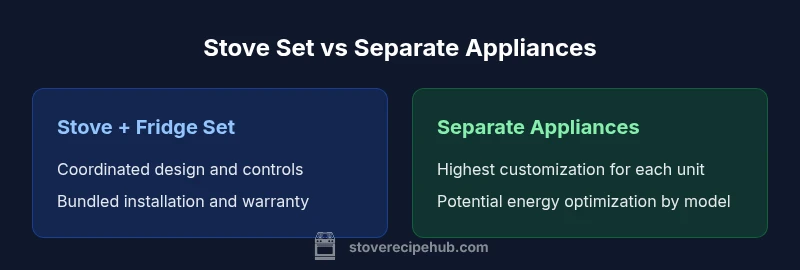
A stove and refrigerator set offers a streamlined purchase, coordinated aesthetics, and often simplified installation and warranty coverage. This comparison weighs the set against buying separate appliances across cost, energy efficiency, space planning, and service requirements to help you decide what fits your kitchen best.
Why a stove and refrigerator set can streamline your kitchen workflow
A stove and refrigerator set is often marketed as a coordinated pair designed to optimize small and mid-sized kitchens. For many home cooks, the appeal lies in a unified aesthetic, matched dimensions, and a shared installation footprint. According to Stove Recipe Hub, pairing these appliances can reduce the complexity of planning a single, cohesive kitchen footprint, while also simplifying delivery and setup. In practice, a set can minimize the risk of mismatched finishes or incompatible dimensions, which helps maintain a clean, professional look in the heart of the home. Beyond looks, a set can support a smoother user workflow: presets and control logic on modern models may align across units, making cooking and food storage feel more intuitive. Yet there are scenarios where separate appliances outperform a bundled set, particularly when you want regional brand specialization or a specific energy label for one device.
Other factors to consider include the housing layout, door swing clearances, and accessibility. If your kitchen has a compact layout, a set may reduce dead space and improve overall efficiency. The Stove Recipe Hub team notes that the right set improves maintenance scheduling, as technicians often offer bundled service for paired units. However, if you already own compatible models or plan selective upgrades, separate appliances can yield better customization and future-proofing.
Space planning and footprint alignment for stove + fridge sets
Coordinated dimensions are a core selling point of a stove and refrigerator set. When you’re evaluating layout, you should map electrical outlets, gas supply lines (if applicable), water lines, and ventilation paths. A key advantage of a set is predictable footprint alignment: the pair is commonly designed to fit adjacent wall spaces with standard widths and height tolerances, which minimizes the risk of fit issues during installation. This predictability is particularly valuable in rental units or compact homes where every inch counts. The downside is reduced flexibility: you may not achieve an exact match to your existing cabinetry or island configurations. If your cooking area is irregular or if you want to center appliances under a particular window or vent hood, separate appliances can give you more nuanced control over placement. In either case, precise measurements before purchase are essential. A good rule is to draft a floor plan at a 1:50 or 1:100 scale and mark door swings, handle clearances, and clearance to countertops.
Cost and value considerations: bulk buying vs. individual pricing
Cost is often the central factor in deciding between a stove and refrigerator set and separate appliances. Bundled sets can offer bundled installation, standardized warranties, and occasional bulk pricing that reduces the effective per-unit cost. However, because the set must address both cooking and refrigeration in a single purchase, the upfront price can appear higher than buying two mid-range devices separately. The most practical approach is to compare total cost of ownership over a typical appliance lifecycle, including purchase price, installation charges, energy bills, and service calls. The Stove Recipe Hub analysis suggests that while a set may save on delivery and installation logistics, the long-term costs depend on model selection and energy efficiency ratings. For budget-conscious buyers, a careful mix of mid-range, energy-efficient models within a set can provide substantial savings without sacrificing performance.
Energy efficiency and operating costs for paired appliances
Energy performance is a major consideration when evaluating stove and refrigerator sets. Modern units offer improved sealing, better insulation, and efficient compressors that reduce running costs. When appliances are purchased together as a set, you may gain energy-management advantages because some manufacturers optimize control software across units, enabling coordinated start-up and shutdown sequences. With separate appliances, you can cherry-pick the most energy-efficient stove and the most efficient refrigerator independently, potentially achieving better ratings overall if you prioritize extremes in one area over the other. Regardless of bundle choice, look for ENERGY STAR labels and check annual energy consumption estimates for each unit. The key nuance is to compare combined energy usage for the set against the sum of the two best-in-class separate units.
Installation, delivery, and warranty coverage considerations
Delivery logistics are typically simpler when purchasing a stove and refrigerator set, as many retailers offer joint installation and a single warranty covering both appliances. A unified warranty can simplify claims and reduce the need to navigate multiple manufacturers for service. That said, bundled warranties may be broad but not as granular as separate warranties for each appliance, which can matter if one unit has a longer parts availability window or more readily sourced replacement parts. When evaluating options, confirm what the warranty actually covers (parts, labor, in-home service), the duration, and whether future upgrades affect coverage. For gas stoves, ensure proper venting and gas line compliance, while electric ranges must meet circuit and outlet requirements. Professional installation is highly recommended to verify venting, drainage, and electrical or gas connections are up to code.
Aesthetics, finishes, and material compatibility with a stove + fridge set
Cohesive styling is often a subtle but meaningful benefit of a paired set. When finishes, panel-ready options, and handle design align, the kitchen gains a seamless, hospital-grade look that many buyers desire. The trade-off is that you may be constrained to the manufacturer’s finish palette rather than choosing your favorite mid-century or contemporary look from multiple brands. If your kitchen features custom cabinetry or non-standard color schemes, separate appliances offer more freedom to mix and match. That said, many premium sets now offer a wide range of finishes such as stainless steel, matte black, and fingerprint-resistant coatings. Consider how the set’s aesthetic aligns with your cabinetry, hardware, and lighting to ensure the overall kitchen feel remains balanced over time.
Features and technology to prioritize in a stove and refrigerator set
When evaluating features, prioritize compatibility and practical functionality. For the stove, look for burner configuration, heat-up times, oven modes, and control simplicity. For the refrigerator, pay attention to storage flexibility, energy-efficient cooling, humidity controls, and door storage options. Sets that harmonize smart features—such as synchronized temperature alerts, voice control compatibility, and consolidated maintenance dashboards—offer notable convenience. However, avoid overloading a set with features you rarely use, as extra features can add to upfront cost and potential maintenance complexity. A pragmatic approach is to create a feature checklist anchored in everyday cooking and food storage needs, then map those requirements to the set’s offerings.
Maintenance and service rhythms for a stove and refrigerator pair
Maintenance is easier when appliances share design language and components. Routine care includes regular cleaning, coil or condenser dust removal, and door gasket inspections for both units. Keep a maintenance calendar that aligns service visits when possible; a single provider for both appliances simplifies scheduling and reduces the likelihood of missed maintenance windows. If you choose a set, ensure you have easy access to common replacement parts (gaskets, light bulbs, racks) for both units. For those who value longevity, investing in extended warranties and scheduled professional cleanings can yield fewer unexpected failures over time. The takeaway is to treat the pair as a single system rather than two separate devices, which helps you plan preventive care more effectively.
Special considerations for safety, accessibility, and future upgrades
Safety should guide your decision to buy a stove and refrigerator set. Confirm proper clearance around the units, ensure ventilation requirements are met, and verify that controls are easily reachable for all household members. Accessibility features, such as adjustable shelves, door openings, and ergonomic controls, should be mapped to the needs of your household. If you anticipate future upgrades—like a smarter home integration or a kitchen remodel—consider whether a set will restrict or facilitate those plans. In some cases, a set can be a stepping stone toward a more integrated kitchen design, while in others it can become a constraint if you plan to mix brands to optimize energy or performance.
Decision framework and actionable steps for buyers
To decide between a stove and refrigerator set or separate appliances, follow a simple framework: (1) define your space constraints and preferred layout, (2) list must-have features for both units, (3) compare total ownership costs across a set vs. separate units, (4) check warranty terms and service options, and (5) verify delivery, installation, and post-purchase support. Create a side-by-side checklist with your top five priorities and assign a score to each unit. Finally, request a demonstration or in-store trial of the set to assess usability. This structured approach helps you avoid sticker shock and ensure long-term satisfaction with your kitchen upgrade.
Comparison
| Feature | Stove + Refrigerator Set | Separate Appliances |
|---|---|---|
| Total Cost (upfront) | Higher upfront for bundled set due to combined unit pricing | Typically lower upfront per appliance but higher total when purchased separately |
| Energy efficiency | Potential coordinated efficiency gains within a single set | Independent optimization possible by choosing best-in-class units |
| Warranty & service | Single, bundled warranty covering both appliances | Separate warranties with item-specific coverage and terms |
| Installation & space | Coordinated footprint simplifies layout and delivery | More flexibility to tailor placement but may require extra measurements |
| Maintenance & repairs | Unified maintenance planning for two units | Two distinct service workflows and parts inventories |
| Best for | Small or uniform kitchens seeking a cohesive look | Larger kitchens or upgrades prioritizing customization |
Upsides
- Streamlined purchasing and installation process
- Unified warranty coverage for both appliances
- Cohesive aesthetics and consistent finishes
- Potential space savings in compact kitchens
- Simplified maintenance scheduling for two units
Downsides
- Higher upfront cost for a bundled set
- Less flexibility to mix brands or models
- Limited customization for energy-focused picks per unit
- Possible fit issues if layout is non-standard
Choose a stove and refrigerator set for space efficiency and simplified maintenance; opt for separate appliances if you prioritize customization and independent energy optimization.
A set is ideal when your kitchen benefits from a cohesive look, predictable installation, and unified service. If you value choosing the best-in-class stove and the best-in-class refrigerator independently, buying separately generally offers more customization and potential energy savings, albeit with a more complex installation path.
Common Questions
What is the main advantage of buying a stove and refrigerator set?
The primary benefit is a cohesive kitchen aesthetic, synchronized installation, and potentially a bundled warranty. This can simplify shopping and service while ensuring the two major appliances work together efficiently.
The main perk is a cohesive look and easier service when you buy the set.
Are there energy efficiency drawbacks to buying a set?
Not inherently. You can select energy-efficient models within a set or choose independently for potentially better efficiency by prioritizing the top-rated unit in each category. Compare annual energy use for the actual models you consider.
Energy efficiency depends on the specific models you choose, whether as a set or separately.
Is delivery and installation easier with a set?
Yes, most retailers offer bundled delivery and a single installation appointment for a stove and refrigerator set. This can save time and reduce scheduling hassles, especially in tight kitchens.
Delivery is simpler with a set because it’s a single installation job.
What warranty coverage should I expect?
Expect a warranty that covers both units, but read the fine print for exclusions and whether service calls are shared or per appliance. Separate warranties may offer clearer terms for each device.
Warranty terms vary; check what is covered for each unit and whether service is bundled.
When should I buy separate appliances instead of a set?
If you want to prioritize the best-in-class option for either cooking or refrigeration, or if you have a non-standard layout, buying separately can maximize performance and flexibility.
Choose separate appliances when you want the best individual options and layout flexibility.
How should I measure space for a stove and fridge pair?
Measure width, height, and depth for both units, plus door swing clearance and any required ventilation. Use a floor plan to simulate the exact footprint and ensure there’s room for cords, hoses, and airflow.
Take precise measurements of width, height, depth, and door clearance for both appliances.
Top Takeaways
- Assess your space to decide between integrated or separate layouts
- Compare total ownership costs, not just upfront price
- Check energy ratings for both units and overall usage
- Ensure warranty and service coverage matches your needs
- Plan for future upgrades before finalizing the purchase