Why Are Convection Ovens Better: A Practical Guide for Home Cooks
Explore why convection ovens are better for even heating, browning, and faster cooking. Practical tips, maintenance guidance, and a clear comparison to conventional ovens.


Convection ovens are typically better for home cooks because their built-in fan circulates hot air, delivering more even heat, faster browning, and consistent results across multiple racks. In most cases, convection yields crisper edges on roasted vegetables and cookies and reduces the likelihood of undercooked centers. This TL;DR guide helps you decide if upgrading to a convection model makes sense for your kitchen tasks.
Why are convection ovens better
Why are convection ovens better? The core answer lies in airflow. A convection oven includes a small fan and exhaust system that circulates hot air around food. This circulation smooths out hot spots and accelerates heat transfer, which leads to more even cooking and browning on prized surfaces like crusts and edges. According to Stove Recipe Hub, this design often translates into more reliable results when you cook on multiple racks or bake at the same time. The Stove Recipe Hub team also notes that many home cooks experience shorter overall cook times without sacrificing moisture inside foods. The goal of this section is to establish the practical implication of airflow and how it changes everyday kitchen tasks—from roasting vegetables to baking cookies. Keep in mind that not every recipe requires convection; some delicate items benefit from gentler, steady heat. Still, for most routine tasks, convection offers a robust path to repeatable results and better texture at the table.
Core advantages of fan-assisted heat
Convection ovens bring several core advantages that influence decision-making for home cooks and DIY enthusiasts. First, heat distribution is more uniform because warm air is continuously moved around the food. Second, browning is more consistent, which helps achieve crisp edges and attractive color across larger batches. Third, multi-rack cooking becomes feasible without sacrificing quality, which is especially helpful when preparing meals for families or guests. Fourth, convection can improve the texture of roasted vegetables, meats, and baked goods by reducing soggy centers and uneven crusts. Fifth, reheating leftovers often yields better texture without drying out the food. Finally, the enclosed environment of a convection oven can support more precise control over temperature and air flow, especially when you are following tested recipes tailored to convection.
How convection improves baking and roasting
When you bake or roast with convection, you’ll notice faster, more predictable results. Cookies spread evenly and edges brown evenly, while roasted vegetables come out with a uniform caramelized finish. Cakes and pastries can benefit from even oven spring when the heat is circulated rather than static. The improved air flow helps reduce variations caused by door opening and rack placement. This section highlights that the method excels for foods that benefit from rapid, uniform heat and separation of moisture from surface textures. For best results, position pans with space for air to circulate and avoid overcrowding. The technique translates well across many common kitchen tasks, from sheet-pan dinners to baked goods.
When convection might not be ideal
Convection can present challenges for some delicate items. Very light, airy cakes or soufflés may not rise evenly if heat is circulated too aggressively. Similarly, very moist batters or cheesecakes can suffer from excessive air movement that disrupts delicate structures. In such cases, you can switch to conventional mode or use convection with a lower fan speed in some ovens. Practice helps: observe how your oven behaves with different recipes and adjust rack positions, pan types, and placement. The goal is to balance airflow with the specific needs of each dish and to avoid introducing unnecessary drying or density changes.
How to adapt recipes for convection
Adapting recipes for convection starts with understanding airflow. Begin by using lower-profile bakeware and lighter pans to minimize shielding effects and allow air to move freely around surfaces. Place trays on middle or upper racks to maximize exposure to circulating air, and rotate pans halfway through cooking to maintain even browning. For cookies or pastries, reduce the surface area of the pan contact and avoid stacking trays too close together. If you’re converting a recipe, monitor the color and texture closely; convection often requires shorter overall times, even if you keep the recipe’s temperature constant. Finally, consult tested convection-specific recipes when possible, as these are tailored to the air movement and heat distribution of fan-assisted ovens.
Energy efficiency and cost implications
Understanding energy use with convection requires looking at how air movement changes cooking dynamics. In practice, convection can shorten cooking times and reduce the need for repeated heating cycles, which can lower energy consumption on a per-dish basis. The overall energy impact also depends on how you use the oven, how often you cook at high temperatures, and how well you manage preheating. Stove Recipe Hub Analysis, 2026 suggests that the potential efficiency gains come most from batch cooking scenarios and multi-dish meals that benefit from simultaneous heat distribution. For households that frequently roast, bake, and reheat, convection ovens can offer meaningful long-term value by delivering consistent results with less time and energy wasted on failed batches.
Maintenance and care for convection ovens
To keep convection ovens performing at their best, regular cleaning is essential. Wipe down the interior after use to prevent grease buildup on the fan and vents. A rotating rack system should be checked for smooth operation; ensure the rack tracks are clean and free of obstructions. Avoid using cookware that blocks air flow, particularly heavy cast iron or enameled pieces with tall rims. If your oven has a dedicated convection setting, use it to carry out routine maintenance checks by cooking simple items to verify airflow remains consistent. By maintaining the fan, seals, and interior surfaces, you protect both performance and energy efficiency over time.
Choosing between convection and conventional ovens
The decision between convection and conventional ovens rests on your cooking style and kitchen needs. If you regularly prepare multi-dish meals, bake cookies and pastries, or roast vegetables for the family, convection is often the better choice due to its even heat and faster results. For delicate items or recipes designed specifically for conventional heat, a traditional setting remains valuable. Consider your space, budget, and willingness to experiment with new techniques. A well-chosen model can deliver long-term value by simplifying weeknight meals and expanding your repertoire of baked goods.
Real-world recipes and troubleshooting tips
To illustrate how convection works in practice, consider a brief starter plan: roast vegetables on two racks with space between pans; bake a sheet of cookies on a separate rack, rotating halfway through; reheat leftovers with convection briefly to restore texture. If you notice uneven browning or stubborn hotspots, rotate pans or adjust their rack position and consider a brief preheat re-run to re-stabilize airflow. Common issues include over-aggressive browning, dry edges, or undercooked centers, which typically point to crowded racks or pan blocking. By isolating problems and adjusting placement, you can optimize performance quickly and reliably.
Comparison
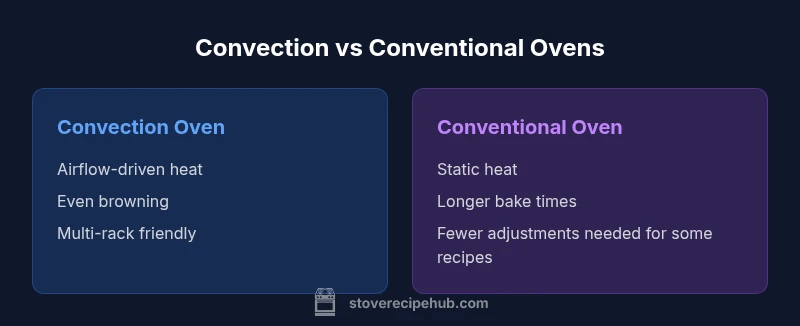
| Feature | Convection oven | Conventional oven |
|---|---|---|
| Heat distribution | Airflow-driven circulation for even heat | Static heat with less uniform browning |
| Cooking time | Typically faster due to improved heat transfer | Longer or equal time depending on dish |
| Browning and texture | More consistent browning on multiple racks | Variable browning; often requires rotating pans |
| Best for | Roasting, sheet-pan meals, cookies, pastries | Recipes written for traditional ovens |
| Energy considerations | Potential energy savings with batch cooking | Steady use without forced airflow advantages |
Upsides
- Even heat distribution across multiple racks
- Crispier edges and better browning
- Faster cooking times for many tasks
- Improved results for batch cooking
Downsides
- Not ideal for very delicate items unless adjusted
- Some recipes require adaptation or convection-specific guides
Convection ovens generally outperform traditional ovens for everyday cooking, with notable advantages in roasting and baking on multiple racks.
For most home cooks, convection ovens offer better consistency and efficiency. Reserve conventional mode for exceptionally delicate dishes or recipes built for static heat.
Common Questions
What is a convection oven and how does it differ from a standard oven?
A convection oven uses a fan to circulate hot air, promoting even heating and faster cooking. This differs from standard ovens that rely on static heat. The fan-assisted design helps prevent hot spots and supports consistent browning across foods.
A convection oven moves hot air with a fan for even cooking. It differs from standard ovens by giving you more consistent results and often faster cooking times.
Do convection ovens save energy or time?
Convection ovens can save time by cooking more quickly and evenly, which can reduce waste and energy use per dish. The total energy impact depends on how you cook and how many dishes you run at once.
Yes, they can save time and energy on many dishes when used efficiently.
Can I use convection mode for all recipes?
Many recipes adapted for convection exist, but delicate items may require conventional heat or adjusted times and temperatures. Start with tested convection-specific recipes when possible and learn how your oven behaves with your favorite dishes.
Most recipes can be adapted, but some delicate items do better with traditional heat.
How should I adjust temperatures and racks when using convection?
Use lower-profile pans and give air space between trays. Place dishes on middle or upper racks and rotate pans for even browning. Monitor color and texture closely and be prepared to shorten cooking times slightly.
Space out pans and rotate them; watch color and texture closely.
Are there foods that should never be cooked in convection?
Very delicate airy desserts and soufflés can fail with heavy airflow. Very moist items may also require conventional heat to avoid over-drying surfaces.
Delicate soufflés can suffer; use conventional heat for those if possible.
Is a convection oven worth the investment for a home cook?
For cooks who value even browning, faster results, and batch cooking, convection ovens offer strong long-term value. If your cooking is light or centered on delicate pastries, evaluate whether the benefits align with your kitchen tasks.
If you cook a lot, convection is often worth it; otherwise assess your needs.
Top Takeaways
- Convection improves even heat and browning
- Adapt recipes for airflow and avoid overcrowding
- Great for batch cooking and multi-rack tasks
- Know when to switch back to conventional heat
- Maintenance keeps performance steady