How Much Stove Top Stuffing for Turkey: A Practical Guide
Learn how much stove top stuffing to use for your turkey, whether you stuff the cavity or bake separately, with safe temperatures, practical measurements, and step-by-step guidance from Stove Recipe Hub.


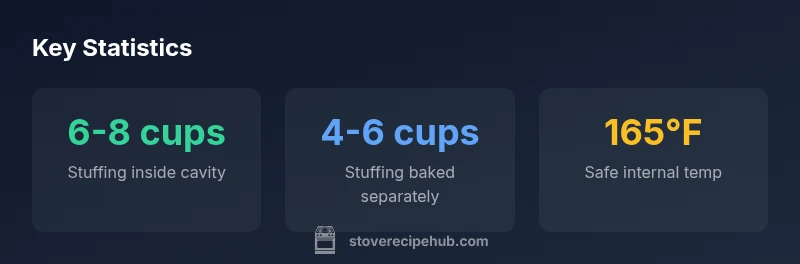
Typically, for a 12–14 lb turkey, plan on about 6–8 cups of stove-top stuffing if you’re stuffing the cavity. If you bake stuffing separately, use 4–6 cups per pan. Regardless of method, ensure the finished stuffing reaches 165°F for safety and flavor. Avoid overpacking the cavity to promote even cooking. If you’re unsure, start with the lower end and adjust for turkey size.
Why the right amount matters for flavor and safety
If you're wondering how much stove top stuffing for turkey, getting the quantity right matters for both moisture and texture as well as food safety. Too little stuffing can dry out the turkey breast and leave the flavor uneven; too much can crowd heat paths, slow down cooking, and create pockets that stay under the safe temperature. According to Stove Recipe Hub, the goal is to have stuffing that is flavorful and well heated without obstructing heat penetration to the turkey’s center. In practice, this means balancing cavity volume with the bird’s size and planning an alternative cooking path if you prefer a crisper stuffing edge.
Think of stuffing volume as a bridge between culinary intention and safety standards. If you overfill the cavity, you risk undercooking the center; if you underfill, you risk dry meat and a weak stuffing flavor. The recommended approach is to choose a range based on turkey size and adjust after checking the bird’s progress during roasting. Keep in mind that stuffing retains moisture and expands slightly during cooking, so leave a little headroom and avoid tightly packing any stuffing.
How to calculate stuffing quantity for turkey
A practical starting rule is to estimate stuffing by pounds, using roughly 0.5–0.75 cups per pound for inside-cavity stuffing. That translates to about 6–9 cups for a 12–14 lb turkey, though many cooks settle on 6–8 cups as a reliable middle ground. If you’re feeding a larger bird, scale up within the same range, and if you’re cooking a smaller bird, scale down. When stuffing separately in a casserole, plan for 4–6 cups per pan, even if you’re cooking two pans—this helps ensure even browning and a safe final temperature. Measuring by cups is convenient, but you can also use weight-based guidelines (roughly 1 cup of dry bread stuffing yields about 0.6–0.8 cups of cooked volume). Whatever method you choose, check that the internal stuffing reaches 165°F.
Example scenarios help: a 12 lb turkey with cavity stuffing uses roughly 6–8 cups; a 14 lb bird might use 7–9 cups. By contrast, baking stuffing outside the turkey gives you a predictable 4–6 cups per pan with crisp edges.
Stuffed vs. unstuffed: how the method changes quantity and time
Stuffing inside the cavity and baking separately are two distinct approaches, each with its own quantity guidelines and timing implications. When stuffed, the stuffing contributes to the overall heat load and can extend the roasting time by roughly 15–30 minutes, depending on the oven and bird size. Stuffing inside clothes the turkey in a moist environment, which can help retain juiciness but requires careful monitoring to avoid undercooking the center. When stuffing separately, you remove the heat burden from the bird and gain more predictable heat penetration for both the stuffing and the turkey. You’ll still need to achieve a safe internal temperature for the stuffing (165°F/74°C) and the turkey (165°F, measured in the thickest part of the breast and the innermost part of the thigh).
Key tip: if you choose to stuff the turkey, do not overfill. Leave room for expansion and for air to circulate, which speeds heat transfer and reduces the risk of undercooked stuffing.
Safety first: safe temperature for stuffing
Safety is non-negotiable when cooking stuffing with a turkey. The stuffing, whether inside the cavity or baked separately, must reach 165°F (74°C). Use a reliable digital meat thermometer to test the center of the stuffing and the thickest part of the turkey. If you’re stuffing the cavity, it’s common for temperatures to rise more slowly at the center; plan to begin checking earlier in the roast and finish with the thermocouple at the deepest portion of the stuffing. For baked stuffing, ensure the center also reaches 165°F throughout the pan. Remember that stuffing can trap heat differently than the turkey meat, so separate checks are essential when you’re cooking both together. Practically, you should consider tenting the exposed areas to prevent overcooking while the interior finishes heating.
Finally, if your stuffing has hard pieces of crust or overly moist areas, it’s a sign to adjust moisture levels next time for a more uniform finish.
Step-by-step: how to prep stuffing for stovetop cooking
Begin with a crisp, lightly toasted bread base for flavor and texture. If you’re using a boxed stove-top mix, follow the packet directions and adjust moisture to reflect the turkey’s volume. When calculating how much stuffing to prepare, consider the weight of the turkey and whether you will stuff the cavity. Gelatinized onions, sautéed celery, and herbs add moisture and aroma, but you should avoid compacting the stuffing inside the cavity. For stovetop cooking, loosen crumbs a little, par-cook onions and celery, mix with seasonings, then fold in broth gradually until the mixture resembles a slightly damp, packable mass. If the mixture seems too dry, you can add a small amount of warmed stock; if too wet, add a bit more bread. After mixing, let the stuffing rest briefly before filling the bird or pan to ensure even distribution of moisture and heat. Finally, bake or roast according to your preferred method, checking temperatures frequently near the end of cooking.
Tips for best results include dividing the stuffing into two portions when stuffing the turkey: one part lightly packed into the cavity and another portion left to bake in a separate pan, allowing you to adjust texture and moisture in real time.
Tips for even cooking: moisture, pan size, and air flow
Even cooking hinges on moisture balance, pan size, and airflow. If the stuffing is too dry, add a small amount of warmed stock or beaten egg to help bind the bread. Conversely, if it’s too wet, let the mixture rest for 5–10 minutes or add a little more bread. When stuffing the cavity, avoid overpacking; instead, loosely fill with a few fingers’ width of space around the stuffing so air and heat can circulate. For pan-baked stuffing, choose a pan that spreads the mixture in a uniform thickness—about 1 to 2 inches deep—to ensure even heating. The oven’s heat should be distributed consistently; if you have a hot spot, rotate the pan halfway through cooking. Resting times after removing from the oven help flavors settle and moisture distribute more evenly. If you plan to keep the stuffing warm before serving, cover lightly with foil to retain warmth without steaming the bread to mushy texture.
As you gain experience, you’ll become more precise in predicting the right amount for your turkey and how long to bake your chosen stuffing method.
Common mistakes and how to avoid them
Common pitfalls include underestimating the amount of stuffing needed for a given turkey, overpacking the cavity, and failing to achieve a safe internal temperature for both the stuffing and the bird. To avoid these, measure by cups or weight, don’t pack stuffing tightly into the cavity, and ensure the final temperatures meet safety standards. Another frequent error is cooking stuffing in a too-slow oven or in a pan that’s too shallow, which can dry it out or fail to heat evenly. To mitigate this, consider preheating the oven to a stable temperature, using a deeper pan for the stuffing, and testing early. Finally, remember that stuffing left at room temperature for too long before cooking invites bacterial growth. Always refrigerate stuffing if you’re not cooking it immediately and reheat to the proper temperature.
Quick-reference checklist
- Determine turkey weight and choose a stuffing method (inside cavity vs. baked separately).
- Use 0.5–0.75 cups of stuffing per pound as a starting point.
- Avoid overpacking the cavity; leave space for heat circulation.
- Ensure both turkey and stuffing reach 165°F.
- Bake stuffing separately if you want crisper edges and easier temperature control.
- Use a thermometer and rotate pans for even cooking.
- Rest the poultry and stuffing before serving for better flavor distribution.
Comparison of stuffing quantities by method
| Scenario | Stuffing Amount | Notes |
|---|---|---|
| Inside cavity | 6-8 cups | For a 12-14 lb turkey |
| Outside turkey (baked separately) | 4-6 cups | Crisp edges and reliable safety |
Common Questions
What is the recommended amount of stuffing for a turkey when cooking inside the cavity?
A practical starting point is about 0.5–0.75 cups of stuffing per pound. For a 12–14 lb turkey this typically equates to around 6–9 cups. Always ensure the center of the stuffing reaches 165°F for safety.
Start with 0.5–0.75 cups per pound, and verify center temperature reaches 165°F.
Can I cook stuffing separately instead of inside the turkey?
Yes. Baking stuffing in a casserole or separate pan gives you more control over texture and temperature. Just ensure it also reaches 165°F and adjust seasoning accordingly.
Yes—bake separately for control and safety; temp still must hit 165°F.
Does stuffing affect how long the turkey takes to cook?
Stuffing the cavity can add roughly 15–30 minutes to roasting time depending on size and oven performance. Stuffing outside the bird typically adds less risk of undercooking and can shorten or preserve timing.
Yes, stuffed birds may take longer to cook; monitor with a thermometer.
How do I know stuffing is safe to eat?
Test the center of the stuffing and the thickest part of the turkey using a digital thermometer. Both should reach 165°F (74°C). If either is under, continue cooking and recheck.
Check center temperature with a thermometer; both stuffing and turkey must hit 165°F.
What should I do with leftovers?
Store stuffing and turkey within two hours of cooking. Refrigerate promptly in shallow containers and reheat to 165°F before serving.
Cool and refrigerate leftovers quickly; reheat to 165°F.
Should I pack stuffing into the cavity tightly?
No. Loose packing allows heat to penetrate evenly. Lightly fill the cavity and avoid dense piles that block heat flow.
Avoid tight packing; leave space for heat to reach the center.
“Precision matters more than guesswork when stuffing a turkey; follow safe temps and measure by weight or volume.”
Top Takeaways
- Plan stuffing by turkey size with flexible ranges
- Stuff lightly to ensure even heat and safety
- Cook stuffing to 165°F regardless of method
- Baking separately offers texture control and simpler timing