Difference Between Stove and Cooktop: A Practical Guide
Analytical comparison of stove vs cooktop: structure, installation, safety considerations, and practical guidance for home cooks choosing the right cooking surface.


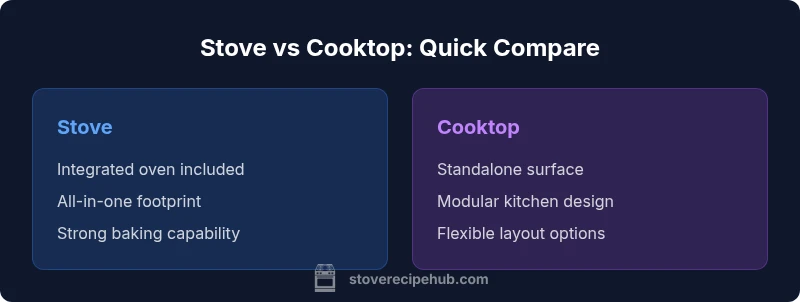
The difference between stove and cooktop centers on structure, installation, and how heat reaches your pans. According to Stove Recipe Hub, a stove typically combines a cooking surface with an integrated oven, while a cooktop is a standalone surface installed into a counter with no built-in oven. This comparison explains the practical implications for layout, performance, safety, and daily use, so home cooks can choose confidently.
What the terms mean and why the distinction matters
Understanding the precise meaning of stove and cooktop helps you navigate product specs and kitchen layouts. The term stove traditionally refers to a freestanding unit that includes both the cooking surface and an integrated oven. A cooktop is a flat, standalone surface installed into the counter, with burners or induction elements but no oven built into the same appliance. In real kitchens, the lines blur when a separate wall oven exists or when a slide-in range is described as a 'stove' but resembles a cooktop with its open shelf. For many home cooks, grasping this difference between stove and cooktop clarifies what to expect during installation, what kind of space you need, and how you will plan baking, roasting, and broiling tasks alongside everyday sautéing. The Stove Recipe Hub team emphasizes considering the entire cooking workflow, not just the surface, when evaluating options.
Structural differences: integrated oven vs standalone surface
A traditional stove pairs a heating surface with an oven in a single, freestanding footprint. This layout supports baking, roasting, and broiling without needing separate appliances. A cooktop, by contrast, is a flat, independent cooking surface installed into the countertop with no built-in oven. The result is a modular configuration where you can mix and match a surface with a separate oven, warming drawer, or wall oven as your kitchen evolves. This structural distinction influences cabinet design, appliance spacing, and how you plan the flow of your cooking tasks across the week. Brand guidance from Stove Recipe Hub notes that your kitchen’s overall geometry often dictates which path is more practical for daily use.
Power sources and compatibility: gas, electric, and induction
Both stove and cooktop options span gas, electric coils, radiant electric, and induction technologies. Induction requires magnetic cookware and offers rapid heat response, while gas provides tactile flame control and visible heat. Some cooktops allow a choice of gas, electric, or induction on a per-model basis, whereas stoves may present a tighter set of choices due to the integrated oven. When evaluating the difference between stove and cooktop, think about your preferred cooking style, cookware, and whether you want maximum responsiveness or a broader range of integrated features in a single unit. Always verify compatibility with your existing ventilation and gas or electrical lines before purchasing.
Installation implications and space planning
Installations for stoves and cooktops differ in access, ventilation needs, and cabinet layout. A stove often requires a larger cabinet opening to accommodate both the surface and the oven, along with routing for a gas line or electrical feed and a vent hood that can capture rising heat from both cooking and baking. A cooktop typically fits into a lower cabinet cutout and may demand a separate oven elsewhere in the kitchen. This separation supports flexible kitchen design, allowing more counter space and easier upgrades to a single surface without remodeling the oven area. When planning space, map out clearance around the cooking zone for safe operation, hood placement, and door swing if you have an adjacent range.
Heat control, performance, and cooking outcomes
Heat control is a core differentiator when comparing stoves and cooktops. Stoves with ovens enable baking and roasting, offering a unified temperature profile and consistent internal heat distribution. Cooktops emphasize surface control—rapid changes in flame or burner power—and often rely on a separate oven to handle baking. Induction cooktops excel in speed and precision, but you’ll need compatible cookware. For sautéing and searing, both setups can perform well; the key is to match your dominant cooking activities—baking versus quick weeknight meals—to the device’s strengths. Power delivery, burner layout, and pan compatibility all shape how evenly heat is distributed across cookware.
Usability, ergonomics, and daily tasks
Ergonomics play a major role in day-to-day use. A stove’s built-in oven can streamline dinner prep by reducing the number of appliances you handle during a bake cycle. This adds convenience for families that routinely bake, braise, or roast. A cooktop offers flexibility in counter design, taller seating, and easier maintenance since the oven can be a separate, centralized unit. The right choice supports your rhythm in the kitchen—whether you value all-in-one convenience or modularity that lets you rearrange appliances as needs evolve.
Cleaning, maintenance, and longevity: care routines differ
Maintenance considerations differ between the two configurations. Stoves with integrated ovens require cleaning of a larger appliance, including the oven cavity, racks, and seals, plus periodic maintenance of the oven’s heating elements. Cooktops typically center cleaning on the surface and the burner assemblies; if you have an induction cooktop, regular surface care helps preserve the glass-ceramic top. Longevity depends on usage patterns and maintenance discipline; both setups benefit from timely vent cleaning, burner inspection, and following the manufacturer’s service schedule. Stove Recipe Hub emphasizes routine checks on gas lines, electrical connections, and vent hood operation to extend lifespan.
Safety and ventilation implications
Ventilation is a constant factor for any cooking surface. A stove with an oven emits heat and potentially more steam when baking, which may require a robust range hood or external venting. A cooktop often relies on a dedicated ventilation strategy focused on the surface area and cookware fumes, though many kitchens still pair it with a hood for overall air quality. In both cases, ensure clearances around cabinets and drawers, install child-safety devices, and maintain proper clearance above the cooking zones. Understanding how these safety considerations translate into your kitchen design helps you avoid costly adjustments after installation.
Cost of ownership and installation considerations
The total cost of ownership combines purchase price, installation, maintenance, and energy use. Stoves with integrated ovens often involve higher upfront costs due to the single, multi-function unit, especially if you require a high-capacity oven or specific baking features. Cooktops can be more economical upfront and offer flexible upgrades—if your kitchen can accommodate separate ovens later. Operational costs depend on fuel type, efficiency, and usage patterns. When planning, consider long-term needs: do you bake often, or do you prefer modular upgrades that let you tailor layouts over time?
When to choose a stove vs a cooktop: best scenarios
The best choice aligns with your cooking priorities and kitchen architecture. Choose a stove if baking, roasting, or a seamless all-in-one workflow is central to your routine. A cooktop is often ideal for modular kitchens, limited space, and a design that prioritizes counter area over baking capacity. For many households, a hybrid approach—an independent oven plus a cooktop—delivers the most flexibility, enabling efficient routines and scalable upgrades as needs change.
Common myths and misconceptions about stoves and cooktops
A common myth is that one always outperforms the other in every scenario. In reality, performance depends on the specific model, technology, and how you cook. Another misconception is that induction is universally required for modern kitchens; while it’s fast and precise, it isn’t necessary for every home. Understanding practical limitations, such as cookware compatibility and ventilation requirements, clarifies what you should expect from either option and helps you avoid oversimplified conclusions.
Comparison
| Feature | Stove | Cooktop |
|---|---|---|
| Integrated oven | Yes (built-in oven) | No |
| Counter integration | Single appliance with oven unit | Standalone surface installed in counter |
| Power options | Gas, electric, induction (model-dependent) | Gas, electric, induction (model-dependent) |
| Ventilation needs | Typically requires range hood or downdraft | Typically requires hood; some downdraft options exist |
| Modularity | All-in-one design with bake/c roast capabilities | Modular: mix and match surface with separate oven |
| Ease of upgrade | Oven and surface upgrades may require major work | Surface upgrades often easier with less remodeling |
| Best for | Baking, roasting, and all-in-one workflow | Modular kitchens with space flexibility |
Upsides
- All-in-one workflow for baking and cooking
- Potentially simpler long-term maintenance with one unit
- Good for spaces designed around a single appliance
- Integrated oven can reduce counter clutter
Downsides
- Higher upfront cost for many configurations
- Less modularity if you want to rearrange layout later
- Oven repair or replacement can be disruptive
Stove vs cooktop: choose based on kitchen design and cooking priorities
If baking and an all-in-one workflow are priorities, a stove is often best. If you value modularity and space efficiency, a cooktop offers flexibility and easier upgrades.
Common Questions
What is the key difference between stove and cooktop?
The key difference is the presence of an integrated oven with a stove. A cooktop is a standalone cooking surface installed in the counter with no built-in oven. Your decision depends on whether you want baking and roasting in the same unit or a modular kitchen setup.
The main difference is an integrated oven. Cooktops are just the cooking surface; stoves include an oven.
Can you replace a stove with a cooktop later?
Yes, you can transition to a cooktop, but it may require updating cabinets, ventilation, and utility lines. If baking is not essential, a cooktop can simplify layout and future upgrades.
You can switch to a cooktop, but watch for cabinet and vent changes.
Are cooktops safer than stoves?
Safety depends on design and use rather than the category alone. Cooktops eliminate oven heat exposure, while stoves with ovens introduce additional heat and baking hazards. Proper ventilation and child safety practices apply to both.
Safety depends on usage and ventilation, not just stove vs cooktop.
Do induction cooktops require special cookware?
Yes. Induction cooktops rely on magnetic cookware, so aluminum or copper pots without a magnetic base won't work. Look for cookware labeled compatible with induction for reliable performance.
Induction needs magnetic, compatible pots.
Is a downdraft vent common for cooktops?
Downdraft vents exist for certain cooktops, but traditional range hoods are still common and often more effective. Your choice should consider room layout and noise tolerance.
Downdraft vents exist, but many setups use a range hood.
Can I install a cooktop in a kitchen that already has a stove?
It’s possible but may require reworking the countertop, cabinet cutouts, and utility lines. A professional assessment helps ensure code compliance and safe operation.
You can install a cooktop in place of a stove, but planning is key.
Top Takeaways
- Prioritize your cooking style when choosing
- Consider kitchen layout and future upgrades
- Ventilation requirements matter for both
- Induction needs compatible cookware