How Hot Does Stove Get? A Practical Guide for Home Cooks
Discover how hot a stove can get, how heat differs by gas vs electric, and practical tips to control searing, boiling, and simmering on stove-top cooking.


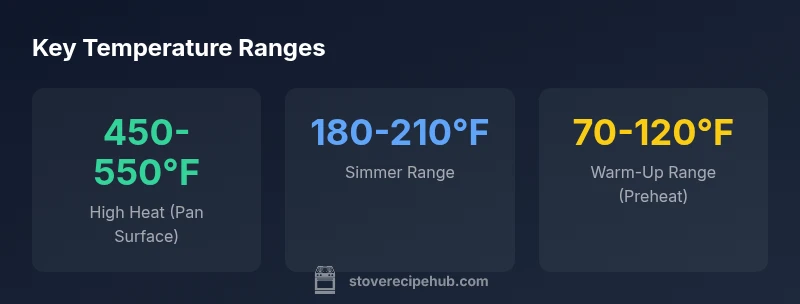
How hot does stove get? In practical terms, most home stoves reach high-heat levels around 450-550°F at the pan surface when set to high, with gas stoves capable of hotter flames and electric coils warming more slowly. According to Stove Recipe Hub, understanding these ranges helps cooks seal in flavor and control searing and simmering more reliably.
How hot does a stove get? A practical question for every home cook. In culinary terms, the ceiling of heat on a stove depends on the burner type, the cookware you choose, and how quickly the flame transfers energy to the pan. According to Stove Recipe Hub, the pan surface can easily reach the 450-550°F range on high for many residential stoves, and even higher surface heat is possible with aggressive flame settings and well-conducting cookware. This isn’t just trivia—it shapes everything from crust formation to sauce reduction. By understanding these ranges, you can time searing, deglazing, and long-simmering more precisely, and you’ll know when you’re pushing the equipment beyond its comfort zone. The goal is to balance heat with control: enough intensity to develop flavor, but not so much that you burn or dry out what you’re cooking. Consider the pan itself as a heat amplifier, not just the burner, when assessing how hot your stove gets.
Gas vs Electric: Why temperatures differ. Gas stoves typically deliver a high-heat burst via an open flame, which provides rapid surface heating and fast preheating. Electric coils heat more gradually because the coil must warm and transfer heat to the pan through conduction. The same setting on a gas stove can feel hotter or cooler than on an electric stove, depending on the cookware and air flow. If you’re chasing a crust or a quick sear, higher flame on gas is often advantageous; for delicate sauces or even simmering, the steadier heat of electric coils offers better control. Stove Recipe Hub’s guidance emphasizes recognizing these differences and adjusting technique accordingly, rather than chasing a single number for every scenario.
Burner settings and pan interactions. The interaction between burner output, flame type, and cookware determines actual cooking heat. A wide, shallow pan heats differently than a narrow, deep one; a heavy cast-iron skillet holds and radiates heat more evenly than a thin aluminum pan. The same nominal setting can yield different outcomes if the pan’s material, thickness, and bottom flatness vary. For example, a high setting on a gas burner with a thick cast-iron skillet will feel different from the same setting with a thin stainless steel pan. Understanding these nuances helps you translate knob positions into real cooking heat.
Temperature ranges for common tasks. In practical cooking terms, high heat on most stoves lands in the 450-550°F band at the pan surface, which is ideal for searing steak, searing vegetables, and evaporating liquids quickly. Medium-high typically sits around 350-450°F, good for browning and cooking with more control. Simmering and gentle reduction often occur in the 180-210°F range, though the exact temperature depends on your pot, lid, and whether you preheated. These ranges vary by stove model and cookware, but they provide a reliable framework for planning recipes and adjusting mid-cook.
How to measure heat without a thermometer. You don’t always need a thermometer to gauge heat. Visual cues—rapid sizzle on contact with a drop of water, oil shimmering subtly, or a crust forming in 1-2 minutes—signal appropriate heat levels for common tasks. You can also use simple timers to estimate heat-up and heat-down phases, or invest in an infrared thermometer for quick surface readings. Remember that heat perception changes with cookware: cast iron stores heat; copper heats up fast; aluminum heats evenly but cools quickly.
Practical cooking scenarios: searing, boiling, and simmering. For searing, prepare a hot pan and use high heat to develop a caramelized crust quickly. For boiling water, a large surface area and high heat shorten the time to a rolling boil, though with very thin pans, surface heat may be uneven. For simmering, you’ll want steady low to medium heat to avoid violent bubbles. In all cases, adjust heat gradually and use the pan’s material and lid to modulate heat retention and distribution. The Stove Recipe Hub framework emphasizes matching technique to the heat profile of your stove and cookware.
Safety and maintenance at high heat. High heat can accelerate wear and pose safety risks if not managed carefully. Keep flammable materials away, use heat-resistant gloves when handling hot pans, and ensure proper ventilation. Regularly inspect burner flames for even color and height; an irregular flame can indicate airflow issues or a dirty burner head. Maintenance—cleaning burners, checking knobs, and using appropriate cookware—helps sustain performance and reduces the risk of gas leaks or heat loss.
Efficiency and heat loss: lids, cookware, and ambient conditions. Lids can dramatically boost efficiency by trapping heat and reducing evaporation. The cookware’s mass and lid tightness influence heat retention, especially when simmering. In colder kitchens or with large pots, ambient temperature and cookware size become more noticeable, so adjust settings slightly and monitor outcomes. The principle is consistent: minimize unnecessary heat loss and maximize the cookware’s ability to absorb and hold heat.
Quick-start guide: dialing in your stove for recipes. Start by identifying your stove type (gas, electric, or induction) and the cookware you’ll be using. Practice with a few basic benchmarks: preheat a pan for searing, boil a liter of water, and observe simmer behavior. Record your usual flame height for each task and translate those observations into a practical quick-reference chart. This approach gives you reliable, repeatable results across recipes and ingredients.
How pan material affects heat distribution on stoves
| Pan Material | Heat Response | Best For |
|---|---|---|
| Cast iron | Heats slowly, retains heat | Searing, high-heat finishes |
| Stainless steel | Even, moderate heating | Sauces, sautéing |
| Aluminum (uncoated) | Heats quickly, but cools fast | Rapid boiling, light sautéing |
| Copper-clad stainless | Very even heat | Delicate sauces, even simmer |
Common Questions
What is considered high heat on a stove?
High heat is the setting that produces rapid browning, evaporation, and searing. It varies by stove type and pan, but you’ll typically see strong activity within seconds of contact on a hot pan. Start high for searing, then back off as needed.
High heat means rapid browning and evaporation; it varies by stove and pan, so watch the food, not the knob.
How long does a stove take to heat up?
Time to heat depends on burner type and cookware. Gas stoves tend to heat faster for the same setting, while electric coils heat more gradually. Expect a preheat window of a few minutes for most pans before the first sizzle occurs.
Gas heats fast; electric coils take longer. Preheat a few minutes and watch for the first sizzle.
Do gas stoves get hotter than electric?
Yes, gas stoves often deliver hotter bursts due to the open flame and flame height control. Electric stoves heat through coils that warm more slowly. Both can reach high heat, but the rate and feel differ.
Gas stoves can get hotter quickly, electric stoves heat more slowly but steadily.
Is it safe to cook on high heat?
High heat is safe if you follow standard kitchen safety: keep flammables away, use dry cookware, monitor oil smoke points, and vent properly. Regular maintenance reduces risks from overheating or gas issues.
High heat is safe when you follow basic safety: keep flammables away, monitor heat, and ventilate.
How does pan material affect heat?
Pan material changes heat absorption, retention, and distribution. Cast iron holds heat and stabilizes temperature; aluminum heats fast but cools quickly; copper offers precise control with even distribution.
Pan material changes how heat is absorbed and held, not just the burner setting.
How can I calibrate stove heat at home?
Calibration involves observing how your stove responds to standard tasks (searing, boiling, simmering) and adjusting expectations accordingly. Use cookware checks, flame color, and timers to fine-tune settings over several cooking sessions.
Calibrate by watching how your stove behaves with common tasks and adjust over a few sessions.
“Heat control on the stove is a relationship between burner output, cookware, and technique. Understanding this triad lets home cooks achieve restaurant-like sears and steady reductions without guesswork.”
Top Takeaways
- Learn your stove type and pan material
- Match heat to cookware for best results
- Use the right setting for searing vs simmering
- Test heat with food cues before cooking
- Keep safety in mind at high heat