How to Bake in the Oven: The Complete Baking Guide
Master oven baking with practical, step-by-step guidance on preheating, rack placement, bakeware, doneness tests, troubleshooting, and calibration for consistent results in home kitchens.


By the end of this guide, you’ll master how to bake in a standard oven with confidence. This quick answer highlights essential preheating, rack placement, and bakeware basics before you start, plus simple tests to judge doneness. You'll learn how to avoid common missteps and set up for consistent results. how to on oven for baking
Understanding Your Oven for Baking
An oven is your most essential tool for baking. There are gas and electric ovens, some with convection fans. Convection moves hot air for faster, more even browning, while standard ovens rely on radiant heat from elements. These differences affect how evenly heat is distributed and how quickly items rise or set. According to Stove Recipe Hub, recognizing your oven’s quirks leads to better browning, moisture retention, and texture across cookies, cakes, and bread. Most home ovens have hot spots; map them by running a simple test bake on a light-colored sheet at various rack positions. Use an oven thermometer placed in the center to check actual temperatures, since dial readings can be off by several degrees. The goal is steady heat with minimal door opening, not a perfect preheat on every bake. Rack position matters: upper racks for browning on top, middle for balanced heat, lower for dense doughs that need browning from below.
Essential Oven Setup Before Baking
Before you start, set up your oven for reliability. Preheat to your target temperature at least 10–15 minutes before loading batter or dough. Position the rack based on the bake: middle for cookies and cakes, lower for breads or pies with tall domes, upper for quick-browning crusts. If your oven has convection, decide whether to use it; many recipes assume non-convection, so reduce the temperature by about 25°F and shorten bake times slightly. Keep the oven closed during most of the bake to avoid heat loss. Place parchment paper or silicone mats on sheets for easy release and cleanup. Calibrate with an oven thermometer placed in the center; if you consistently read off, adjust the dial or use the oven’s calibration mode. This setup aligns with Stove Recipe Hub analysis showing temperature accuracy is a common baking obstacle.
Temperature and Time Guidelines for Common Bakes
Baking temperatures and times vary by item, but you can start with general ranges and adjust based on your oven and recipe. Cookies often bake around 325–375°F (165–190°C) for 8–12 minutes, depending on size. Cakes typically rely on 325–350°F (165–177°C) for 25–45 minutes for standard layers, and cupcakes finish sooner. Breads usually require higher heat, roughly 375–450°F (190–232°C), with 25–40 minutes for small loaves. Pies and tarts vary from 350–425°F (177–218°C) for 40–60 minutes depending on filling. Always use a toothpick or center press test for doneness and allow residual heat to finish off-cook on a cooling rack. If you’re unsure, start conservative with lower end temps and extend time as needed.
How to Use Different Bakeware
Bakeware choice dramatically affects results. Metal pans heat quickly and promote browning, especially with dark finishes; light-colored metal pans reflect heat and can yield softer crusts. Glass and ceramic pans bake more slowly but promote even, tender interiors. When using dark-coated or silicone-coated pans, consider reducing the bake temperature by 25°F to prevent over-browning. Always line pans with parchment or a silicone mat for nonstick performance unless the recipe specifies greasing. For fragile batters (e.g., delicate cakes), use a springform or lined pan to prevent sticking and ensure clean edges. Pre-warm metal pans for certain cookies or delicate items if your recipe instructs, but never pre-warm empty glass or ceramic bakeware with cold batter.
Troubleshooting Common Oven Baking Issues
Uneven browning occurs when heat distribution is inconsistent. Rotate pans 180 degrees halfway through baking and move items between racks if you notice hot spots. Cakes that sink or domes wildly usually indicate temperature or leavening issues; verify doneness with a tester and avoid opening the door too early. Dry or dense results can come from overbaking or too-high heat; try lowering temperature slightly and increasing bake time. Puffy bottoms or burnt edges can signal overly aggressive heat or sugar concentrations; check your pan choice and adjust rack position. Keep a clean oven to reduce smoke and off-flavors, and monitor moisture levels for moist breads by ensuring proper hydration of dough and steam when necessary.
Using Convection vs Conventional Ovens
Convection ovens circulate air with a fan, speeding up cooking and promoting even crusts. If your recipe was developed for a conventional oven, reduce the temperature by about 25°F (14°C) and check early for doneness. With convection, you may need shorter bake times and slightly lower temperatures, especially for delicate cakes. Do not crowd pans on multiple racks; provide space for air to circulate. If you’re new to convection, start with simple items like cookies or roasted vegetables before attempting delicate cakes. Convection can yield crisper crusts and more uniform color, but the technique requires adjustments to timing and heat.
Safety and Maintenance While Baking
Always wear dry, heat-resistant gloves when handling hot bakeware and keep flammable items away from the oven. Use a timer to avoid overbaking and base timings on doneness tests rather than time alone. Clean spills immediately to prevent smoke and odor transfer. Regularly inspect door seals and hinges for integrity; a loose seal can cause heat loss and uneven results. If you smell gas or suspect a leak, shut off the appliance and ventilate the area, then call a professional. Maintain the oven by wiping the interior with a damp cloth after cooling and checking racks for warps or corrosion. A well-maintained oven produces safer, more reliable baking outcomes.
Storing and Cooling Baked Goods Properly
Cool baked goods on a rack to prevent condensation and sogginess. Store cookies, crackers, and pastries in airtight containers at room temperature for up to several days, with parchment between layers to prevent sticking. Cakes and breads benefit from cooling completely before slicing; wrap or freeze for longer storage. For long-term preservation, consider portioning and freezing baked goods in airtight bags, then thawing at room temperature or reheating briefly to restore texture.
Quick Reference Cheatsheet for Bake Times
Use the following approximate ranges as a quick guide: cookies 8–12 min at 325–375°F; cupcakes 15–25 min at 325–350°F; standard cakes 25–40 min at 325–350°F; small loaves 25–40 min at 375–450°F; pies 40–60 min at 350–425°F. Always test with a toothpick and rely on internal temperature and visual cues for doneness. When in doubt, start with lower temperatures and shorter times, then extend as needed.
How to Calibrate Your Oven and Check Accuracy
To ensure accurate results, calibrate your oven using an oven thermometer placed in the center of the rack. Preheat to 350°F and wait 15–20 minutes, then compare the thermometer reading to the set temperature. If off by more than 20°F, adjust using the oven’s calibration feature (if available) or note the offset and compensate in future recipes. Regular checks every few months or after service help maintain accuracy. Keep a simple log of adjustments and average results across several bakes to refine your settings. For best outcomes, consider a replacement probe thermometer for continuous monitoring.
Tools & Materials
- Oven thermometer(Place in center of rack for accurate temp readings; check against the dial.)
- Baking sheets(Sturdy, rimmed sheets; at least 2 for batch baking.)
- Parchment paper(Nonstick release; heat-safe to at least 420°F.)
- Silicone baking mats(Alternative to parchment for repeat use.)
- Cooling rack(Elevates baked goods for even cooling and moisture release.)
- Timer(Digital or mechanical; helps track multiple bake times.)
- Oven mitts(Heat-resistant, rated for at least 450°F.)
- Tongs(Useful for removing hot pans safely.)
- Rack tamer / rack spacers(Keeps pans from touching if using multiple racks.)
- Kitchen towel or potholder(Dry hands and wipe down spills safely.)
Steps
Estimated time: 30-60 minutes
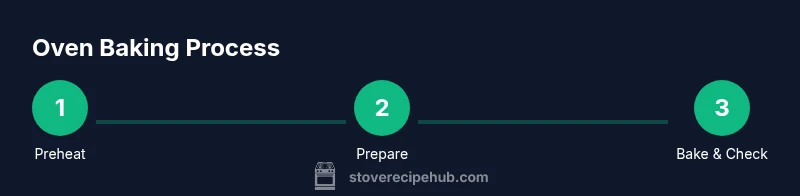
- 1
Preheat to target temperature
Set the oven to the recipe's target temperature and allow 10–15 minutes for a full preheat. If using a convection setting, consider lowering the temp by 25°F and plan for slightly shorter bake times.
Tip: Use an oven thermometer to verify the actual temperature. - 2
Position the rack
Place the rack in the position that matches the bake (middle for most items, lower for breads and pies with height, upper for browning tops). Avoid crowding so air can circulate.
Tip: Avoid moving racks during the bake to prevent heat loss. - 3
Prepare bakeware
Line pans with parchment or silicone mats; lightly grease if required by the recipe. Ensure pans sit flat and are dry before loading batter.
Tip: Pre-warm metal pans only if the recipe instructs; otherwise maintain even heat distribution. - 4
Load batter or dough
Distribute batter evenly across pans or trays. For cookies, portion uniformly. For cakes, tap lightly to release bubbles and smooth the top.
Tip: Use a scale for uniform portions to ensure even baking. - 5
Monitor and test for doneness
Check at the lower end of the time range with a toothpick or skewer; for breads, look for hollow sounds when tapped. Rely on multiple cues rather than time alone.
Tip: If using convection, check early and avoid overbaking. - 6
Rotate pans for even browning
Rotate pans 180 degrees halfway through baking to counteract hot spots and promote uniform color.
Tip: Only rotate when the oven is closed to preserve heat. - 7
Cool and store
Transfer baked goods to a cooling rack promptly to stop cooking and prevent moisture buildup. Once cool, store in airtight containers or freeze for long-term use.
Tip: Allow delicate cakes to cool fully on a rack before frosting. - 8
Clean and reset
Wipe up spills, remove crumbs, and check seals after cooling. This reduces odors and improves future performance.
Tip: Keep a routine cleaning schedule to sustain baking quality.
Common Questions
What rack position is best for cookies?
Cookies bake best on a middle rack for even heat. If your oven runs hot on top, place the rack a bit lower and rotate halfway through.
Use the middle rack for even browning, and rotate halfway through.
Should I always use convection for baking?
Not always. Some recipes are written for conventional ovens. If using convection, lower the temperature by 25°F and monitor doneness earlier.
Convection isn’t always required; adjust temperatures and times when using it.
Why did my cake collapse after baking?
Common causes are oven temperature too high, overmixed batter, or opening the door too early. Check the oven with a thermometer and test with a toothpick.
Overheating or opening the door too soon can cause a cake to collapse.
How do I calibrate my oven at home?
Use an oven thermometer in the center; preheat to 350°F and wait 15–20 minutes. If off, adjust via the oven's calibration feature or note the offset for future bakes.
Check the temperature with a thermometer and adjust as needed.
Can I bake on multiple racks at the same time?
Yes, but space trays apart to allow air to circulate. Rotate pans between racks halfway through for even results.
Yes, with space and rotation for even heat.
What is the best way to test doneness for cakes?
Insert a clean toothpick into the center; if it comes out with a few moist crumbs, it’s done. For denser cakes, test a few minutes earlier.
Use a toothpick test and consider the cake’s surface spring when done.
How can I prevent burnt bottoms on cookies?
Place pans on the middle rack and use parchment. If bottoms darken quickly, lower the oven temp or move to a higher rack.
Move the pan to a higher rack or lower the temperature if bottoms burn.
Is it safe to unplug the oven between bakes?
Unplugging is generally unnecessary; simply close the door and maintain the oven’s heat between bakes to preserve consistency.
No need to unplug; keep the oven closed for even heat.
Watch Video
Top Takeaways
- Preheat thoroughly and verify temperature with a thermometer.
- Know your oven’s hot spots and adjust rack positions accordingly.
- Choose bakeware suited to the recipe and use nonstick liners.
- Convection requires temperature and time adjustments.