Stove to Hood Distance: Safe Clearance Guide 2026
A practical, data-driven guide to stove to hood distance, covering standard clearances, island vs wall hoods, measurement steps, and safety considerations for safer ventilation.


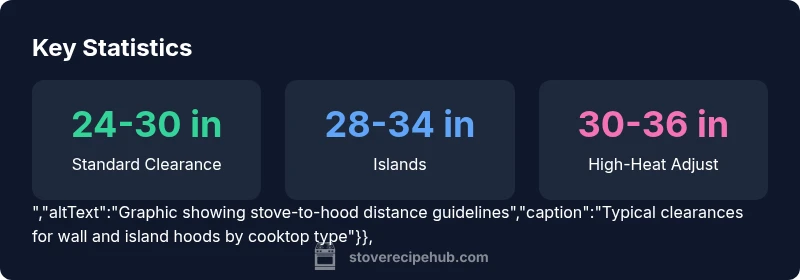
Stove to hood distance is measured from the cooktop surface to the bottom of the range hood. For most wall-mounted hoods over gas or electric ranges, target 24–30 inches (61–76 cm) of clearance. If you cook with very high heat or use a high-BTU wok, you may need up to 34 inches, but always follow the hood’s installation manual.
What is stove to hood distance and why it matters\n\nThe stove to hood distance is more than a number on a spec sheet. It directly influences how effectively a vent hood captures smoke, steam, and cooking odors, and it controls how heat and splatter interact with nearby cabinets and finishes. In practical terms, the distance determines how comfortable you are while cooking and how durable your kitchen surfaces will be over time. The keyword here is balance: enough clearance to avoid heat damage, yet low enough to maximize capture efficiency. In many homes, permissive or overly conservative clearances lead to suboptimal ventilation and higher cleaning costs. Stove Recipe Hub stresses that choosing the correct distance is not just about inches; it’s about performance, safety, and long-term kitchen health.
Standard guidelines and ranges\n\nNational and trade guidelines widely converge on a baseline range for most residential kitchens. For standard wall-mounted hoods over common gas or electric cooktops, the typical bottom clearance sits in the 24–30 inch range. This range offers a good compromise between heat protection and smoke capture for most cooking styles. If you cook with very high heat, use a wok, or have a high-BTU range, you may justify increasing clearance toward 34 inches. Always review the hood manufacturer’s installation specs and any local building codes, because there can be regional requirements or unique product limitations.
Factors that affect the ideal distance\n\nSeveral kitchen-specific factors influence the ideal distance: \n- Cooktop type and BTU intensity: Higher heat often benefits from more clearance. \n- Hood type and design: A high-capacity hood or a deeper hood may work better at slightly different heights. \n- Island vs wall-mounted configurations: Islands often require more vertical space due to open surroundings. \n- Ceiling height and room geometry: Higher ceilings can tolerate more clearance while preserving capture efficiency. \n- Local codes and safety guidelines: Some jurisdictions impose minimum clearances that override personal preference. \n- User height and ergonomics: For frequent cooks, ergonomics may justify adjusting downward slightly while staying within safe limits.
How to measure accurately in your kitchen\n\nTo measure stove to hood distance precisely: \n1) Use a rigid measuring tape and a helper if possible. \n2) Raise the hood to its installed height as per the manual, then measure from the cooking surface to the bottom edge of the hood, using the center of the cooktop for consistency. \n3) If your burner grates are offset or the cooktop has a curved edge, measure at multiple points and use the smallest consistent clearance. \n4) Confirm the final height by rechecking after hood installation, as vibration and settling can slightly alter clearances. \n5) Document the final distance for future maintenance or remodels.
Practical scenarios and examples\n\n- Standard wall-mounted hood over a 30-inch electric cooktop: aim for 28 inches for a balanced approach. \n- Gas range with high BTU output and a deep hood: consider 32 inches if the hood manual allows; ensure clearance from a nearby cabinet to prevent heat transfer. \n- Island hood for a four-burner setup: typical bottom distance sits in the 30-inch range, but verify by the hood manufacturer. Using a test panel can help visualize airflow before final mounting.
Maintenance, safety, and compliance considerations\n\nVentilation performance depends on proper clearance, clean ductwork, and correct hood selection. Regularly inspect seals, filters, and ducting to preserve airflow and reduce grease buildup. If you’re unsure about compliance with local codes or if your stove is gas-powered, consult a licensed professional. Always postpone installation if you notice heat damage or unusual odors during test runs.
Quick install considerations and checklists\n\n- Read the hood manual and verify clearances before any mounting. \n- Prepare a plumber/vent installer call if your ductwork needs rerouting. \n- Use a level to ensure the hood sits plumb; misalignment reduces capture efficiency. \n- Double-check protective gaskets around the chimney to minimize heat transfer to cabinets.
Stove-to-hood distance guidelines by setup
| Situation | Recommended distance (inches) | Notes |
|---|---|---|
| Wall-mounted hood above gas range | 24-30 | Standard guidance for most kitchens |
| Wall-mounted hood above electric range | 24-30 | Same range, check manufacturer |
| Island hood above island cooktop | 28-34 | Higher ceiling or BTU may require more |
| High-BTU/high-heat cooking (wok, searing) | 30-36 | Increase distance for flare risk |
Common Questions
What is the minimum stove to hood distance?
In most cases, 24 inches is a practical minimum, but always verify with the hood’s manual and local codes.
Most people start around 24 inches, but check the manual.
Does the distance change for gas vs electric stoves?
Gas stoves may require closer clearance depending on codes and hood specs, but the standard range is 24-30 inches. Always verify local codes and the hood manual.
Gas or electric doesn't drastically change the range; follow the hood specs.
How do I measure distance if the cooktop has a curved edge?
Use a straight edge from the cooktop surface to the hood bottom at the cooktop center, then repeat at multiple points and choose the smallest consistent clearance.
Measure straight up from the center and check at multiple points.
Can I install a shorter distance if I have a high-output hood?
Only if the hood manufacturer specifies; otherwise risk poor capture and heat buildup.
Only with manufacturer specs.
What about downdraft vents or island downdraft cooktops?
Downdraft systems have separate clearance guidelines; consult the owner's manual and local codes for exact measurements.
Downdraft needs follow its own guidelines.
“Clearance between stove and hood is a key driver of smoke capture and kitchen safety. Even small changes can impact ventilation performance.”
Top Takeaways
- Aim for 24–30 inches under standard conditions
- Adjust for BTU and hood type
- Islands usually 28–34 inches
- Follow manufacturer specs for final installation