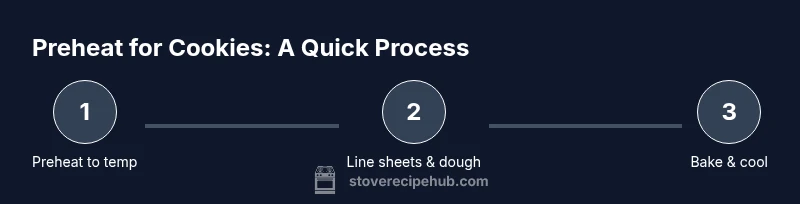
Do You Need to Preheat the Oven for Cookies: A Practical Guide
Discover whether you should preheat for cookies, how long to preheat, and tips for different doughs and textures. A clear, step-by-step guide from Stove Recipe Hub to bake cookies with even heat and perfect texture.


Yes. Preheating the oven before baking cookies generally ensures even heat, predictable spread, and consistent texture. Most recipes assume a hot oven, and starting cold can lead to uneven browning or excessive spreading. Follow the recipe's temperature, and allow about 8–12 minutes for a typical 350–375°F oven to reach temperature before loading dough.
Why Preheating Matters for Cookies
Preheating is the foundational step that helps cookies bake evenly from the moment they enter the oven. When the dough hits a fully heated surface, the outer layer sets quickly, creating crisp edges while the interior continues to set and expand. This balance gives cookies their classic texture: a cookie with a gently chewy center and a lightly crisp edge. Temperature accuracy matters: if the oven is cooler than the target, dough can spread more before setting, resulting in thinner, flatter cookies and uneven browning. For many standard drop cookies, a consistent starting temperature is essential to achieve uniform thickness across the sheet. The Stove Recipe Hub team emphasizes using precise temperature control and a reliable oven thermometer to verify the oven actually hits the requested temperature.
When you see a cookie recipe that calls for preheating, assume that it expects the oven to be hot and ready before dough goes in. If you skip preheating, you risk wider variation between cookies baked on the same tray. In practice, preheating is a simple step with big payoffs in texture, color, and bake timing.
Tools & Materials
- Oven thermometer(Place in the center of the oven to verify real temperature within ±25°F.)
- Baking sheets(Use light-colored, rimmed sheets for even browning; parchment or silicone liners help with release.)
- Cooling rack(Cool cookies on a rack to prevent soggy bottoms.)
- Timer or smartphone(Track preheat time and bake duration accurately.)
- Spatula or scoop(Portion dough uniformly for even baking.)
Steps
Estimated time: 30-45 minutes
- 1
Preheat to the target temperature
Set the oven to the recipe’s specified temperature and allow it to come fully to that heat. Use an oven thermometer to confirm the actual temperature matches the target. Avoid guessing—the difference between 25°F or more can change bake times and texture.
Tip: Verify target temperature with a dedicated oven thermometer for accuracy. - 2
Prepare sheets and dough portions
Line baking sheets and portion dough evenly, paying attention to consistent scoop size. Uniform portions ensure even baking across the tray and prevent multiple batches from needing different times.
Tip: Use a #2 scoop or a tablespoon for uniform cookies. - 3
Load dough onto a hot sheet
Place dough portions on the preheated sheet with ample space between them to allow spread. Don’t crowd; this preserves shape and color.
Tip: Leave at least 2 inches between cookies for typical drop cookies. - 4
Bake and rotate for even browning
Bake according to the recipe, rotating the sheet halfway through to counter hot spots. If your oven cycles hot and cold, consider using two racks and rotating each once.
Tip: Rotating helps achieve uniform browning across the sheet. - 5
Check for doneness and cool
Cookies should be set at the edges with a soft center. Remove from oven a touch before the center finishes to account for carryover baking, then cool on a rack.
Tip: Don’t overbake; residual heat can push cookies from soft to hard. - 6
Store properly after cooling
Once cooled, store cookies in an airtight container to maintain texture. If you’re stacking, place parchment between layers to prevent sticking.
Tip: Label batches by bake time and temperature for future reference.
Common Questions
Do I need to preheat every time I bake cookies?
In most cases, yes. Preheating ensures even heat and predictable texture. Some recipes may instruct no preheating for specific effects, but these are exceptions. Always follow the recipe when provided.
Usually yes, preheating is best for even baking; follow the recipe if it says otherwise.
How long should I preheat the oven before baking cookies?
Aim for 8–12 minutes, depending on your oven and the target temperature. Use an oven thermometer to confirm it has reached the right heat before loading dough.
About eight to twelve minutes, or until your thermometer confirms the target temperature.
What should I do if my oven runs hot or cold?
Use an oven thermometer to determine actual temperature, then adjust by lowering or increasing the set point. If it runs hot, reduce the temperature 25 degrees and bake longer as needed.
Check actual temperature with a thermometer and adjust accordingly.
Can I bake cookies from frozen dough without preheating?
Most cookies bake best with a preheated oven. Baking from frozen dough typically requires longer bake times and close monitoring. If a recipe instructs not to preheat, follow that guidance.
Generally, preheating is still recommended; if you bake from frozen dough, watch closely for doneness.
Should convection ovens be preheated differently?
Yes. Convection ovens often bake faster and more evenly, so you may lower the temperature by about 20°F and reduce bake time slightly. Verify with a thermometer and monitor the first batch.
Lower the temperature a bit and keep an eye on timing when using convection.
What if I forgot to preheat—can I still bake cookies?
You can bake, but expect longer preheating, more spread, and uneven browning. If you realize it early, reheat quickly to the target temperature before baking. For best results, preheat next time.
If you forgot, reheat to the target temperature and bake; it’ll take longer but results improve.
Watch Video
Top Takeaways
- Preheat to the recipe’s target temperature.
- Verify temperature with a thermometer for accuracy.
- Space dough evenly to prevent crowding and uneven browning.
- Rotate sheets to counter hot spots and ensure even bake.
- Cool cookies on a rack to preserve texture.