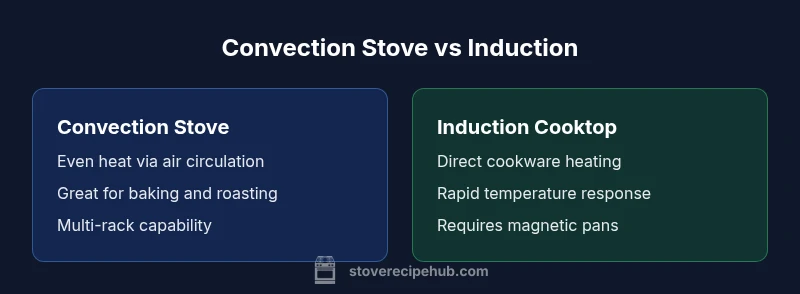
Convection Stove vs Induction: A Practical Guide
A rigorous, evidence-informed comparison of convection stoves and induction cooktops for home kitchens. Learn how heat delivery, cookware needs, energy use, and maintenance shape everyday cooking and long-term value.


Convection stoves and induction cooktops deliver heat differently, so your choice depends on cooking style. Induction offers instant, precise control and excellent energy efficiency, but requires magnetic cookware. A convection stove (range with a convection oven) excels at even air circulation for baking and roasting, yet its cooktop may lag in response. For speed and control, induction wins; for baking versatility, convection shines.
How convection stove and induction work: the basics
In plain terms, a convection stove combines a conventional cooktop with an oven that uses a fan to circulate hot air. An induction cooktop, by contrast, uses electromagnetic fields to heat pots and pans directly on the surface. Understanding these fundamentals helps you predict why each system behaves the way it does in real cooking. According to Stove Recipe Hub, the core distinction is that convection is a heat-delivery method that relies on air circulation (and often an oven), while induction is a heat-transfer method that relies on magnetic coupling beneath the cookware. This means you’ll see different strengths in the kitchen: ovens excel at even browning and multi-rack baking, while induction shines in speed, precision, and safety. Throughout this guide we’ll compare these two technologies across common tasks, energy use, cookware requirements, maintenance, and long-term value. By the end you’ll have a clear sense of which system fits your cooking style and kitchen layout.
Heat transfer mechanisms and why it matters
Heat moves through a kitchen stove in distinct ways depending on the technology. In a convection stove, heat starts at the burner, then transfers through metal, air, and the oven walls before reaching food. The convection fan accelerates heat distribution, reducing hot spots and enabling browning on multiple racks. Induction ovens heat cookware directly, via magnetic fields, which means the food’s temperature responds to changes in the pan almost instantly. Understanding these mechanisms helps explain practical differences: induction heats with minimal lag and preserves pan surfaces, while convection ovens rely on circulating air to deliver even temperatures to baked goods. Stove Recipe Hub notes that this difference often dictates how you’ll approach recipes that require precise control versus those that benefit from sustained heat and air movement. In practice, expect induction to feel decisive and quiet, and convection to feel forgiving in long, multi-stage cooking sessions.
Performance in common tasks: boiling, simmering, searing, baking
Different tasks reveal the strengths and limits of each technology. On induction, boiling water comes to a boil quickly, and simmering is controllable with small increments. Searing meats on a flat induction surface is precise but relies on the pan; high heat can cause sticking if not preheated properly. Convection stoves excel at baking and roasting because the circulating air produces even browning across racks and reduces hot spots. Roasting a chicken on a convection setting yields uniform browning, and multi-rack vegetables cook consistently. For tasks like stir-frying or quick sautéing, induction offers rapid temperature changes and minimal residual heat in the cookware handle, but the cooktop may show limited surface area and require good ventilation due to steam. In a nutshell, induction is great for fast, precise control; convection is ideal for bake-focused cooking and large quantities.
Energy efficiency, costs, and long-term value
Energy efficiency in this comparison depends on where heat is generated and how it travels to the food. Induction heats cookware directly, which typically translates to less wasted energy and faster task completion. Convection ovens use electric heating elements or gas with a fan, which improves heat distribution but can still waste energy if preheating or long bake times are needed. Long-term value hinges on how often you bake vs how often you boil or sauté. Induction may reduce electricity usage for daily tasks and speed up meal prep, while a convection oven expands your repertoire for bread, pastries, roasting, and multi-rack cooking. When evaluating costs, consider installation, cookware upgrades, and the potential for broader kitchen integration.
Cookware compatibility and maintenance implications
Induction requires magnetic cookware. Cast iron, magnetic stainless steel, and some iron-core aluminum pans work well, while non-magnetic aluminum, copper, and glass do not. This means a potential upfront investment in compatible pots and pans. Convection ovens, by contrast, primarily interact with the oven cavity and baking sheets, so cookware compatibility is less restrictive for oven-focused tasks, though bakeware quality and oven-safe materials still matter. Maintenance wise, induction surfaces are typically easy to wipe clean, but scratches or uneven heating can occur if the pan’s base is dented or warped. For convection, routine oven cleaning and sensor maintenance matter as part of long-term care.
Safety features and user experience
Induction cooktops are praised for safety: the surface stays cooler than the pan, reducing burn risk, and many units auto-shut when a pan is removed. Convection stoves with electric ignition or gas burners provide reliable heat control but require attention to flame behavior or gas linings. Oven safety features, automatic shutoffs, and child-lock options are common across modern ranges. The user experience differs: induction delivers instant feedback and precise tuning, while convection systems reward steady, predictable oven performance but may require more patience when adjusting temperatures mid-cook. Both technologies offer benefits in consistent results when used with proper kitchen practices.
Practical buying considerations and how to assess your needs
Start with your typical meals. If you bake a lot and value browning and air circulation for roasts, a convection oven is a strong fit. If you often boil water for pasta, simmer sauces, or need quick, precise temperature control, induction is compelling. Consider space: an integrated range with a convection oven can save counter space, while a separate induction cooktop offers flexible placement. Look at energy use, warranty, and service availability in your region. Examine cookware compatibility for induction and whether your current pots and pans can be leveraged or replaced. Finally, factor in sheen on maintenance and the availability of replacement parts for long-term reliability.
Real-world cooking scenarios and quick guidelines
For weeknight dinners, induction can bring water to a boil faster, then reduce heat for a delicate sauce with exact control. On weekends, convection baking shines with breads, pies, and roasted vegetables—especially when you load multiple racks. If your kitchen prioritizes safety and low residual heat, induction is a strong choice. If you value bakery-grade browning and even cooking on large trays, convection is the better route. In mixed kitchens, some homeowners opt for a hybrid setup to enjoy both capabilities.
Common myths and misconceptions
A common myth is that induction cooktops are unsafe due to electricity; in reality, they are among the safest cooking options because the surface remains cool and only heats the pan. Another misconception is that convection ovens always require more energy; actually, they can improve efficiency by reducing preheat and shortening cooking times when used properly. Some assume induction cannot bake pastries well; modern induction-enabled ranges are perfectly capable when paired with suitable oven settings. Lastly, people often think convection means faster cooking across all foods; the truth is that performance varies by recipe, tray placement, and monitoring.
Decision framework: how to choose for your kitchen
Start with your priorities: speed and precision (induction) vs baking versatility and multi-rack capacity (convection). Map out your current cookware and consider upgrading needs. Evaluate kitchen layout, ventilation, and installation costs. Read user reviews focusing on reliability and service, not just features. Finally, plan a test in your own kitchen if possible, trying a few representative recipes on both systems to confirm your comfort and results.
Installation, warranty, and service considerations
Installation costs for induction are often separate from the appliance price, and some homes require electrical upgrades. Convection ovens in ranges are typically integrated but may demand professional calibration for best performance. Warranty terms for both technologies differ by brand and model, so read coverage carefully, especially for sensors, fans, and electrical components. Ensure you have access to qualified technicians in your area for maintenance and potential repairs, as service quality can greatly affect long-term satisfaction.
Next steps for buyers
Use this guide to shortlist models that fit your cooking style, price range, and kitchen space. Verify cookware compatibility, review energy ratings, and check warranty terms. Arrange a hands-on demo if possible, and compare cooking results for your favorite recipes across the shortlist. A thoughtful choice now can pay dividends in daily cooking ease and long-term kitchen happiness.
Comparison
| Feature | Convection Stove | Induction Cooktop |
|---|---|---|
| Heat source & transfer | Burner/oven with convection air flow | Direct magnetic heating of cookware |
| Response time | Slower adjustability on cooktop; oven cycles affect timing | Near-instant heat adjustment; surface stays cool to touch |
| Cookware compatibility | Broadened bakeware for oven; cooktop uses standard pots | Requires magnetic cookware; non-magnetic pans do not heat |
| Energy efficiency | Oven-based heat with circulating air; efficiency varies by recipe | High efficiency due to direct heat transfer to cookware |
| Best for | Baking, roasting, multi-rack cooking | Rapid heating, precise control, sauces and sautés |
| Cost range | Mid to high (range depends on model and features) | Mid to high (module cost and installation vary) |
Upsides
- Induction delivers near-instant heat and precise control
- Convection ovens provide even heat and excellent browning for baked goods
- Induction surfaces are easy to clean and stay cooler to the touch
- Convection enables multi-rack cooking and versatile baking applications
Downsides
- Induction requires magnetic cookware; non-magnetic pans won’t heat
- Convection can be slower to respond to heat adjustments on the bake setting
- Induction can have higher upfront costs and may require electrical upgrades
- Oven preheating may be longer than a dedicated induction task for some recipes
Choose induction for speed, precision, and overall energy efficiency; choose convection for baking versatility and even, multi-rack roasting.
Induction excels in rapid, controlled heating with compatible cookware. Convection shines in baking and roasting with even heat distribution. Your decision should align with whether you bake most or cook with quick, high-precision tasks.
Common Questions
What is the main difference between a convection stove and an induction cooktop?
The main difference is heat delivery: induction heats pots directly using magnetic fields, while convection involves air circulation for even oven heat. The choice affects speed, control, and cookware needs.
Induction heats the pan directly and quickly; convection uses circulating air to bake evenly. Your choice depends on whether you want fast, precise heating or versatile baking and roasting.
Can I use any cookware on an induction cooktop?
Induction requires magnetic cookware, such as cast iron or certain stainless steels. Non-magnetic pans like aluminum, copper, or glass won’t heat. You can test with a simple magnet.
If a magnet sticks to the base, it will heat on induction.
Is convection better for baking than induction for all recipes?
Convection ovens excel at browning and even air distribution for baked goods, while induction is excellent for quick cooking but doesn’t replace oven performance for baking-heavy tasks.
For baking and roasting, convection is typically superior; induction shines in quick, precise stove-top cooking.
Are there safety concerns with induction or convection?
Induction has safety advantages due to cooler surfaces and no open flame. Convection ovens and stoves include standard safety features like auto shutoffs and child locks. Follow manufacturer guidelines for safe use.
Induction is generally very safe; ovens have built-in safeguards too.
What should I consider when buying a convection stove vs induction?
Consider your primary cooking tasks, space for installation, cookware you already own, and maintenance expectations. Look for warranties and service options in your area and balance upfront cost with long-term value.
Think about your cooking style, cookware, and installation needs before buying.
Can I have both in the same kitchen?
Yes. Some kitchens use a convection oven within a range and a separate induction cooktop, providing the strengths of both systems. Ensure proper electrical and venting considerations.
A hybrid setup can give you the best of both worlds.
Top Takeaways
- Prioritize induction for speed and precise control.
- Favor convection when baking and multi-rack roasting are your staples.
- Check cookware compatibility before choosing induction.
- Consider installation costs and service availability in your area.