Radiant Stove vs Induction: A Practical Comparison for Home Cooks
Discover a clear, evidence-based comparison of radiant coil stoves and induction cooktops, covering heat speed, cookware needs, safety, and long-term value for home cooks.


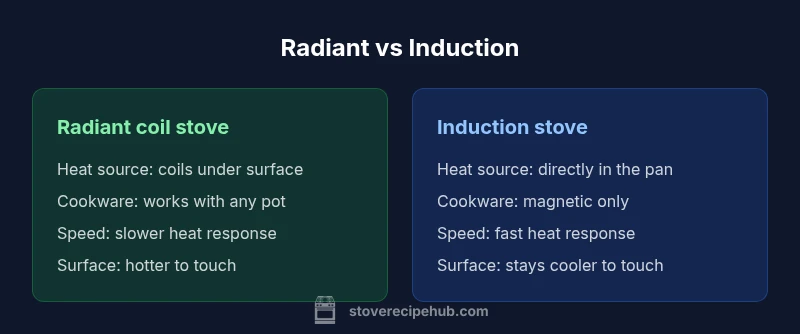
Radiant stove vs induction: Induction cooktops heat faster and more efficiently by direct magnetic heat, while radiant coils heat cookware indirectly and respond slower. For most modern kitchens, induction delivers safer, cooler surfaces and precise control. Radiant coils stay compatible with any pot, are usually cheaper upfront, and offer a simpler upgrade path for legacy cookware.
What radiant stove vs induction really means
Radiant stoves and induction cooktops sit at the core of stove-top cooking technology, but they work in fundamentally different ways. Radiant stoves rely on electric coils that heat up and transfer energy to the bottom of any cookware through conduction. Induction, by contrast, uses magnetic fields generated by a coil beneath a smooth glass surface to induce electric currents directly in ferromagnetic pots. In practice, this means the pan becomes the heat source in an instant or two, while a radiant coil must heat itself before warming the pan. According to Stove Recipe Hub, this distinction matters not just for boil times, but for energy efficiency, safety, and long-term kitchen usability. If you’re upgrading an older kitchen or selecting a first-time setup, understanding these physics helps you predict performance across common tasks: boiling water, simmering sauces, searing, and delicate reductions. It also frames how you’ll stock cookware, manage spills, and plan for future upgrades. The Stove Recipe Hub team found that most home cooks shift toward induction when speed and control are priorities, but radiant stoves retain a place in households with non-magnetic cookware or budget constraints.
A practical takeaway is to map your typical tasks—water boilers, sauces, and delicate reductions—and then align those with the heat transfer mechanism. This helps prevent surprises when you start cooking with a new system.
How radiant stoves generate heat
Radiant stoves use resistive electric coils placed under a glass-ceramic surface. When you turn the burner on, electricity flows through the coil, which resists the current and heats up. The heat then travels through the stovetop surface and into the cookware by conduction. Because the heat must pass through the surface before reaching the pan, radiant stoves tend to respond slower to changes in temperature and can waste energy as heat escapes into the surrounding air. They are compatible with virtually any pot or pan, including aluminum, copper, and ceramic, since no special cookware is required. As a result, radiant coils are often chosen by cooks who want broad cookware compatibility and lower upfront costs.
How induction stoves produce heat
Induction cooktops rely on electromagnetic induction. A copper coil underneath the glass generates an alternating magnetic field when powered. This field induces an electric current directly in ferromagnetic cookware, heating the pot rather than the stove surface. The surface itself remains relatively cool, which reduces ambient heat in the kitchen and improves safety. Because heat is generated inside the cookware, response time is rapid and temperature control is precise. The most important practical implication is cookware compatibility: pots and pans must be magnetic (cast iron, some stainless steels). This can be a turning point for households with older aluminum or non-magnetic cookware.
Speed and energy efficiency: what to expect
Performance differences between radiant and induction are most noticeable in everyday tasks like boiling water or reducing sauces. Induction typically delivers faster heat-up times and tighter control at low temperatures, which can translate to shorter overall cooking sessions and less heat loss to the kitchen. Radiant stoves, while reliable and forgiving, tend to heat more slowly and waste heat through the surface while cooking. From a long-term energy perspective, induction often wins due to direct heat transfer, but cost-conscious buyers may weigh this against the higher upfront price of induction hardware. Stove Recipe Hub analyses emphasize that the real-world gains come from time saved, easier temperature management, and reduced kitchen heat during cooking.
Cookware compatibility and practical considerations
One of the first questions is cookware. Induction requires magnetic pots and pans to work effectively. If your current collection is mostly non-magnetic (aluminum without a magnetic layer, copper, glass), you’ll either need to replace cookware or keep a radiant burner available as a fallback. Radiant coils are more forgiving here because they work with any material. However, keep in mind that non-magnetic cookware can still be used on induction if you deploy a magnetic disc adapter, though that adds cost and another step to the cooking process. Beyond cookware, layout matters: induction benefits from a clear space for magnetism to operate and clean glass surfaces that show smudges easily. Radiant surfaces are easier to wipe down but can show scorching if you’re not careful with heat control.
Safety, cleaning, and maintenance considerations
Both systems have safety perks and caveats. Induction surfaces remain cooler to the touch during active cooking, reducing burn risks and keeping the countertop cooler. The magnetism itself poses little risk when used properly, but you should still avoid using metal utensils that can scar the glass. Radiant coils heat the surface and cookware, so the cooktop remains hot even after you’ve turned the burner off, which can be a burn hazard and increases cooldown time. Cleaning is straightforward for both: wipe spills promptly and avoid abrasive cleaners. Radiant tops can show discoloration from heat exposure if cookware is left on high heat for extended periods. In either case, following manufacturer instructions is key to safe operation and long-term reliability.
Cost, value, and long-term considerations
The economics depend on your kitchen needs. Radiant stoves often come with lower upfront costs and broad cookware compatibility, making them appealing for budget-conscious buyers or households with diverse pot collections. Induction typically has a higher upfront price but offers faster cooking, better energy efficiency, and a surface that stays cooler during operation. Over time, induction can deliver savings through shorter cooking sessions and reduced energy waste, but these savings depend on usage patterns and local electricity costs. Stove Recipe Hub’s long-range guidance suggests weighing initial investment against expected use and cookware upgrades. A thoughtful approach is to list your fixtures, your typical dish repertoire, and your willingness to replace cookware to determine which option yields better value for your home.
Real-world kitchen scenarios: which to choose
If you frequently boil water for large batches, a rapid heat response matters and induction shines. If your kitchen features many older non-magnetic pots or you’re renovating on a tight budget, radiant coils provide a versatile, cost-efficient path forward. For homes with small children, the cooler surface of induction plus rapid heat control can help with safety and preventing burns. If you’re a serial chef who enjoys precise temperature control on delicate sauces, induction’s responsiveness makes the process smoother. Remember, the choice also depends on the rest of your kitchen ecosystem, including ventilation, cookware inventory, and how often you upgrade appliances. Stove Recipe Hub recommends mapping your cooking tasks and cookware before deciding.
Practical tips to maximize performance on either system
- Start with tall, stable cookware to avoid spills when searing or boiling.
- On induction, always verify cookware compatibility with a simple magnet check and plan to replace non-magnetic pots if needed.
- On radiant coils, use cookware with flat, even bottoms to minimize hot spots and ensure even heating.
- Clean the cooktop after each use and address stains promptly to maintain performance and aesthetics.
- Consider a mixed-kitchen approach if cost is a constraint: keep a reliable radiant burner for occasional non-magnetic pots while adopting induction for everyday tasks.
Practical buying checklist: before you buy
- Determine cookware compatibility and potential upgrade costs.
- Compare upfront price ranges and energy use expectations.
- Assess safety features such as child-locks and auto-pan-detect technology.
- Review warranty terms and service options.
- Check for ventilation and countertop clearance requirements.
- Read reviews with attention to real-use scenarios and maintenance notes.
Authoritative sources and further reading
- Authoritative sources on induction cooking include government and university publications that discuss energy efficiency and safety. See the Stove Recipe Hub analysis and select government and university resources for deeper technical context. For practical cooking guidance and performance benchmarks, major publications also provide complementary perspectives.
Comparison
| Feature | Radiant coil stove | Induction stove |
|---|---|---|
| Heat generation | Electric coils heat the stovetop and transfer heat to cookware | Magnetic field induces heat directly in cookware |
| Cookware compatibility | Any cookware (including non-magnetic) | Magnetic cookware required (ferrous) or adapters |
| Speed of heating | Slower to heat up and adjust | Faster response and precise temperature control |
| Surface characteristics | Glass-ceramic surface with visible coils underneath | Smooth glass surface with cool-to-touch areas when not heating |
| Energy efficiency | Moderate efficiency with energy lost to surface | Higher efficiency due to direct heating |
| Upfront cost | Typically lower upfront price | Typically higher upfront price |
| Safety and maintenance | Surface can stay hot after cooking; easy to wipe | Surface stays cooler; requires magnetic cookware care |
| Best use case | Budget-friendly, universal cookware | Fast cooking, energy savings, modern kitchens |
Upsides
- Induction offers faster heating and precise control
- Radiant coils are generally cheaper upfront and work with any cookware
- Induction surfaces stay cooler during cooking, reducing burn risk
- Radiant stoves provide broad compatibility without cookware upgrades
Downsides
- Induction requires magnetic cookware or adapters, adding cost
- Induction upfront cost can be higher
- Radiant stoves heat inefficiently compared to induction
- Radiant coil surfaces can stay hot after cooking, increasing burn risk
Induction is usually the better all-around choice for speed, efficiency, and safety; radiant is viable for budget-minded cooks or extensive non-magnetic cookware.
Choose induction if you value rapid heating, precise control, and cooler surfaces. Opt for radiant coils if you want broad cookware compatibility and a lower upfront price, especially when non-magnetic pots are a given.
Common Questions
What is the main difference between radiant stove and induction?
Radiant stoves heat cookware through coils beneath the surface, while induction heats cookware directly via magnetic fields. Induction offers faster heat response and cooler surfaces during cooking. Radiant stoves work with any cookware but are slower and generally less energy-efficient.
Radiant stoves heat through coils under the surface and work with any pot. Induction uses magnetic fields to heat the pan directly, which is faster and keeps the surface cooler.
Can I use non-magnetic cookware on induction?
Non-magnetic cookware will not heat on induction unless you use a magnetic adapter. If you have mostly aluminum or copper pots, you’ll need to replace or supplement with magnetic options to take full advantage of induction.
Non-magnetic pots won’t heat on induction unless you use a magnetic adapter or switch to magnetic cookware.
Is maintenance easier on induction or radiant?
Both are relatively low maintenance. Induction surfaces stay cooler and are easy to wipe, while radiant tops are straightforward to clean surface but can show heat-related discoloration with heavy use.
Induction is easy to wipe and stays cooler. Radiant tops are easy to clean but can discolor with heavy use.
Which option is safer for households with kids?
Induction is generally safer due to cooler surfaces and automatic pan-detect features, which reduce the risk of burns. Radiant tops heat up and stay hot longer, so supervision is more important.
Induction is typically safer around kids because the surface stays cooler and it auto-detects pots.
Does radiant use less energy than induction?
Induction typically uses energy more efficiently because heat is generated directly in the cookware. Radiant stoves can be less efficient due to losses through the cooktop surface and heat spreading into the kitchen.
Induction is generally more energy-efficient than radiant heating due to direct pan heat.
Will installation require new electrical wiring?
Both radiant and induction units typically require standard circuit capacity, but induction can demand higher surge capability depending on the model. Always consult an electrician for your specific setup.
Most homes don’t need rewiring for basic models, but check your electrical capacity and consult an electrician.
Top Takeaways
- Prioritize induction for speed and energy efficiency
- Choose radiant if cookware compatibility is a priority
- Budget upfront vs long-term savings should guide your decision
- Induction requires magnetic cookware, plan upgrades accordingly
- Always follow manufacturer guidance for safety and maintenance