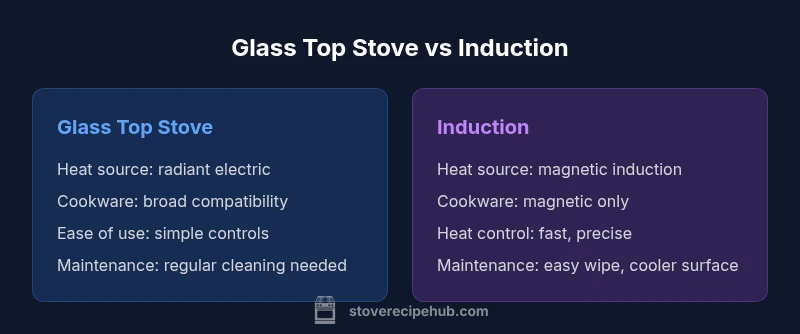
Glass Top Stove vs Induction: A Practical Comparison
Compare glass top stoves and induction cooktops across heat, efficiency, cookware, safety, maintenance, and cost to help home cooks choose the best fit for their stove-top setup.


Induction cooktops heat rapidly, offer precise control, and typically deliver better energy efficiency than radiant glass-top stoves. Glass-top models are cheaper upfront and tolerate a wider range of existing cookware. For a deeper dive, see the full comparison from Stove Recipe Hub. This quick snapshot helps you decide whether you should upgrade to induction or stick with glass-top based on your budget, cooking style, and long‑term energy goals.
What glass top stove vs induction cooktops are
A glass top stove, often called a radiant electric stove, uses electric coils or radiant elements hidden beneath a smooth glass-ceramic surface. Heat transfers to cookware through the surface, which becomes hot and then cools as the pot is removed. An induction cooktop uses a copper coil to generate an electromagnetic field. When a ferromagnetic pan sits on the surface, the field induces current in the cookware itself, heating the pot directly. This fundamental difference drives performance, efficiency, and usability across the kitchen. According to Stove Recipe Hub, induction typically delivers faster heating, tighter temperature control, and better energy efficiency, while glass-top options remain budget-friendly, broadly compatible with non‑magnetic cookware, and easier to find in used markets. For many households, the choice comes down to how you cook most of the time, what cookware you own, and how much you value long‑term operating costs.
How heat is generated
Radiant glass top stoves heat via electric coils or radiant elements beneath a glass-ceramic surface. The energy is transferred to cookware by conduction, and the surface attains high temperatures that slowly dissipate after cooking ends. Induction, by contrast, relies on electromagnetic induction: an alternating current in the coil creates a magnetic field that induces heat directly in magnetic cookware. This means the glass-ceramic surface itself stays cooler during cooking (though not always). The result is a big divergence in speed, control, and energy waste. Practically, induction shines for rapid boils and precise simmering, while glass tops excel in straightforward, predictable cooking with familiar control schemes.
Efficiency and heat control
Efficiency matters when you’re feeding a family or cooking long meals. Induction systems convert electricity directly into heat in the pan, which reduces heat loss to the environment and offers near-instant responsiveness to temperature changes. Glass top stoves rely on radiant heat transfer, which inherently wastes more energy as heat escapes into the air and the surface itself may heat unevenly. In real kitchens, this translates to faster boil times and better control with induction, but it can come at the cost of needing compatible cookware and higher purchase prices. The Stove Recipe Hub team notes that the efficiency and control advantages of induction are most noticeable during tasks requiring rapid temperature shifts, such as searing or rapidly reducing a sauce.
Cookware compatibility
Cookware compatibility is a pivotal practical factor. Induction requires ferromagnetic pans—think cast iron, certain stainless steels, and many carbon steels. Flat, smooth bottoms maximize contact and heating efficiency. Non-magnetic cookware (aluminum without a magnetic layer, copper, or glass) will not heat on induction unless used with a compatible ferromagnetic disk adapter. Glass-top electric stoves, on the other hand, work with a wide range of cookware, including aluminum and copper pots, as long as the cookware is stable and has a flat bottom. This broad compatibility is a common reason homeowners delay a switch, especially if they already own a collection of non-magnetic pots. Stove Recipe Hub’s analysis highlights the practical trade-off: induction rewards cookware investment, glass tops reward compatibility and lower upfront costs.
Real-world cooking performance
Real-world performance hinges on heat delivery, control, and cookware. Induction delivers near-instant heat, precise temperature changes, and stable simmering even with small adjustments. This translates into quicker meals and more consistent results for delicate sauces, searing, and high-heat cooking. Glass tops can handle most everyday tasks well, but heat discovery is slower, and maintaining steady low heat for simmering can require more attention. Heavy-bottom pans help both types distribute heat more evenly, though induction still requires magnetic cookware. For many home cooks, induction offers the most noticeable improvements in timing and precision, while glass tops align with budgets and existing inventories.
Cleaning and maintenance
Both glass top stoves and induction cooktops share a smooth, glass-ceramic surface, which makes cleanup simple when spills are horizontal and surfaces are cool. Induction surfaces tend to stay cooler underneath cookware during cooking, which can reduce burn risk and make cleanup straightforward. Glass-top stoves can show scorch marks or fingerprints more visibly, and aggressive scrubbing can scratch the surface. Regular maintenance—keeping the surface clean, avoiding abrasive cleaners, and using a soft sponge—keeps both looking new. If you cook with sugar-based sauces or highly acidic liquids, wipe promptly to avoid staining or etching on either surface. Stove Recipe Hub emphasizes choosing compatible cookware and routine cleaning to maximize longevity.
Safety considerations
Safety features differ across models but share common elements: hot-surface indicators, auto shutoff, and child locks. Induction cooktops are often lauded for safety since the cook surface remains cooler and the heating occurs in the pan. But you should still heed safety notes about metal objects, cookware stability, and cord placement if you’re using a freestanding unit or slide-in range. Glass-top stoves, while safe and familiar, still require attention: the surface can be slippery when wet, and heavy cookware can crack the surface if mishandled. The Stove Recipe Hub team notes that both types benefit from regular maintenance and adherence to manufacturer safety guidelines.
Installation, costs, and value
Upfront costs for induction cooktops are typically higher than glass top stoves, in part due to advanced electronics and the need for compatible cookware. Installation sometimes requires a dedicated electrical circuit and a licensed technician, especially for built-in units. Over the long term, induction can offer energy savings and faster cooking, potentially offsetting higher initial costs, but that balance depends on usage, energy prices, and cookware upgrades. For budget-minded kitchens, a glass-top stove remains a sensible choice if you want a straightforward upgrade without changing your current cookware collection. Stove Recipe Hub’s analysis suggests that your long-term energy costs and cooking style drive the decision more than sticker price alone.
Common myths and misconceptions
A common myth is that induction only works with expensive, heavy cookware. In reality, many common cookware items work once magnetism is present on the base; the key is a flat, smooth bottom. Another misconception is that induction emits no heat; in fact, the heat is generated in the cookware, and the surface may become hot due to contact or heat transfer. Some people assume glass top stoves are safer because the surface remains cool; while induction surfaces tend to stay cooler during cooking, the pan and surrounding surface can still become very hot, so proper handling remains essential. By understanding the physics of heat transfer, you can choose the setup that best fits your kitchen routine.
Practical kitchen scenarios
Consider your typical cooking: if you regularly boil pasta, stew sauces, or do high-heat searing, induction’s speed and control can transform your workflow. If you cook mainly with one or two large pots and value compatibility with existing utensils, a glass-top model can be more convenient and economical. For rental kitchens or temporary setups, a glass-top option often provides a lower barrier to entry. In a small apartment, induction’s efficiency and compact control logic can deliver noticeable benefits, while in a family kitchen with a wide cookware library, glass-top may avoid an extra cookware upgrade. The choice should align with your most frequent tasks and your willingness to update cookware.
What to consider before buying
Before purchasing, assess your current cookware, budget, and cooking pace. Check if you already own magnetic pots or if you’re open to upgrading. Inspect cabinet space, electrical capacity, and ventilation, especially for full-size induction or radiant ranges. Read consumer reviews focused on heat control, reliability, and maintenance experiences. Compare warranty terms and service networks in your area. Finally, weigh long-term energy costs against upfront price and convenience. Stove Recipe Hub recommends building a practical checklist that captures cooking habits, cookware compatibility, and electrical readiness to guide your final choice.
Decision framework and next steps
To apply a practical decision framework, list your top three cooking scenarios and rate how each type would perform. Create a side-by-side pros and cons list for your household. Visit showrooms to test temperature control and pan response, bringing a few familiar pots for reference. If you already own magnetic cookware, induction becomes more appealing; if not, the cost of new pots may factor into the overall decision. Use the evaluation framework to decide whether the short‑term cost of upgrading to induction is justified by long-term energy savings and improved cooking experience. The Stove Recipe Hub approach emphasizes customization: tailor your choice to your kitchen, not the latest trend.
Comparison
| Feature | glass top stove | induction cooktop |
|---|---|---|
| Heat source mechanism | Radiant heat via glass-ceramic surface | Electromagnetic induction heats cookware directly |
| Cookware compatibility | Works with most non-magnetic cookware; flat bottoms preferred | Requires magnetic ferrous cookware (cast iron, some stainless steels) |
| Energy efficiency | Moderate, varies by model and usage | High efficiency due to direct heat transfer |
| Heat-up time | Slower to heat compared with induction | Very fast to heat and cool with precise control |
| Maintenance/Cleaning | Smooth surface; prone to visible smudges; scratches possible with abrasives | Smooth surface; spills typically wipe away quickly; coolest surface during cooking |
| Price range (upfront) | Lower upfront cost on average | Higher upfront cost due to advanced electronics |
| Best for | Budget-conscious buyers; easy upgrade from older electric stoves | Home cooks valuing speed, precision, and energy savings |
Upsides
- Lower upfront cost for glass-top models
- Broad cookware compatibility on glass tops
- Simple, familiar controls and layouts
- Wide service networks and replacement parts
Downsides
- Slower heat-up and less precise control with glass tops
- Higher long-term energy costs on radiant tops in some scenarios
- Potential for surface scratches or cracks with heavy use
- Induction requires compatible cookware and sometimes upgrades
Induction generally offers better speed, control, and energy efficiency; glass top remains appealing for cost and compatibility.
Choose induction if you want faster cooking and precise control and are prepared to invest in compatible cookware. Opt for a glass top if upfront cost and cookware flexibility matter more, and you prefer a familiar setup.
Common Questions
What is the main difference between glass top stoves and induction cooktops?
The primary difference is the heating method: induction heats cookware directly via magnetic fields, while glass top stoves heat the surface and transfer heat to cookware. Induction offers faster heating and greater control, but depends on magnetic cookware, whereas glass tops work with most common pots and pans.
Induction heats cookware directly, giving fast, precise control. Glass tops heat through the surface and work with most pots. For details, see our full guide.
Can I use my existing cookware on induction?
If your pots and pans are magnetic, they should work on induction. Flat-bottom cookware yields the best contact and heat transfer. Non-magnetic or curved bottoms may not heat efficiently or at all on an induction surface.
Magnetic pots work on induction; flat bottoms heat best. Non-magnetic cookware may not heat.
Is induction safer than radiant glass-top stoves?
Induction tends to stay cooler on the surface and includes strong safety features, reducing burn risk. However, the cookware itself can become very hot, so caution is still needed. Glass tops can crack if mishandled and need careful cleaning.
Induction stays cooler to the touch, but the pan can be hot. Cleanliness and care matter for both.
How much do these appliances cost to operate?
Operating costs depend on usage and energy prices. Induction tends to be more energy-efficient in practice, especially for quick heating and precise cooking, but the actual savings vary by meal type and frequency.
Induction is generally more energy-efficient, but costs depend on usage and rates.
Do induction cooktops require professional installation?
Induction units often require a suitable electrical circuit and sometimes a professional installation, especially for built-in or slide-in models. A licensed electrician can ensure proper wiring and safety compliance.
You may need a professional install to ensure safe wiring and compliance.
Which is easier to clean, induction or glass top?
Both have smooth glass surfaces, which wipe clean when cool. Induction surfaces can stay cooler during cooking, reducing the chance of baked-on residue, but spills should still be cleaned promptly to avoid staining.
Both are easy to wipe; induction may resist stains a bit better due to cooler surface during cooking.
Top Takeaways
- Induction excels in speed and control; expect higher upfront costs
- Glass top is budget-friendly and broadly compatible with existing cookware
- Cookware compatibility is the deciding factor for induction adoption
- Regular cleaning and correct usage extend surface life for both types
- Evaluate long-term energy costs alongside purchase price