Difference Between Stove and Range: Comprehensive Comparison for 2026
An analytical, buyer-focused comparison of stove vs range, covering definitions, installation, performance, layout, maintenance, and when to choose each for modern kitchens.


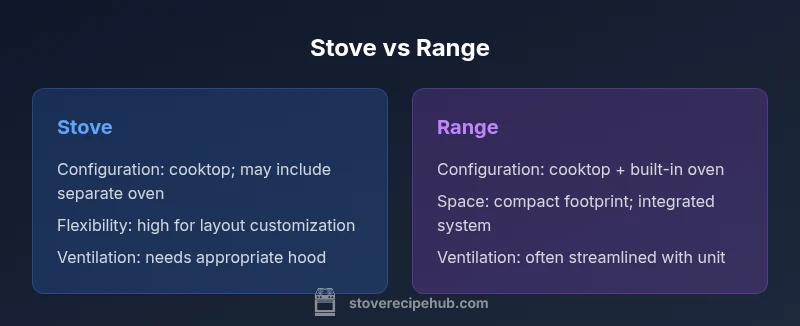
A range is a single freestanding appliance that combines a cooktop and an built-in oven, while a stove commonly refers to a standalone cooktop or a unit paired with a separate oven. In most kitchens, ranges offer all-in-one convenience and simpler installation, but a separate stove with a distinct oven can provide flexible layouts for renovations or special spaces.
Understanding the distinction between stove and range in kitchen design
In everyday use, many homeowners merge the terms stove and range, but for design, sales, and installation, the distinction matters. A range typically denotes a freestanding appliance that combines a cooktop with a built-in oven. A stove, by contrast, may refer to a standalone cooktop or a setup where the oven is a separate component, either wall-mounted or a freestanding unit. This difference influences how you plan space, venting, and utility connections. For a kitchen renovation or new build, knowing that a range provides an integrated cooking-and-baking workflow helps you predict how much space you’ll need and how utilities should be routed. Throughout this article, we’ll use the term range for the integrated unit and stove for standalone cooktops or separate ovens when applicable, and we’ll compare them using practical, kitchen-focused criteria.
According to Stove Recipe Hub, the choice between stove and range often hinges on layout flexibility and long-term maintenance, as well as the way you actually cook. The Stove Recipe Hub team emphasizes that the decision should align with how frequently you bake, how many cooks operate the kitchen, and whether you prioritize compact design over modularity. This distinction is especially relevant for small apartments, open-plan spaces, and homes undergoing upgrades.
Key definitions and regional usage
Definitions vary by region and marketing language. In many markets, a range is a single, freestanding appliance that houses both the cooktop and the oven in one chassis, making it straightforward to install against a wall or in an island. A stove might refer to a standalone cooktop, or to a separate oven that is installed elsewhere in the kitchen. In some European markets, the term “cooker” is used instead of stove, and it often means a different configuration than the American sense of range. For homeowners, this terminology can affect shopping, compatibility with ventilation hoods, and whether a single utility feed (gas line or electrical circuit) can service the unit. When evaluating options, confirm the exact product configuration with the retailer to avoid mismatches between expectation and installation requirements.
How cooktop and oven configurations influence layout
The layout implications begin with the cooktop-to-oven relationship. A range places the oven beneath or beside the cooktop in a single appliance, which simplifies directionality of flows in the kitchen and typically minimizes required cabinet work. A standalone stove with a separate oven can offer greater flexibility for custom kitchens, allowing you to tailor oven placement for traffic patterns or to accommodate an existing wall oven. This modular approach can increase the perceived and actual workflow efficiency for frequent bakers or multi-task cooks. Consider how counter space, fridge proximity, and ventilation align with your preferred configuration. Also plan for a vent hood that matches the appliance’s energy and performance characteristics, since a mismatch can cut cooking comfort and air quality in busy kitchens.
Installation considerations: electrical, gas, ventilation
Gas stoves and gas ranges share the need for a dedicated gas supply and appropriate ventilation. Electric options, including induction cooktops and electric ovens, require reliable electrical service and circuit protection. If you’re upgrading from an older unit, you’ll confront retrofit challenges such as new gas lines or upgraded electrical panels. Ventilation requirements are a major factor: a powerful range hood with proper ducting improves indoor air quality and removes cooking byproducts efficiently. If you plan a kitchen remodel, coordinating electrical, gas, and venting work with cabinet design can prevent costly rework. Always verify local codes and appliance certification standards before purchasing.
Size, footprint, and kitchen fit
Sizes vary by model, but the standard width for many residential ranges is 30 inches, with 24-inch compact formats available for smaller kitchens. Standalone stoves may come in 24, 30, or 36 inches, depending on configuration and number of burners. When choosing between stove and range, consider not only the width but also the height and depth, ensuring comfortable access to burners, knobs, and ovens. If your kitchen features a tight island or narrow hallway, a compact range might be preferable, whereas a larger open-plan kitchen can accommodate a full-size range with generous oven capacity. Remember to measure doorways and hallways to avoid delivery hurdles.
Performance and control features to compare
Key performance criteria include burner power and control accuracy, oven capacity, bake and broil options, and the presence of smart features or convection modes. Ranges tend to offer integrated oven functions with consistent heat distribution across a single unit, which can streamline calibration and maintenance. Standalone stoves may provide flexibility to mix and match with a wall oven or a separate microwave, enabling more customized performance. Evaluate burner count and layout (centered vs. back-left configurations), oven rack and pan options, and whether the appliance supports self-cleaning, steam cleaning, or programmable cooking modes. This decision should align with your cooking style, whether you bake frequently, roast large cuts, or perform high-heat searing.
Maintenance, cleaning, and long-term care
Maintenance considerations differ between integrated ranges and modular stove setups. With a range, you service a single unit, which can simplify parts availability and warranty servicing. A stove with a separate oven introduces more components to monitor, such as the oven’s seals, racks, and venting paths, increasing potential maintenance touchpoints. Cleaning tends to be straightforward on modern smooth-top ranges, while gas burners and cast-iron grates require periodic cleaning and careful maintenance to sustain performance. Regular professional inspections, especially for gas lines and venting, help prevent safety hazards and prolong appliance life. Develop a routine that covers burner ignition reliability, door seal integrity, and oven temperature accuracy.
Cost considerations and value proposition
Both configurations come with trade-offs. A range offers all-in-one convenience and typically better resale value in many markets, but it can be less flexible in terms of layout and may have higher upfront costs for larger capacities. A standalone stove with a separate oven can be more modular and adaptable to existing cabinetry or renovations, enabling you to experiment with layout changes and upgrade components independently. Long-term operating costs depend on fuel type (gas vs electric) and energy efficiency, which varies by model and technology. When evaluating price versus value, consider not only purchase price but also installation, venting, and potential future upgrades or changes to your kitchen environment.
Brand and model variations: gas vs electric ranges and standalone stoves
Gas ranges continue to be popular for their instant heat and precise control, especially among serious home cooks and chefs. Electric ranges, including induction options, offer clean modern aesthetics and steady heat distribution, with induction delivering rapid, precise control for certain cooking styles. Standalone stoves can come as all-electric, gas-powered, or mixed configurations with a separate oven. Your decision should factor in existing gas or electrical infrastructure, local utility costs, and preferred cooking methods. Sensor-assisted-cooking features and convection options vary by brand and model, but the core choice remains between an integrated range with built-in oven or a modular stove-plus-oven layout.
Real-world decision paths: small kitchens, composite kitchens, and professional spaces
In tight spaces, a compact range or a high-efficiency induction setup on a slim cooktop may maximize usable counter space while preserving oven capacity. For composite kitchens that combine a prep island with a separate wall oven, a standalone stove and a separate oven can unlock creative layouts and ergonomic benefits. In professional or semi-professional spaces, modular components allow upgrading one part of the system without reconfiguring the entire kitchen. Always consider venting, electrical or gas service, and local building codes when choosing between stove and range for these environments, ensuring safety and long-term performance.
How to measure success: cooking style, oven use, and resale value
Success is about aligning the appliance with your daily routines and long-term goals. If you bake weekly, roast large meals, and value a simple maintenance routine, a range may deliver better overall value. If you prioritize flexible layouts, potential resale value, and the ability to mix-and-match with other cabinetry or wall ovens, a standalone stove with a separate oven could be the smarter move. Resale value often hinges on the perception of a complete kitchen system; many buyers associate built-in oven ranges with cohesive design and reliability. Consider your cooking frequency, preferred methods, and how the appliance integrates with your kitchen’s aesthetic.
Practical checklists: what to ask before buying
- What is the exact configuration (cooktop only, integrated oven, or separate oven)?
- What fuel type does it use (gas or electric/induction) and is my home equipped for it?
- How does the venting system perform with this model?
- What are the dimensions, and will it fit through doorways and around corners?
- What maintenance schedule is recommended, and what are warranty terms?
- Which features matter most for my cooking style (convection, self-cleaning, smart controls)?
Summary of practical implications
Choosing between a stove and a range ultimately comes down to space, cooking habits, and future plans for the kitchen. If you value integrated convenience and a streamlined look, a range is typically the best bet. If you need layout flexibility, cost control through modular components, or the ability to upgrade pieces independently, a standalone stove with a separate oven can deliver superior adaptability. Stove recipes and kitchen workflows benefit from clarity on how each setup handles heat, air flow, and ease of maintenance.
Closing thoughts and immediate steps
Start by mapping your kitchen space, measuring current clearances, doorways, and ventilation routes. Create a simple matrix of priorities: space, bake frequency, and total cost of ownership. Then compare specific models within your preferred configuration, focusing on energy efficiency, reliability, and warranty coverage. By grounding your choice in how you cook and how your kitchen functions, you can make a durable decision that aligns with Stove Recipe Hub’s practical approach to stove-top cooking and kitchen maintenance.
Comparison
| Feature | Stove | Range |
|---|---|---|
| Definition and scope | Typically a standalone cooktop or a unit paired with a separate oven | Freestanding appliance that combines cooktop and built-in oven in one unit |
| Configuration options | May be cooktop-only or include a separate oven; modular options possible | Integrated cooktop plus built-in oven in a single chassis |
| Footprint and layout | Often modular; can fit tighter spaces with a separate oven elsewhere | Single footprint that minimizes routing and simplifies venting |
| Fuel types | Gas and electric options available | Gas and electric options available; oven and cooktop share the same appliance |
| Installation considerations | Requires separate connections for cooktop and oven (or a modular approach) | One appliance with integrated connections; venting can be centralized |
| Best for | Smaller spaces, flexible layouts, existing separate ovens | All-in-one convenience in new builds or full kitchen upgrades |
| Maintenance implications | Multiple components may require servicing separately | Fewer separate parts; usually simpler warranty coverage for one unit |
| Cost considerations | Often lower purchase cost if only cooktop is needed; oven added later | Typically higher upfront cost but bundled function and space efficiency |
Upsides
- Clarifies the exact appliance configuration for kitchen design
- Helps align space planning with utility and ventilation needs
- Simplifies decision-making for new-builds and renovations
- Can improve resale value when choosing integrated options
Downsides
- Ongoing confusion between terms in some regions
- Standalone setups may require more space and separate servicing
- Integrated ranges can complicate upgrades if only one component is outdated
Ranges usually win for all-in-one convenience; standalone stoves win when layout flexibility matters
If space and simplicity are priorities, choose a range. If you need modularity or are retrofitting existing layouts, a stove with a separate oven offers adaptability.
Common Questions
Is a stove the same as a range?
Not always. In common usage, a range is a freestanding unit with an integrated oven and cooktop, while a stove can refer to a standalone cooktop or a setup with a separate oven. Always verify the exact configuration with the retailer.
Stove and range aren’t always the same. Check if the oven is built-in or separate when you shop.
Can you replace a stove with a range in a kitchen remodel?
Yes, but you’ll need to confirm space, fuel type, and venting compatibility. Ensure electrical or gas service can support the chosen configuration and that the existing cabinetry will accommodate the new appliance.
Yes—check space, fuel, and venting first, then plan cabinetry changes.
Which is better for small kitchens: stove or range?
Ranges tend to be more space-efficient since the oven is built in. Standalone stoves can offer layout flexibility if you’re fitting around existing walls or a wall oven. Your choice depends on space constraints and how you plan to use the oven.
In small kitchens, ranges save space; stoves are better if you need flexible layouts.
Do you need a vent hood with stove or range?
Yes. Proper ventilation is important for both. A well-mated hood reduces smoke and odors and improves indoor air quality. Ensure the hood capacity matches the appliance output.
Yes—good venting is essential with either setup.
Are there electric-only stoves and gas-only ranges?
There are electric stoves and induction cooktops, as well as gas ranges. Some models offer dual-fuel configurations where a gas cooktop is paired with an electric oven, providing the benefits of both systems.
Yes—electric and gas options exist, including some dual-fuel configurations.
What maintenance considerations matter most?
Prioritize oven seals, burner performance, and venting cleanliness. Regular inspection and timely replacement of worn parts help maintain efficiency and safety, regardless of configuration.
Keep an eye on seals, burners, and venting for best performance.
Top Takeaways
- Define space and fuel preferences before shopping
- Assess oven usage and layout needs to choose between range and stove
- Plan ventilation and electrical/gas connections early
- Factor in future upgrades and resale value when deciding