Gas Stove vs Gas Range: Which Option Fits Your Kitchen?
A detailed, analytical comparison of gas stove versus gas range, covering oven presence, heat control, installation, maintenance, and real-world use to help home cooks choose wisely.


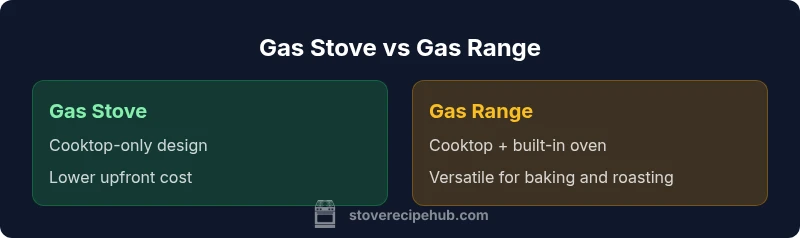
Gas stove vs gas range: the key decision is whether you need a built-in oven and more culinary flexibility. A gas range combines a cooktop with an oven, often with convection options, while a gas stove focuses on surface cooking in a more compact footprint. Consider space, baking needs, and maintenance when choosing.
What gas stove vs gas range means in practice
In everyday kitchens, the distinction between a gas stove and a gas range defines your cooking options, footprint, and future upgrade path. A gas stove is typically a stand-alone cooktop with multiple burners mounted on a base cabinet or freestanding appliance. A gas range combines that same cooktop with an integrated oven below, creating a single unit that handles baking, roasting, and broiling as well as surface cooking. For many households, the decision hinges on how much you value an oven inside the same footprint, versus the flexibility to locate a separate appliance or to swap out the cooktop later. When you analyze the choice through the lens of the keyword 'gas stove vs gas range', you are balancing two core capabilities: raw burner performance and the reliable, consistent oven functionality. The Stove Recipe Hub team notes that the right choice depends on kitchen layout, cooking habits, and long-term maintenance expectations. A range adds culinary versatility but may demand more space and higher upfront investment, while a stove-alone setup often fits tight kitchens and offers simpler upgrades in the future.
Oven presence dramatically changes use-case and planning
An oven-inclusive gas range changes the cooking equation far more than you might expect. If you bake or roast weekly, the integrated oven provides a seamless workflow—from preheating to cooking to broiling—without switching devices. Conversely, a gas stove without an oven means you’ll either rely on a separate oven (countertop, built-in, or wall-mounted) or accept a limited repertoire mainly focused on surface cooking. The decision matters for energy distribution within the kitchen and for ventilation planning, as ovens introduce higher heat density and different exhaust profiles. The Stove Recipe Hub team emphasizes that the presence of an oven often justifies a larger initial investment but can translate into space-saving gains and faster meal completion in busy households. In smaller kitchens, a well-chosen range can consolidate appliances and reduce clutter; in larger spaces, the flexibility of keeping appliances separate can offer design and upgrade advantages.
Heat control and burner layout: precision matters
When you compare gas stoves to gas ranges, burner's arrangement and control precision stand out as the most immediate differences. A modern gas stove typically offers a cluster of burners with varying BTU outputs, enabling precise simmering, rapid boiling, and high-heat searing. A gas range adds the oven, which introduces additional heat management considerations, including bake and broil modes, convection where available, and thermal cycling. For home cooks who value accurate simmer, consistent low temperatures, and predictable startup performance, both options can perform well, but ranges with well-designed control panels and front-mounted knobs can offer smoother operation across both cooktop and oven. In practice, the best choice aligns with your cooking style: if you rarely bake, a stove with a robust burner lineup may suffice; if you bake or roast regularly, a range’s integrated oven becomes a meaningful advantage.
Oven performance and features in gas ranges
Gas ranges frequently bring features like conventional bake, convection bake, broil, and sometimes multiple oven racks. Convection, when present, improves even heat distribution and can reduce cooking times for many dishes. However, convection adds cost and complexity, and not all ranges implement it well. In contrast, a gas stove (cooktop only) has no oven, so you’ll rely on a separate oven option that may be a freestanding unit or a built-in wall oven. If you value integrated control and a cohesive aesthetic, a range’s single footprint can streamline operation and resale appeal. The trade-off is that you may be paying for oven technology you don’t use as frequently if your baking needs are modest. The Stove Recipe Hub team notes that checking for true convection performance and reliable temperature control in ranges is essential before buying.
Installation realities: gas lines, ventilation, and space
Installing a gas range often involves coordinating a longer gas line run, a suitably sized vent hood, and adequate clearance around the unit. A range’s taller profile and dimensions can affect cabinet layout and the flow of traffic in a kitchen. A gas stove, especially a compact model, may fit more easily into smaller kitchens or spaces with limited cabinet depth. Ventilation must match the appliance’s output; ranges commonly demand a more robust hood and ductwork, while stoves may require lighter ventilation. The decision should consider existing gas lines, venting capacity, and future remodeling plans. The Stove Recipe Hub Team emphasizes ensuring professional installation to meet safety standards and local codes and to avoid under-ventilation or improper gas connections that could lead to safety concerns.
Cleaning and maintenance realities
Care for a gas stove focuses mainly on the cooktop surface, grates, and burner caps. Cleaning is generally straightforward, with occasional deep cleans to remove grease build-up and to inspect ignition ports. A gas range adds oven cleaning into the mix; depending on the model, you’ll contend with oven racks, glass doors, and interior liners that may require specialized cleaners or cycles. The oven often contributes to ongoing maintenance costs, including seal replacements or thermostat recalibration. Consumers should weigh how much effort they’re willing to invest in cleaning, especially if the kitchen’s daily rhythm leaves little time for deep cleans. The Stove Recipe Hub Team notes that keeping burners clean and ensuring proper gas ignition are essential to maintaining performance over time.
Operating costs, energy efficiency, and long-term value
Operating costs for gas stoves versus gas ranges depend on usage patterns, fuel efficiency, and maintenance. A range’s oven contributes to energy consumption, but improved insulation and modern convection technologies can offset some of that cost. Prices for basic cooktops tend to be lower than full ranges, but the total cost of ownership includes installation, potential venting upgrades, and service considerations. Variability across brands makes apples-to-apples comparisons challenging, so evaluators should look at energy guides, insulation quality, and the presence of programmable timers or smart controls. The Stove Recipe Hub Team advises focusing on real-world usage patterns—how often you bake, roast, and prepare multi-dish meals—when estimating long-term costs.
Real-world scenarios by kitchen size and lifestyle
For small apartments, a compact gas stove may be preferable to preserve space and keep renovations minimal. In a family kitchen with frequent roasting and baking, a gas range can offer significant advantages in cooking cadence and meal variety. For households that value a seamless, minimalistic design, a single-range setup can streamline maintenance and aesthetics. For professional-level cooking at home, neither option is inherently superior; rather, the choice hinges on the balance between space, baking needs, and budget. By mapping your weekly menu and family size to the appliance’s capabilities, you can create a practical plan that aligns with both current needs and future growth.
User experience: ergonomics, controls, and accessibility
Control layout and ergonomics influence the day-to-day experience. Front-mounted knobs that are clearly labeled and easy to grip reduce the friction of turning burners on and off, while a range’s combined interface can simplify or complicate operation depending on design quality. The presence of a glass oven door, its ease of cleaning, and the oven racks’ accessibility are practical factors for users who frequently bake. For households with children or caregivers who require straightforward controls, selecting units with large, tactile knobs and simple, intuitive interfaces can pay dividends in safety and comfort.
Buying guide: criteria and steps for gas stove vs gas range
When evaluating options, start with space constraints and ventilation capacity, then assess your baking needs and appetite for maintenance. Don’t assume that a higher price guarantees better performance; compare burner BTUs, ignition reliability, oven temperature accuracy, and insulation quality. Consider the finish and ease of cleaning, the availability of replacement parts, and warranty terms. Finally, check for energy efficiency labels and the brand’s service network. A practical buying workflow: (1) measure space, (2) list must-have features (oven, convection, broil, timer), (3) compare two or three models, (4) verify installation requirements, (5) read user reviews for real-world reliability.
Practical decision framework and caveats
In the end, your choice between a gas stove and a gas range depends on whether baking versatility or compact cooking is more valuable to you. If space is at a premium and you rarely bake, a stove with a separate oven might be the most economical path. If you love roasting and baking and have the space, a gas range can deliver smoother workflow and long-term value. Always consider local building codes, ventilation requirements, and the potential resale impact when making your decision. The Stove Recipe Hub Team reminds readers to balance upfront cost with anticipated usage to choose a solution that stands the test of time.
Comparison
| Feature | Gas Stove | Gas Range |
|---|---|---|
| Primary cooking surface design | Cooktop-only design | Cooktop + built-in oven |
| Ignition & control | Continuous spark ignition on all burners | Separate oven controls with cooktop ignition |
| Oven presence | No oven | Integrated oven (often with convection) |
| Oven capacity | N/A | Typical built-in oven capacity varies by model |
| Space & footprint | Generally smaller footprint | Taller footprint due to oven |
| Maintenance & cleaning | Cooktop-focused cleaning | Oven adds interior cleaning load |
| Price range | Lower upfront cost for cooktops | Higher upfront cost for ranges with oven |
| Best for | Cooking-only needs, tight spaces | Cooking + baking/roasting versatility |
Upsides
- Lower upfront cost on basic cooktops
- More compact options for small kitchens
- Easier maintenance for cooktop-only units
- Flexible upgrade path if you want to add an oven later
Downsides
- No built-in oven for baking enthusiasts
- Range units require more space and possibly heavier installation
- Higher upfront cost when choosing an oven-equipped model
- Ventilation needs are greater with ranges
Gas range generally offers more versatility due to the built-in oven; gas stove suits tight spaces and simpler maintenance.
If baking or roasting is part of your routine, a gas range is usually the better long-term pick. For kitchens with limited space or strict budgets, a gas stove provides a practical, space-saving alternative. Your final choice should align with your cooking habits, kitchen layout, and maintenance tolerance.
Common Questions
What is the main difference between a gas stove and a gas range?
The main difference is that a gas stove is cooktop-focused without an integrated oven, while a gas range combines the cooktop with a built-in oven. This affects baking capability, space requirements, and overall kitchen workflow.
Gas stoves are cooktops only, while gas ranges include an oven. If you bake often, a range is usually more convenient.
Do gas stoves include an oven?
Most gas stoves do not include an oven. If you need baking capability, you’ll typically pair a stove with a separate oven or choose a gas range with an integrated oven.
A gas stove generally doesn’t come with an oven; you’d add a separate oven or pick a range with one.
Are gas ranges more expensive than gas stoves?
Gas ranges with built-in ovens typically cost more upfront than basic gas stoves due to the added oven and potential convection features. Total costs also depend on venting, installation, and model choices.
Ranges usually cost more upfront because of the built-in oven, but the difference depends on features and installation.
What features matter when buying a gas stove vs gas range?
Key features include ignition reliability, burner variety, oven convection capability, insulation, and the ease of cleaning. Also consider hood compatibility, cabinet space, and warranty terms.
Look for reliable ignition, the right number and type of burners, and a well-insulated oven if you’re choosing a range.
Can I upgrade from a gas stove to a gas range later?
Yes, it’s generally possible to upgrade, but it may require cabinet modifications, gas line adjustments, and venting upgrades. A professional installer can assess feasibility and safety.
Upgrading to a range later is usually possible but may need some remodeling work and proper venting.
Top Takeaways
- Choose gas stove when space is at a premium and baking is rare.
- Choose gas range for built-in oven and broader cooking versatility.
- Assess kitchen layout and ventilation to determine feasibility.
- Prioritize ignition reliability, oven temperature accuracy, and maintenance needs when buying.