Glass Top Stove vs Coil: A Practical Comparison for Home Cooks
In-depth, balanced comparison of glass top stoves and coil stoves for home cooks. Learn heat control, cleaning, durability, and value to decide which surface fits your kitchen and budget.


Glass top stove vs coil: the glass-ceramic surface is easier to wipe clean and looks sleeker, while coil stoves are rugged, cheaper upfront, and simpler to repair. For most home cooks, glass tops offer a cleaner kitchen experience and smoother simmering, but coils excel on budget and durability. The right choice depends on how you cook, how you clean, and how much you’re willing to invest upfront.
Heat delivery fundamentals
Understanding the core difference in heat delivery helps explain why glass top stoves and coil stoves feel so different in everyday cooking. Glass top surfaces use a glass-ceramic plate that transfers heat from radiant elements below to your cookware through a flat, even surface. Coil stoves rely on exposed resistive coils that transfer heat directly to the pot or pan. This means glass tops tend to provide a smooth, even cooking surface with less hot spots when your cookware sits flat, while coils can deliver rapid bursts of heat and faster adjustments when you’re boiling water or searing. According to Stove Recipe Hub, the glass top stove vs coil debate often centers on spill management, heat responsiveness, and the overall aesthetic of the kitchen. The result is two distinct cooking experiences that favor different routines rather than a single universal winner.
In practice, the choice is not just about surface material; it’s about how you use the stove. If you frequently simmer sauces, a glass top can be forgiving and easy to manage with steady, gentle heat. If your meals demand quick high heat and robust pulse cooking, coils may feel more immediate. Remember that cookware quality matters too: flat, flat-bottomed pots on glass tops distribute heat more evenly, while mismatched pots can cause hotspots on either surface.
Heat delivery fundamentals
Comparison
| Feature | Glass top stove | Coil stove |
|---|---|---|
| Heat delivery | Radiant heat through a flat surface for even transfer | Exposed coils with direct, fast-response heat |
| Cleaning difficulty | Smooth surface with spill cleanup easier | Drips and grime collect in pans and coils; more surfaces to wipe |
| Durability risk | Cracking or scratching the ceramic surface if heavy objects drop | Coils can burn out or sag; drip pans can accumulate residue |
| Cookware compatibility | Works with most flat-bottom pots; avoid warped or very heavy bottoms | Generally compatible with most cookware; coils tolerate a wider range of bottoms |
| Heat control speed | Slower to cool and slightly slower to heat depending on model | Rapid changes in heat; immediate feedback when adjusting power |
| Aesthetics and kitchen look | Sleek, seamless surface; modern appeal | Classic, rugged look that many kitchens still favor |
| Typical upfront cost | Often higher upfront cost, depending on brand and features | Lower upfront cost; simple repairs possible |
Upsides
- Easier cleaning with a smooth, wipeable surface
- Sleek, contemporary kitchen appearance
- Mirrors a premium kitchen vibe that can boost home value
- Coil stoves tend to have lower upfront replacement costs
Downsides
- Glass tops can crack or scratch if heavy pots are dropped or misused
- Requires gentle cookware and careful handling to avoid damage
- Coil stoves can be harder to clean due to drip pans and coil rims
- Coil stoves may lack the modern look some buyers want
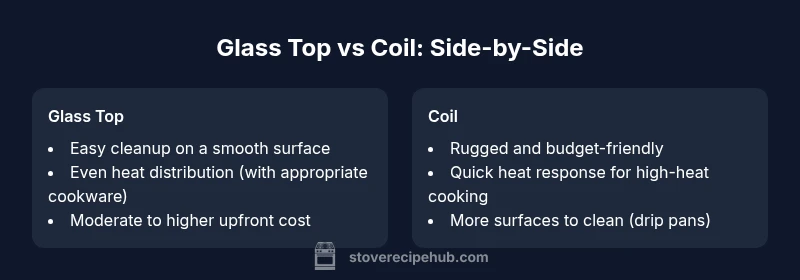
Glass top stoves offer better cleaning ease and a modern look; coils win on upfront cost and rugged durability.
For most cooks who value ease of maintenance and aesthetics, glass tops are appealing. If budget and long-term durability matter more, coils remain a sensible, reliable choice. Stove Recipe Hub’s comparison reinforces these practical distinctions for real-world kitchens.
Common Questions
What is the main difference between glass top stoves and coil stoves?
The main difference lies in heat delivery and surface care. Glass tops offer a smooth, easily cleaned surface with radiant heat, while coil stoves use exposed elements for rapid heat changes and easier coil replacement. Your choice should align with how you cook and clean.
Glass tops provide a smooth surface with radiant heat and easier cleanup, while coil stoves respond quickly with exposed heating elements. Your decision should match your cooking style and cleaning preferences.
Are glass top stoves harder to clean than coil stoves?
Glass top stoves are generally easier to clean because spills wipe away on a flat surface. Coil stoves involve cleaning drip pans and around coils, which can be messier and more time-consuming.
Yes, glass tops usually clean up faster, while coils require more focused cleaning around the coils and pans.
Can you use cast iron on a glass top stove?
Cast iron can be used on most glass top models if the pan has a flat, smooth bottom. Avoid rough or warped bottoms, and lift heavier pans to prevent scratching the surface.
Cast iron can work on glass tops if the bottom is flat; lift the pan to move it and avoid sliding to prevent damage.
Do coil stoves heat up faster than glass tops?
Coils typically respond faster to power changes, delivering quick heat. Glass tops heat more gradually but provide even distribution once hot, which can help with simmering.
Coils heat quickly; glass tops heat more gradually but offer steady, even heat once hot.
Which is safer for kids and busy households?
Safety depends on usage. Glass tops reduce exposed elements but can cause burns if touched when hot. Coil surfaces expose hot coils and drip pans that can create hot spots. Proper supervision and cookware handling are essential for both.
Both surfaces require careful use around kids; teach children to avoid touching hot surfaces and keep cookware stable.
Is upgrading to a glass top worth it for a small kitchen?
If you value aesthetics and easy cleanup and can manage the potential fragility, upgrading to glass top is worth considering. If you prioritize budget and rugged durability, coils may remain preferable.
Upgrading can be worth it for a modern look and simple cleaning, but if budget or durability is your priority, coils may be better.
Top Takeaways
- Evaluate budget against maintenance expectations
- Prioritize cookware compatibility for your surface
- Consider how quickly you need heat adjustments
- Choose glass top for aesthetics and cleanup; choose coils for ruggedness and cost