Which Stove Is Better: Gas, Electric, or Induction?
A rigorous, objective comparison of gas, electric coil, and induction stoves. Learn which stove is better for safety, efficiency, heat control, and budget with practical guidance for home cooks in 2026.


Induction stoves generally offer the best balance of safety, speed, and precise control for most home cooks. Gas stoves excel at high-heat searing and provide budget-friendly upfront costs, while electric coils remain a budget-friendly option with slower response. The best choice depends on cookware compatibility, ventilation, and how you value speed, control, and energy efficiency.
The Core Idea: What Makes a Stove 'Better'?
When people ask which stove is better, they are really asking which heat source best fits their kitchen, cooking style, and safety priorities. There is no one-size-fits-all answer. Gas stoves deliver blistering flame and immediate feedback, electric coils offer easy installation and low upfront costs, and induction stoves provide rapid heating with cool-to-touch surfaces. For most home cooks in 2026, the question shifts from 'which stove is better' to 'which stove is better for my specific tasks.' According to Stove Recipe Hub, the best choice depends on cookware compatibility, ventilation, and how you value speed, control, and energy efficiency. In this article we will compare the three main stove types using practical scenarios, not marketing claims, to help you decide with data-backed reasoning.
Heat Source Fundamentals: Gas, Electric, Induction
Gas stoves burn natural gas or propane to produce an open flame. They excel at quick heat-ups and allow you to see and feel heat changes instantly, which many professional cooks rely on for stir-frying and searing. Electric coil stoves use resistance coils beneath a solid surface. They are common, easy to install, and inexpensive upfront, but cooling and heat response are slower and hotter areas are less even. Induction stoves use electromagnetism to heat only the pan, leaving the cooktop cool to the touch. They offer the most rapid response, precise control, and high energy efficiency, but require compatible cookware (magnetic pots) and robust electrical circuits. The choice among these depends on your existing kitchen setup, cookware inventory, and how much you value immediate feedback versus convenience.
Heat Delivery, Response, and Energy Efficiency
A key difference across stove types is how heat is delivered and how quickly it responds to your adjustments. Gas responds fastest in perception; flame height changes are immediate, enabling aggressive sears or gentle simmering. Induction heats cookware directly, so it reacts in fractions of a second to control changes, with minimal surface heat and safer operation. Electric coils lag behind, with slower ramp-up and more inertia when you adjust power. In terms of energy efficiency, induction generally leads in everyday use because energy is transferred directly to the pan with limited heat loss. Gas can waste energy through heat escaping to the kitchen, and electric coils can waste more heat due to radiant surface losses. Stove Recipe Hub analysis shows that energy savings with induction are most noticeable in typical home cooking tasks like boiling water and delicate simmering.
Real-World Cooking Scenarios: Searing, Simmering, and Boiling
Consider three common tasks: a quick sear on a steak, a delicate sauce simmer, and a fast boil for pasta. For searing, gas stoves offer unmatched browning due to the ability to produce very high flames and immediate feedback. For sauce work, induction's precise control shines: you can lower the heat in an instant to prevent scorching, and the surface stays cooler for safer handling. For high-volume boiling, induction heats the pan rapidly, reducing wait times and keeping consistent temperatures. Electric coils can handle all three tasks but may require more time and attention to avoid scorching or uneven cooking. The right choice also depends on cookware: cast iron and steel cookwares work well with gas and induction, while some old copper pots work best on traditional coils. In short, your decision should mirror your most frequent tasks and your tolerance for upgrading cookware.
Practical Considerations: Installation, Ventilation, and Cookware
Before selecting a stove, evaluate your kitchen’s electrical capacity, gas lines, and ventilation. Induction requires a dedicated, properly wired circuit—typically a 240-volt supply with sufficient amperage. Gas installations must meet local codes and venting requirements; ensure you have proper hood ventilation to manage combustion byproducts. For cookware, induction demands magnetic materials such as stainless steel or cast iron; aluminum or copper without magnetic layers will not heat. Electric coils work with most cookware, but you may notice hot spots and slower recovery. Budget is another factor: induction stoves can be more expensive upfront but may save money over time through energy efficiency. Finally, consider resale value and service networks in your region; induction and gas generally have broad support, while certain electric coil models may be limited in availability.
Budget, Availability, and Ecosystem Compatibility
Budgetary considerations shape the decision just as much as performance. Gas stoves tend to have lower upfront costs and broad maintenance services, but you must pay attention to ventilation and gas safety. Electric coil stoves are typically the cheapest to purchase and install, offering a long lifespan with straightforward repair needs. Induction stoves usually require a higher upfront investment, but can reduce energy usage, heat loss, and kitchen mess over time. Availability and ecosystem compatibility matter: if your home already has robust electrical infrastructure or you frequently upgrade your cookware, induction can be the most future-proof option. If you cook with a wok, ensure your range has appropriate burner capability or a compatible wok ring when choosing gas; induction will need a flat-bottomed pan for best performance.
Decision Framework: A Simple Checklist for Choosing
- Identify your most frequent tasks (searing, simmering, boiling) and rank their importance. - Check cookware compatibility; induction requires magnetic pots, while gas and electric coils are more forgiving. - Assess kitchen infrastructure: is your electrical service capable of supporting induction? Do you have adequate ventilation for gas? - Consider upfront costs versus long-term energy use and maintenance. - Factor safety priorities and potential resale value in your area. - Review local service networks and parts availability to minimize downtime during repairs.
Authoritative Sources
This section cites reputable sources to help you verify the concepts discussed. Where possible, prefer primary or academic references over marketing materials. The goal is to ground practical stove guidance in established engineering and safety standards.
- https://www.energy.gov/eere/buildings/induction-cooking
- https://extension.oregonstate.edu/
- https://www.cpsc.gov/
Feature Comparison
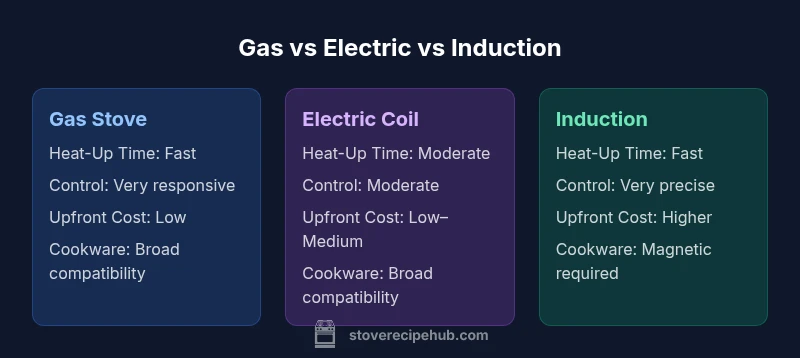
| Feature | Gas Stove | Electric Coil | Induction Stove |
|---|---|---|---|
| Heat-Up Time | Fast | Moderate | Fast |
| Heat Control Precision | Very responsive | Moderate response | Very precise and instant |
| Energy Efficiency | Low to moderate | Moderate | High |
| Cookware and Maintenance | Compatible with most cookware; routine cleaning | Works with most cookware; simple cleaning | Requires magnetic cookware; easy surface cleaning |
| Upfront Cost | Low | Medium | High |
| Safety Features | Open flame; basic safety devices | No flame; electrical safety concerns | No flame; advanced safety with surface-cooling |
| Best For | High-heat searing, budget-friendly setups | Everyday cooking on a budget | Precision cooking, energy efficiency |
Upsides
- Induction offers no open flame and cool-to-touch surface for safer operation
- Induction delivers rapid, precise heat control and easier cleanup
- Gas provides exceptional heat for searing and wok-style cooking, with broad appliance availability
- Electric coils are typically the cheapest upfront and easiest to install
Downsides
- Induction requires compatible cookware and a robust electrical circuit
- Gas carries open-flame safety risks and requires ventilation
- Electric coils can heat unevenly and respond slowly compared to induction
Induction is the overall best choice for most homes, with gas as a strong alternative for high-heat performance.
Induction delivers safety, speed, and precision with practical cookware requirements. Gas remains ideal for high-heat cooking and budget-conscious buyers, while electric coils are a budget-friendly option but slower to respond. Your setting will determine the final pick.
Common Questions
What is the main difference between gas, electric, and induction stoves?
Gas uses an open flame and provides instant feedback for heat adjustments; electric coils heat indirectly with slower response; induction heats the pan directly using magnetic fields and offers fast, precise control. Each type has distinct cookware and installation needs.
Gas uses flames for heat, induction heats the pan with magnets and is very fast, electric coils heat more slowly. Your choice depends on cooking style and setup.
Is induction really safer than gas?
Yes, induction is generally safer because there is no open flame and the cooktop surface remains cooler to the touch. It reduces burn risks, though care with hot pots is still important.
Induction is safer overall since there’s no open flame and the surface stays cooler, but always handle hot cookware with care.
Can I use any pot on an induction stove?
Most induction stoves require magnetic cookware with flat bottoms. Pots that aren’t magnetic won’t heat. A simple magnet test can tell you if your cookware will work.
Induction needs magnetic cookware; test with a magnet to be sure your pots work.
Which stove is cheapest to operate over time?
Gas upfront costs are lower, but fuel prices and usage affect long-term costs. Induction is often more energy-efficient in everyday cooking, potentially reducing operating costs over time.
Gas is cheap upfront, induction saves energy over time, but actual costs depend on usage and local energy prices.
Do induction stoves require special cookware beyond magnetic pots?
Mainly magnetic cookware. Most stainless steel and cast iron work well. Non-magnetic aluminum or copper-based pans typically won’t heat unless they have a magnetic layer.
Induction needs magnetic cookware; most stainless steel and cast iron are fine.
What installation considerations matter for a stove upgrade?
Induction requires a strong electrical circuit (often 240V) and proper wiring. Gas stoves require venting and gas line checks. Electric coils usually fit standard electrical outlets but may still need ventilation considerations.
Induction needs a solid electrical setup; gas needs venting. Electric coils are generally straightforward but ensure proper ventilation.
Top Takeaways
- Prioritize induction if safety and efficiency matter most
- Gas is best for high-heat searing and wok cooking
- Check cookware compatibility for induction before buying
- Consider electrical upgrades and ventilation in your decision