Range vs Stove vs Oven: Which Cooking Setup Is Right for You?
Explore the differences between range, stove, and oven setups. This practical guide from Stove Recipe Hub helps home cooks choose the best stove-top and baking configuration for small spaces, flexibility, and long-term maintenance.


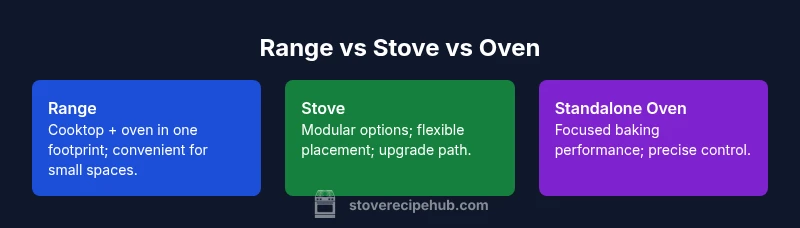
At a glance, a range combines a cooktop and an oven in one appliance, while a standalone stove or oven emphasizes modular layout. In practical terms, the range is convenient for compact kitchens with limited space, the stove (as a cooktop or standalone unit) offers flexible placement, and the oven focuses on baking performance. According to Stove Recipe Hub, your choice should hinge on kitchen space, cooking style, and maintenance preferences.
What range, stove, and oven actually mean
In everyday kitchen talk, people use “range,” “stove,” and “oven” as if they describe three distinct products. In practical terms, a range is a single, freestanding appliance that combines a cooktop (gas burners or electric coils) with an oven beneath. A stove, on the other hand, is a term that can refer to either a standalone unit with a cooktop or, less precisely, to a range in casual speech. An oven is a dedicated baking and roasting chamber, which can be part of a range or a separate wall- or counter-mounted unit. Understanding these distinctions helps you map your cooking patterns to a layout that fits your kitchen and your budget. For many homes, the choice hinges on whether you want everything in one footprint or prefer modular components you can upgrade over time. This section will walk through the functional differences, so you can interpret product specs with clarity.
Core criteria for choosing among them
Choosing between a range, stove, or standalone oven should start with your space and your cooking priorities. Space constraints drive whether you need an all-in-one footprint or can accommodate modular pieces. Your typical meal patterns matter too: do you bake weekly, roast monthly, or rely on high-heat searing? Utilities and ventilation influence feasibility—gas lines, electrical circuits, and hood sizing all play a role. Durability and repairability are practical concerns as well; a single, well-supported range can simplify maintenance, while modular components allow upgrades without replacing the entire system. Finally, consider resale value and long-term comfort in use. This section links these practical factors to real-world outcomes, helping you align the setup with how you actually cook.
How each setup performs in common tasks
The range shines when you want everything in one footprint: bubbling sauces on the cooktop while a roast or sheet pan bakes in the oven, all under synchronized control. A standalone oven, whether wall-mounted or freestanding, can excel at baking precision and even heat distribution, especially with modern convection models. A stove unit—whether it’s a separate cooktop or an integrated module—offers layout flexibility, allowing you to place the heat source where it makes the most sense in your kitchen workflow. In real use, consider how you manage heat, pan sizes, and ventilation: a range with a capable hood tends to be the most efficient all-around, while a modular setup can be tailored to specific rooms or design schemes.
Installation, space, and utility considerations
Installation considerations are often invisible until you start planning a kitchen remodel. Gas ranges require proper venting and gas supply, while electric ranges depend on circuit capacity and dedicated outlets. A standalone wall oven may demand a separate cabinet and dedicated ventilation, making a modular approach attractive in small kitchens. Clearances around the cooktop and oven influence performance and safety; inadequate ventilation can degrade cooking quality and create moisture or odor buildup. If you’re upgrading from an existing setup, consider whether you’ll need new cabinetry, rewiring, or vent hood upgrades. A professional installer can help assess your space, ensure code compliance, and optimize the layout for your cooking habits.
Cost considerations and maintenance expectations
Cost is a major driver, but it’s not the only factor. A single-range unit can be more affordable upfront than purchasing separate components, but replacement parts and repairs may be more complex for integrated systems. Modular configurations can offer lower replacement costs for damaged components and easier upgrades, though the initial setup might be more expensive or require more space. Maintenance habits differ as well: ranges integrate controls and burners into one chassis, while modular setups distribute wear across pieces, potentially simplifying service. Budget for regular cleaning, especially around burner ports, oven seals, and venting components, to sustain performance over time.
Real-world usage scenarios and best-fit recipes
For households that cook a lot in one go—searing steaks on the cooktop while roasting vegetables in the oven—a range often delivers the best balance of convenience and versatility. If your kitchen design emphasizes open sightlines and flexible room usage, a modular stove layout (cooktop plus separate wall oven) can maximize layout efficiency while preserving storage and countertop space. In baking-heavy households, a dedicated standalone oven with advanced convection and precise temperature control may outperform a traditional range on even heat distribution. Your preferred cooking repertoire and how you prioritize space will guide the final choice.
Myths and misconceptions
One common myth is that ranges are always cheaper than separate components; in reality, total cost depends on model features and installation complexity. Another misconception is that gas is inherently faster or safer than electric; both fuel types have safety considerations and performance differences that depend on design and ventilation. A third myth is that standalone ovens cannot be integrated into a small kitchen; clever layouts and wall-oven configurations can yield strong saving in space when planned carefully. Distinguishing fact from fiction helps you avoid overpaying for features you don’t need and missing opportunities for a better fit.
Evaluation checklist: questions to ask when shopping
- What is my primary cooking style (baking, roasting, high-heat searing)?
- Do I want everything in one unit or prefer modular components for future upgrades?
- What are the available utility connections in my kitchen (gas lines, 240V circuits, ventilation)?
- How important is convection in baking and roasting, and does the oven support it?
- What are the safety and maintenance requirements for each configuration?
- How will the footprint fit with my cabinets and hood system?
- What is the expected replacement cycle for major components (cooktop vs oven module)?
- What is my budget and potential long-term energy costs?
These questions help you compare like for like and avoid over-indexing on aesthetics alone.
Upgrading paths and long-term considerations
If you’re planning a future remodel or anticipate changes in family size or cooking style, consider how easy it will be to upgrade. A modular stove setup offers flexibility to swap out a damaged or outdated cooktop or oven without replacing the entire unit, while a range often provides a streamlined upgrade path with fewer moving parts to manage. Think about resale value, warranty coverage, and the availability of service in your area. Also consider how a future kitchen redesign might affect ventilation, electrical load, and gas-draft requirements. Planning with these possibilities in mind can protect your investment and keep your kitchen adaptable as your needs evolve.
Feature Comparison
| Feature | Range (cooktop + oven) | Stove (standalone cooktop/oven module) | Standalone Oven |
|---|---|---|---|
| Fuel Type | Gas or electric | Gas or electric | Gas or electric |
| Installation Footprint | One unit in a single cabinet | Modular layout with separate components | Single standalone baking unit |
| Cooking Versatility | All-in-one cooking with bake/broil | Flexibility in placement; may require separate oven to bake | Dedicated baking performance with controlled heat |
| Maintenance/Repair | Unified service; common parts | Modular repairs; replace only faulty module | Repair only oven; depends on model |
| Energy Efficiency | Depends on model and fuel choice | Depends on modules; varied efficiency | Typically efficient for baking when convection present |
| Best For | Compact kitchens; all-in-one setup | Flexible layouts; upgrade components | Focused baking performance |
Upsides
- All-in-one convenience with one installation
- Potential cost savings vs separate appliances
- Streamlined controls and maintenance for integrated units
- Maximized use of kitchen space when arranged compactly
Downsides
- Less flexibility to upgrade components individually
- Potential higher repair costs for a single unit
- Can limit design customization if you want a larger oven or specialty cooktop
Range generally wins on convenience; standalone ovens excel in baking precision; modular stove setups win when layout flexibility matters.
Choose range for all-in-one footprint and simple maintenance. Choose standalone oven if baking precision and separate control are priorities. Choose modular stove when your kitchen layout demands flexible placement and future upgrades.
Common Questions
What is the main difference between a range and an oven?
A range includes a cooktop and an oven in one unit, while an oven is a standalone baking appliance that can be part of a range or installed separately. The choice affects layout, venting needs, and how you manage heat across tasks.
A range combines heat on top with baking below; an oven is a standalone baking unit that can stand alone or be part of a range.
Is a range better for small kitchens?
Ranges save footprint by combining functions in one unit, which can be beneficial in tight spaces. If layout flexibility and future upgrades are important, a modular stove and wall oven might be preferable.
Ranges save space in small kitchens, but modular setups offer layout flexibility as your space changes.
Can I upgrade from a stove to a range later?
Yes, this upgrade is possible, but you may need cabinet adjustments, ventilation changes, and gas or electrical rewiring. A professional installer can help plan a smooth transition.
Upgrading is possible with some adjustments; consult a pro for a smooth transition.
Do ranges use more energy than separate units?
Energy use depends on model and fuel type. A modern convection oven paired with an efficient cooktop can be competitive with separate units, so compare energy ratings rather than assumptions.
Energy efficiency varies by model; compare ratings rather than assuming one setup is always better.
What maintenance is required for ranges vs ovens?
Regular cleaning of burners or heating elements, oven seals, racks, and venting is essential. Ranges may require integrated maintenance, while modular ovens can simplify service by component.
Keep burners clean, check seals, and keep vents clear for best performance.
Are gas ranges safer than electric ranges?
Both can be safe when installed correctly. Gas requires proper ventilation and leak monitoring; electric avoids flame risk but depends on electrical safety. Follow manufacturer guidelines and keep vents clear.
Both can be safe with proper installation and ongoing maintenance.
Top Takeaways
- Define your kitchen space before choosing an setup
- Prioritize all-in-one vs modular based on cooking style
- Evaluate maintenance implications and future upgrades
- Consider ventilation and utility compatibility
- Ask for a clear comparison of fuel type and energy use