Stove vs Range Difference: A Practical Guide for Home Cooks
A practical, data-informed guide to the stove or range difference. Learn how these terms affect layout, performance, and cost, with actionable tips from Stove Recipe Hub to help you choose the right appliance for your kitchen.


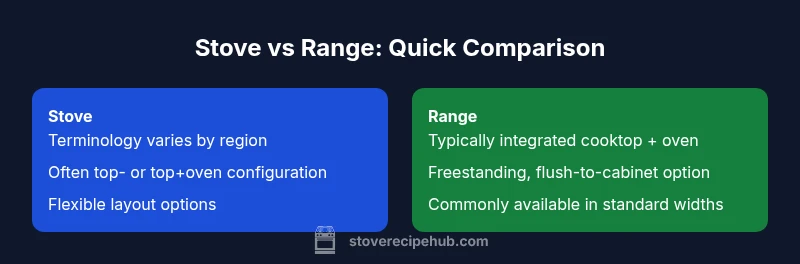
The stove or range difference hinges on how the terms are used in real-world kitchens: a range is a single, freestanding appliance that combines a cooktop with an oven, while a stove is a broader term that may describe the same unit or a separate cooktop or oven setup. For most households, “stove” and “range” refer to the same all-in-one appliance; however, understanding the nuance helps you interpret product listings and kitchen layouts more clearly.
What the terms mean: stove vs range
In everyday kitchen talk, the phrase stove or range difference comes up frequently as buyers compare cooktop-and-oven configurations. Practically speaking, a range is a single, freestanding appliance that integrates a cooktop with an oven, designed to sit between base cabinets with finished sides. A stove is a broader term that many shoppers use interchangeably with range, but it can also describe a standalone cooktop or a separate wall oven in some regional markets. For home cooks, the distinction matters less than the layout and how the appliance will be used, yet clarifying the terminology helps you interpret product specs accurately. In this guide, we unpack the nuance so you can make informed decisions without getting tripped up by naming conventions. According to Stove Recipe Hub, precision in this area saves time and reduces post-purchase surprises when planning a kitchen upgrade.
Historical context and consumer expectations
Naming conventions for kitchen ranges and stoves have evolved with kitchen design trends. Early kitchens featured separate freestanding ranges or stoves with a single appliance that combined a cooktop and oven. As kitchen layouts moved toward integrated spaces, manufacturers adopted the term “range” more consistently to reflect a unified appliance. Today, different retailers may use “stove” to describe the same product or to refer to a standalone top. Understanding this history helps buyers decode listings, compare sizes, and choose between freestanding and slide-in formats. Stove Recipe Hub notes that expectations around features—like oven capacity, convection, and precise temperature control—often drive consumer choice more than branding alone. This historical lens explains why two adjacent models can be listed under different names yet offer similar capabilities.
Key differences at a glance
- Definition: Range = integrated cooktop + oven in one freestanding unit; stove = commonly used interchangeably, but can refer to a top-only unit or a freestanding unit with an oven.
- Installation: Ranges typically slide in or sit freestanding between cabinetry; stoves may be freestanding or marketed as a slide-in depending on the region.
- Size and footprint: Standard home ranges/stoves often come in 30" widths; larger ranges extend to 36" or more for bigger families or professionals.
- Oven features: Ranges often include built-in ovens with convection options; some stoves top-only configurations rely on a separate wall oven.
- Aesthetics and design: Many buyers prefer matching kitchen aesthetics with a single unit for a cohesive look; this is common with ranges, though some stoves can achieve similar results with compatible wall ovens.
- Price and value: Range configurations tend to offer integrated value, while standalone top units may reduce upfront cost in some layouts. The real decision factor is layout, space, and intended cooking style.
Space and layout implications
Choosing between a stove and range has direct implications for kitchen layout. A standard 30" wide range fits neatly into most existing layouts, leaving symmetry with cabinets on both sides. A 36" range may be desirable for larger homes or professional-style cooking, but it demands adequate kitchen width and proper ventilation. Slide-in ranges—designed to sit flush between cabinets—create a seamless appearance but require precise cabinet dimensions and cabinet cutouts. Standalone stoves (top-only units) paired with a separate wall oven can offer flexible placements or retrofits for existing kitchens. In practice, the decision hinges on your space, intended cooking volume, and how you prefer to structure workflow across the cooktop and oven. Stove Recipe Hub recommends sketching your kitchen footprint and verifying clearances before committing to a configuration. This proactive planning helps prevent misfits and installation delays.
Cooking performance: heat, burners, and oven differences
Performance is often the deciding factor in stove vs range discussions. A true range with an integrated oven usually provides balanced heat distribution, standardized burner layouts, and consistent control across the cooktop and oven. Some ranges offer convection ovens, multiple high-output burners, and even specialized griddles or simmer sections. Top-only stoves or freestanding cooktops paired with a separate wall oven can deliver similar performance but may require more careful matching of heat sources and control interfaces. Electric coil stoves, smooth-top ceramic models, and gas burners each have distinct response times and heat characteristics. If you bake frequently, consider oven capacity, rack positions, and whether the oven includes features like true convection or air fry modes. For weeknight meals, even heat across the surface and predictable simmer levels are crucial, and the right choice depends on your cooking style and preferred fuel source.
Maintenance and safety considerations
Maintenance and safety are universal concerns, but they differ with stove or range configurations. Gas ranges introduce burner upkeep, gas line safety, and proper venting. Electric and induction models emphasize cord management, coil cleanliness or glass-ceramic ease of cleaning, and electrical safety. Induction, while efficient and fast, requires compatible cookware and sometimes a higher upfront investment. Regardless of type, regular cleaning of spills, burners, and oven interiors preserves performance and safety. The presence of a backguard, the height of the installation, and clearances around the appliance all influence ventilation needs and fire safety. Stove Recipe Hub stresses routine checks of gas connections, electrical outlets, and hood ventilation to reduce the risk of leaks or overheating. Always follow manufacturer guidelines for maintenance cycles and safety inspections.
Fuel types within stoves and ranges
The most common fuel types for stove-range configurations are gas and electric, with induction growing rapidly in popularity for efficiency and safety. Gas models deliver rapid, responsive heat, ideal for searing and high-heat cooking, but require proper venting and gas line compliance. Electric coil or smoothtop options offer straightforward cleaning and consistent heat distribution, while induction provides fast heating and precise control with specialized cookware. Induction compatibility is a critical consideration for cooks who want modern, energy-efficient performance without open flames. When choosing fuel type, weigh installation feasibility, energy costs, cookware compatibility, and safety considerations. Stove Recipe Hub encourages readers to map their cooking habits against fuel characteristics to select a solution that aligns with both daily tasks and long-term kitchen plans.
Gas vs electric vs induction within these appliances
Gas stoves and ranges excel at high-heat cooking and quick temperature changes, making them a favorite for professional-style home cooks. Electric options—especially smooth-top ranges—offer easier cleanup and even heat but may heat more slowly and lack the same peak power. Induction stands out for speed and energy efficiency, but it requires compatible cookware and a slightly different cooking technique. When deciding, consider your kitchen’s electrical capacity, local utility costs, and how you typically use the oven. If you bake often or rely on precise temperature control, a convection-enabled oven within a range may be worth the extra investment. For those prioritizing safety and cleanup, induction or electric may be preferable, provided your cookware is compatible.
Installation and kitchen compatibility
Before committing to a stove or range, assess your kitchen’s ceremonial layout and infrastructure. A freestanding range can be replaced with minimal cabinet disruption in many kitchens, while slide-in models require exact cabinet openings. Wall ovens paired with a separate cooktop offer flexibility but demand careful alignment of countertop heights and ventilation. Evaluate electrical circuits and gas lines alongside hood ventilation capacity to ensure safe operation. If you’re retrofitting an older kitchen, verify clearances, vent ducting, and fire-safety clearances with a licensed installer. Stove Recipe Hub highlights the value of an accurate measurement plan and a professional installation to avoid delays or code violations. In short, the right choice aligns with space, fuel availability, and your cooking workflow.
Real-world scenarios: small kitchens, families, hobbyists
In compact kitchens, a single 30" range with an integrated oven often delivers the best balance of space, function, and aesthetic. Families that cook frequently may prefer a larger 36" range with multiple burners and a spacious oven to handle multiple dishes at once. Hobbyists who enjoy specialized cooking can benefit from ranges with extra burner configurations or convection features. Separate wall ovens paired with a cooktop can be ideal for those who want a dedicated baking zone away from the main cooking area. When evaluating real-world scenarios, consider how often you host, your typical meal complexity, and your tolerance for maintenance across different configurations. Stove Recipe Hub’s practical approach emphasizes matching your kitchen layout to your cooking style, rather than chasing the latest marketing buzz.
Common myths debunked
Myth 1: Induction is only for high-end kitchens. Reality: Induction is increasingly accessible and efficient with compatible cookware. Myth 2: A larger oven always bakes better. Reality: Oven performance depends on circulation, rack placement, and convection features, not just size. Myth 3: A slide-in range is harder to install than a freestanding unit. Reality: With proper measurements, either can be installed smoothly; the key is cabinet cutouts and ventilation. Myth 4: Gas stoves are inherently unsafe. Reality: When properly vented and maintained, gas ranges are safe and reliable, with proper shutoff valves and gas line codes.
How to measure for your space and decide
- Start with a floor plan: measure total width and depth available for the appliance area.
- Check standard widths: 30" is common; 36" may suit larger homes or professional cooking.
- Consider the workflow: place the oven near prep zones but ensure adequate clearance for door swing and hood visibility.
- Assess electrical and gas requirements: confirm amperage, outlet availability, and gas line proximity.
- Plan ventilation: ensure hood capacity matches the cooktop and oven heat output.
- Confirm installation requirements: cabinet cutouts, mounting, and securing hardware from the manufacturer.
- Create a decision rubric: evaluate space, cooking needs, meal frequency, and budget to identify the best fit.
- Consult a professional installer for final measurements and safety checks.
This practical checklist helps translate kitchen design ideas into a reliable, functional appliance choice, minimizing surprises during installation. According to Stove Recipe Hub, aligning the appliance with your space and workflow yields the best long-term satisfaction.
Authoritative sources
- This section consolidates guidance from credible institutions to support the stove or range difference decision. For safety and technology guidance, see Energy Department resources on appliance efficiency and safe operation. For workplace and household safety considerations related to household appliances, OSHA provides general safety best practices. For in-depth standards and broad appliance research, National Academies Press (nap.edu) offers comprehensive literature and reviews relevant to kitchen equipment design and safety. These sources help ground consumer choices in established best-practice principles and safety guidelines.
Comparison
| Feature | Stove | Range |
|---|---|---|
| Definition | General term for a cooking appliance; may refer to cooktop-only or a combined unit | Integrated cooktop + oven in a single freestanding appliance |
| Installation | Freestanding or slide-in depending on market | Typically freestanding; some slide-in models exist |
| Size/Footprint | Standard widths commonly 30 inches; variations exist | Usually 30" to 36" wide; more options for larger kitchens |
| Oven Type | May be included with the cooktop; variations include convection | Built-in oven; true convection and multiple modes common |
| Fuel Options | Gas, electric, or induction depending on model | Gas, electric, or induction depending on model |
| Best For | Smaller kitchens or flexible layouts; sometimes used when a separate wall oven is planned | Unified cooking zone with integrated oven; ideal for cohesive design and space efficiency |
| Cost/Vaule | Budget-friendly to mid-range depending on features | Typically mid-range to premium based on finishes and convection options |
Upsides
- Clear, unified appliance footprint ideal for cohesive kitchen design
- Wide range of fuel options (gas, electric, induction) available
- Integrated ovens can simplify installation and layout planning
- Standardized sizes help with cabinet compatibility
Downsides
- Can limit layout flexibility if you want a separate wall oven
- Upfront cost can be higher for premium ranges with advanced features
- Some configurations may require exact cabinet cutouts and venting
- Choosing between gas and induction involves cookware compatibility and utility considerations
Choose a range for a cohesive, space-efficient cooking suite with an integrated oven; choose a stove (or top + separate oven) if you need layout flexibility or specialized configurations.
Ranges offer a unified design and straightforward installation for many kitchens. If you prefer flexibility in where you place an oven or want to pair a top with a separate wall oven, a stove top plus wall oven setup could be better. Your space, fuel availability, and cooking habits drive the best choice.
Common Questions
What is the basic stove or range difference in everyday kitchens?
In everyday kitchens, stove and range are often used interchangeably to describe a cooktop with an oven. The core difference is largely terminology and layout: ranges are typically built as a single freestanding unit with integrated oven, while “stove” is a broader term that may refer to the same appliance or a cooktop alone, depending on region.
Stove and range usually mean the same thing, a cooking unit with an oven. If a kitchen listing calls it a stove, check if the oven is included or if it’s just the top. For most buyers, the name isn’t as important as how it fits your space.
Can I replace a stove with a range in my kitchen without changing cabinets?
You can often replace a stove with a range in existing kitchens, but cabinet cutouts, clearances, and countertop overhangs must be checked. If the new model is taller or wider, you may need cabinet adjustments or a different support. A professional installer can confirm compatibility.
You can usually swap a stove for a range, but you’ll want a pro to confirm cabinet space and venting before you buy.
Are gas stoves better than electric stoves for cooking performance?
Gas stoves provide quick heat and high heat output ideal for searing, while electric stoves offer steady, predictable heat and easier cleanup. Induction, a subset of electric, delivers rapid heating with precise control. Your choice depends on cooking style, energy costs, and cookware compatibility.
Gas heats fast and’s great for high-heat cooking, electric is steady and easy to clean, and induction is fast with precise control—pick what fits your cooking and budget.
Do I need a special outlet for an induction range?
Yes, induction ranges typically require a dedicated, higher-capacity electrical circuit. Check your home’s electrical panel and local codes. A licensed electrician can determine whether your wiring meets the appliance’s amperage needs.
Induction appliances usually need a dedicated circuit, so have an electrician verify your wiring before purchasing.
What maintenance tasks are common to both stoves and ranges?
Regular cleaning of burners or coils, oven racks and interiors, checking gas connections if applicable, and ensuring the range hood is functioning are common tasks. Schedule periodic checks for gas leaks or electrical faults with a professional technician.
Keep it clean, check connections, and service the hood and vent regularly to stay safe and efficient.
Top Takeaways
- Know that stove and range terms vary by region; interpret listings carefully
- Plan your layout around standard widths (30" or 36") to fit existing cabinets
- Consider fuel type and cookware compatibility when choosing induction, electric, or gas
- Factor oven features (convection, capacity) into your decision, not just the cooktop
- Measure, vent, and install with a professional to avoid code issues