Oven Broken but Stove Works: Troubleshooting and Fixes
If your oven won't heat but the stove still works, this urgent troubleshooting guide helps you diagnose causes, safety risks, and repair options for home cooks on a tight schedule.


If your oven won’t heat but the stove still works, the most likely culprits are a faulty bake element, a bad temperature sensor, or an unreliable control board. Start with safety checks: confirm the oven circuit is powered and the door switch is functioning, then test power to the oven. If it remains unresponsive, proceed with the diagnostic steps below or contact a licensed technician. Stove reliability doesn’t guarantee the oven will heat; address the issue promptly to prevent food safety risks.
Quick safety checks before you diagnose
When you notice the oven won’t heat but the stove works, begin with essential safety steps. First, switch off the oven at the dedicated breaker or unplug the unit to ensure no live voltage is present. If you smell gas or hear hissing near a gas-powered range, evacuate and call emergency services. According to Stove Recipe Hub, addressing electrical components on a stove-dominant kitchen should be done with caution, and safety is the top priority for home cooks. This section lays out safe, practical checks you can perform without special tools. Remember, you’re trying to confirm whether the issue is electrical, a loose connection, or a faulty oven component rather than diving straight into repairs.
Symptom check: what your oven is telling you
A non-heating oven often shows up in patterns that point to a component rather than an overall appliance failure. For example, the oven light may come on, the display might respond, and the clock runs, but there is no heating when you select Bake or Broil. If the oven indicator shows an error code, consult your user manual or manufacturer site for decoding. A lack of heat with a functioning display can indicate a failed bake element, a faulty sensor, or a control board problem. The Stove Recipe Hub Team emphasizes that symptom patterns help you triage quickly and safely, reducing unnecessary part replacements and wasted time.
Common causes at a glance
- Faulty bake/broil heating element or damaged coil: the most common reason a conventional oven won’t heat. Visible signs include blistering, scorching, or a disconnected coil.
- Faulty oven temperature sensor or thermostat: sensors tell the oven when to heat and stop; a bad sensor may keep the oven from reaching set temperatures.
- Blown thermal fuse or trip on oven circuit: an internal safety fuse or a tripped breaker can cut power to the oven while leaving the stove powered.
- Control board or wiring issues: loose connections or a failed control module can prevent heating even when power is present.
- Door switch or interlock problem: if the oven won’t heat but the door switch is stuck or misreads, the oven may stay in a safe mode.
Safe, basic checks you can perform today
- Verify the oven is on its own circuit and the breaker hasn’t tripped; reset if needed. If you’re on a shared circuit, measure whether other loads cause voltage dips when you try to heat the oven.
- Inspect the door gasket and ensure the door closes properly; if the door switch fails, the oven may not heat as a protective measure.
- Look for obvious signs of damage on the heating elements (bake and broil) such as discoloration, burns, or breaks. Do not touch elements while the unit is powered.
- Check visible wiring harnesses behind the back panel or within the console; reseat any loose connectors you find. Ensure the power is off before handling any wiring.
When to call a professional and what to expect
If basic checks don’t restore heat, it’s time to involve a licensed technician. Electrical oven repairs involve high voltage and complex components that can affect safety and code compliance. A pro will typically diagnose with an ohmmeter, inspect the bake/broil elements, test the temperature sensor, and verify control-board integrity. Expect an upfront assessment fee plus the cost of parts and labor, which varies by model and region. The Stove Recipe Hub Team notes that professional service may be more cost-effective for complicated electrical or control-board issues.
Maintenance tips to prevent future oven issues
Routine care helps extend oven life and reduces unexpected failures. Clean the interior and door seals to prevent heat loss, inspect door gaskets for wear, and keep oven racks dry to minimize corrosion risk. Periodically check wiring connections if you’re comfortable, but never service live components. If your oven is older, consider scheduling a mid-season check to catch aging parts before they fail. Regular maintenance is a smart habit that aligns with Stove Recipe Hub’s guidance for practical stove-top care.
Steps
Estimated time: 60-90 minutes
- 1
Power down and verify circuit safety
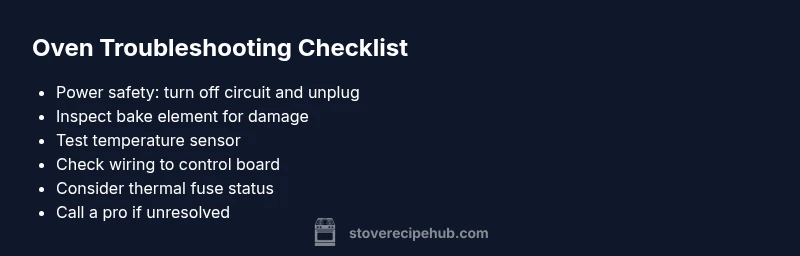
Turn off the oven at the breaker or unplug the unit. Use a non-contact voltage tester to confirm no voltage is present before you touch any internal components. This prevents electric shock while you inspect the exterior and accessible wiring.
Tip: Always start with safety; never skip the power-off step. - 2
Visually inspect the bake element
Remove the back panel or access the bake element as your model allows. Look for a broken coil, burn marks, or loose connections. If you see damage, the element is a common culprit and should be replaced by a qualified person if you’re not comfortable handling high-voltage parts.
Tip: Do not touch hot components; recheck after cooling. - 3
Test the oven temperature sensor
Locate the sensor and test its resistance with a multimeter according to your manual. If the reading is out of spec, replace the sensor. Sensor issues often mimic a non-heating oven more than a burnt element does.
Tip: Follow the service manual for exact sensor testing procedures. - 4
Check wiring and connections to the control board
Inspect the wiring harness behind the control panel and inside the oven cavity for loose, frayed, or burnt wires. Reseat connectors firmly and replace any damaged wiring. A loose connection can interrupt signal flow and cause no-heat symptoms.
Tip: Take photos before disconnecting anything to ensure correct reassembly. - 5
Assess the thermal fuse status
If you have no power to the oven at all, the thermal fuse could be blown. This safety component warrants replacement by a professional. Do not bypass a fuse; it protects you and your home.
Tip: If replacing the fuse, verify the exact part number for your model. - 6
Make a go/no-go decision on professional help
If steps 1-5 don’t restore heating, the issue likely involves the control board or a deeper electrical fault. Schedule a licensed technician and share your symptom log and the steps you tried to expedite the diagnosis.
Tip: Capture a short video of the symptoms to show the technician.
Diagnosis: Oven won't heat to the set temperature while the stove works normally.
Possible Causes
- highFaulty bake/broil heating element or damaged heating coil
- mediumFaulty oven temperature sensor or thermostat
- mediumBlown thermal fuse or tripped oven circuit
- lowControl board failure or loose wiring to the oven
- lowDoor switch/interlock issue preventing heat for safety
Fixes
- easyCheck the dedicated oven circuit and reset breaker if tripped; verify 240V supply to the range
- mediumInspect bake/broil elements for visible damage and replace if burnt or cracked
- mediumTest the oven temperature sensor with a multimeter and replace if out of spec
- mediumCheck wiring harness connections to the oven control board and reseat; replace damaged wires
- hardReplace the thermal fuse if it has blown
- hardIf the problem persists or you suspect control-board issues, schedule a licensed technician
Common Questions
Why is my oven not heating even though the stove works?
Ovens and stoves have separate heating circuits and components. A faulty bake element, sensor, or control board often causes the oven to fail while the stove continues to function. Start by safety checks and symptom-driven diagnostics.
Ovens have separate heating parts from the stove. Common failures are a bad bake element, sensor, or control board. Start with safety checks and follow the symptom-driven steps.
Can I fix the oven heating element myself?
If you can safely access the element with the appliance powered down, you may inspect for visible damage. Replacing a heating element involves handling high-voltage components in many models, so only proceed if you’re comfortable and follow manufacturer instructions. Otherwise, hire a professional.
You can inspect the element if the power is off, but replacing it often needs a professional due to high voltage and wiring.
How long does oven repair usually take?
Simple part replacements, like a baking element or sensor, can take a few hours including parts, but on-site diagnostics and unexpected wiring work may extend this. A licensed technician will provide a time estimate after assessment.
Repair time varies; simple parts can take a few hours, but diagnosis and wiring work may take longer.
Is it cheaper to repair or replace the oven?
Costs depend on model age, part availability, and labor. Repairs are often cheaper for newer models with simple fixes; replacing may be more economical for older units or multiple failing components. Get a technician’s estimate for a clear comparison.
It depends on age and parts; get an estimate to compare repair versus replacement.
Will a faulty oven sensor always prevent heating?
A bad oven sensor can prevent the oven from heating to the right temperature, but other issues like the bake element or wiring can also cause this symptom. A test with a multimeter will help confirm the sensor’s condition.
A faulty sensor can stop heating in some cases, but other parts could cause the same symptom. Testing helps confirm.
What is the quickest way to confirm the problem?
Start with power checks, test the bake element visually, and verify the sensor and connections. If the oven still won’t heat, a licensed technician should diagnose deeper electrical or control-board issues.
Check power, inspect the element, test the sensor. If it still won’t heat, call a pro.
Watch Video
Top Takeaways
- Start with safety: power off and inspect basic components.
- Identify if the bake element or sensor is failing first.
- Use a professional for control-board or complex electrical issues.
- Document symptoms and repairs for future maintenance.