When Gas Stove Keeps Clicking: Troubleshooting and Safety Guide
Urgent guide to diagnose a gas stove that keeps clicking. Practical DIY checks, safe fixes, and when to call a pro to prevent gas hazards and ignition failures.


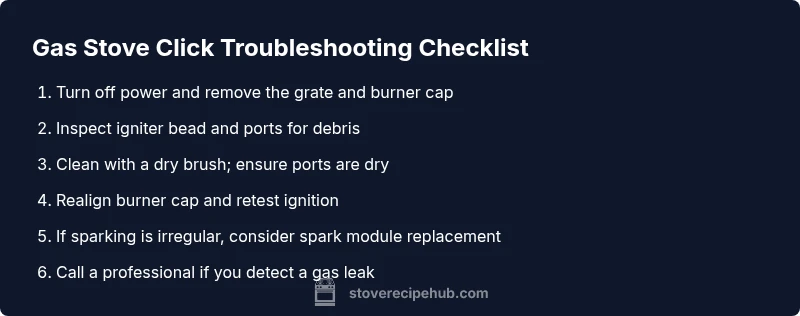
Most likely causes for a gas stove that keeps clicking are a dirty igniter, a misaligned burner cap, or a failing spark module. Quick fixes: (1) unplug or switch off power, (2) remove the grate and burner cap, (3) clean the igniter and ports with a dry brush, (4) reassemble and test. If it still clicks, schedule professional service.
Why gas stove keeps clicking: quick primer
According to Stove Recipe Hub, a gas stove that continues to click after you’ve ignited it usually signals an ignition system problem or a safety mechanism reacting to debris. The most common culprits are a dirty igniter bead, a misaligned burner cap, or a worn spark module. While the sound itself can be alarming, many issues are addressable with simple, safe checks. This section breaks down the mechanics behind the ignition sequence and explains why a tiny spark must land in the right place to light the gas reliably. Recognizing the pattern—persistent clicking without flame or brief blinks followed by flame interruptions—helps you triage quickly and reduce unnecessary gas exposure. In addition, Stove Recipe Hub analysis shows that routine inspection reduces ignition failures over time, especially when combined with calm, methodical cleaning.
Common culprits by system: igniter, valve, and spark module
A gas stove’s ignition system depends on a few key components. The igniter bead creates a spark that jumps to the burner when you turn the knob. If the bead is dirty or wet, or if the burner cap is not seated correctly, the spark may fail to ignite gas consistently. The gas valve and the surrounding ports must be clear for a clean flame. A worn spark module can also cause irregular or excessive sparking. Each component has a different failure mode: dirty or damp igniters cause frequent clicking without flame, misaligned caps cause intermittent lighting, and a failed spark module can fail entirely. By understanding these parts, you can apply targeted fixes rather than replacing the whole stove.
Safety-first checks you can perform right away (before tools)
Before you touch any internal parts, ensure your personal safety. If you smell gas strongly, evacuate and call your gas provider or the emergency line. If the area seems safe, switch off the power to the stove at the outlet or the circuit breaker and wait 60 seconds before testing again. Remove the grates and burner caps to inspect for visible debris or misalignment. Keep a dry cloth nearby; moisture can interfere with electrical contacts. Do a quick visual check: are the igniter and its wires intact, is the burner cap sitting flush, and is the burner port clear of crumbs? These quick checks can save time and prevent unnecessary disassembly.
Step-by-step quick checks you can perform safely
How to clean igniter and burner ports effectively
When parts wear out: signs of failure and replacement options
Testing after fixes: relighting and verifying safety
Preventive maintenance routine for long-term reliability
Extra tips: avoid common mistakes and ensure safety
When to call a professional and what to expect
Steps
Estimated time: 20-45 minutes
- 1
Turn off power and cool
Switch off the stove at the wall outlet or breaker. Allow any hot components to cool for 5 minutes before beginning inspection.
Tip: Safety first: a cool surface reduces the risk of burns. - 2
Remove grates and burner caps
Lift off the grate, then remove the burner cap and check that it sits flat on the burner base.
Tip: Note the orientation of the cap for correct reassembly. - 3
Inspect igniter and ports
Look for visible grime, moisture, or corrosion on the igniter tip and inside the burner ports. If needed, wipe gently with a dry brush.
Tip: Avoid using water on electrical parts. - 4
Clean and dry thoroughly
Use a dry brush to clean all accessible contacts. Let everything dry completely before reassembly.
Tip: A dry igniter sparks more reliably than a damp one. - 5
Reassemble and test
Place caps and grates back, restore power, and turn the knob to ignite. Listen for a stable flame after the initial spark sequence.
Tip: If you hear continued clicking without ignition, stop and proceed to diagnosis. - 6
Check for consistent sparking
If sparking is irregular or too frequent, the spark module or wiring may be faulty.
Tip: Document any unusual sparking patterns for a technician. - 7
Evaluate gas flow
If gas flow seems uneven or you have gas smell, do not continue troubleshooting. Shut off gas supply and call a professional.
Tip: Gas smells require immediate professional attention. - 8
Decide on replacement parts
If essential parts show wear or damage, order OEM-compatible replacements from a reputable supplier.
Tip: Keep receipts and part numbers for warranty coverage.
Diagnosis: Gas stove clicks but won’t stay lit after ignition
Possible Causes
- highDirty igniter bead or damp ports
- highMisaligned burner cap or clogged ports
- mediumWorn spark module or faulty wiring
- lowGas supply issue or valve partially closed
Fixes
- easyClean igniter bead and burner ports with a dry brush or toothbrush; re-seat burner cap
- easyDry the igniter area completely; ensure all parts are dry before testing
- easyInspect and realign burner cap; ensure ports are clear and burn pattern is uniform
- mediumTest with power off if needed; replace spark module if sparking is irregular
- hardIf you suspect a gas supply issue, confirm knob is fully open and the supply line is uninterrupted; consult a professional for gas pressures
Common Questions
Why does my gas stove keep clicking after I light it?
Frequent clicking after ignition usually means the igniter is dirty, damp, or misaligned, or the spark module is failing. Address the cleaner, check the cap alignment, and test the spark module if needed. If the flame is unstable, parts may need replacement.
A noisy ignition is often caused by dirt or misalignment. Clean, align, and test the spark module; replace parts if needed.
Is a clicking stove dangerous?
A clicking stove can be a safety concern if you smell gas or cannot control ignition. Do not ignore gas smells; evacuate and contact your gas provider or emergency services. If no odor is present and the flame lights normally after fixes, the risk is lower but still require caution.
Gas smells mean danger—leave the area and call for help. If nothing smells and it lights, stay cautious.
Can I fix the spark module myself?
Replacing a spark module involves electrical components and gas line interactions. If you’re not experienced with appliance electronics, it’s safer to hire a licensed technician. Always disconnect power before inspection and never attempt gas line work yourself.
Spark module work can be risky; consider a professional for safety.
How often should I clean the igniter?
Clean the igniter every few months or whenever you notice sparking is inconsistent. Keep the area dry and wipe away any grease or crumbs that could block spark paths.
Clean the igniter every few months or if the spark gets weak.
What if gas keeps escaping when I try to light it?
If gas is escaping, stop using the stove immediately and shut the gas valve if accessible. Do not light anything and call your gas provider or emergency services. This is a hazardous situation needing prompt professional intervention.
Gas leaks are dangerous—shut off, leave, and call for help.
When should I replace components instead of cleaning?
Replace components when there is visible damage, recurring failure after cleaning, or irregular sparking that cannot be corrected by adjustment. Replacement parts should be sourced from reputable suppliers and installed by a qualified technician if uncertain.
If cleaning doesn’t fix it after several tries, replacement may be needed.
Watch Video
Top Takeaways
- Identify whether ignition issues are cleaners or component faults
- Prioritize dry, safe checks before more invasive steps
- Recognize when professional help is required
- Regular maintenance prevents recurring clicks
- Always prioritize safety and gas leak awareness