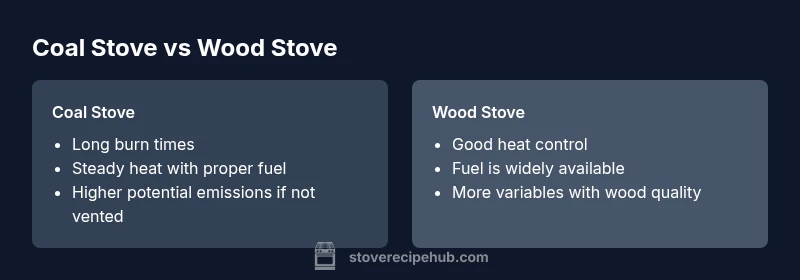
Coal Stove vs Wood Stove: An Objective Comparison
Explore a thorough, objective comparison of coal stove vs wood stove, covering heat, emissions, fuel costs, and maintenance to help homeowners choose the best option for climate, fuel access, and off-grid needs. Insights from Stove Recipe Hub, 2026.


When deciding between a coal stove and a wood stove, wood stoves generally offer cleaner emissions, broader fuel access, and easier maintenance for most homes. Coal stoves can deliver longer, steadier heat and better off-grid performance, but require specialized fuel, venting, and maintenance. The right choice depends on climate, fuel availability, and your tolerance for complexity.
Understanding the coal stove vs wood stove landscape
According to Stove Recipe Hub, the coal stove vs wood stove decision hinges on fuel logistics, venting, and climate. In practice, homeowners weigh heat stability, emissions, and maintenance. This guide compares both options side by side, focusing on real-world performance rather than marketing claims. Whether you live in a snowy region or rely on off-grid power, the choice should align with available fuel, space, and safety considerations.
Coal stoves and wood stoves share the goal of delivering reliable warmth with minimal fuss, but they approach that goal through different fuel cycles, burn characteristics, and maintenance rhythms. The right choice is rarely universal; it depends on local fuel supply, home heating needs, and willingness to manage a more or less complex venting system.
Fuel sources and availability
Fuel access is the first practical lens through which to view coal stove vs wood stove. Coal remains a common fuel in regions with established supply chains and industrial heating history, often ensuring long burn cycles and strong heat output when the stove is designed for it. Wood is by far the most ubiquitous fuel in many temperate regions, especially where forests or arborists provide a steady stream of logs and season wood. Availability, delivery logistics, and storage space strongly influence total cost and convenience. Stove design also matters: some models use pelletized coal or processed briquettes, while many wood stoves rely on seasoned firewood for reliable performance. The Stove Recipe Hub team notes that regional fuel ecosystems can tip the scales toward one option or the other.
Heat delivery, efficiency, and control
Heat delivery in coal stoves tends to be steadier over long burn periods when the stove and fuel are matched to the appliance design. Wood stoves offer excellent controllability with load-driven heat that can be dialed up or down, but performance depends on wood seasoning, moisture content, and chimney draft. Efficiency is highly model-dependent in both categories, and EPA-certified wood stoves can significantly improve clean burn performance. Operators should pay attention to flame behavior, ash management, and heat distribution across living spaces to minimize hotspots and cold pockets. The practical takeaway is: size the stove to your space and learn to modulate burn rate with the specific fuel you use.
Emissions, air quality, and safety
Emissions and indoor air quality differ meaningfully between coal and wood stoves. Without proper venting, coal stoves can produce higher particulates and sulfur compounds, particularly in areas with suboptimal chimney design. Wood stoves can also emit particulates if used with damp wood or an underperforming flue; however, modern, EPA-certified models with good draft control and sealed fireboxes tend to emit less smoke than older designs. Safety concerns revolve around chimney integrity, creosote buildup, and fire risk. Regular inspection, proper fuel selection, and routine maintenance are essential for both fuels.
Operating costs and long-term economics
Cost considerations hinge on locally available fuels, maintenance, and the stove’s efficiency. Coal prices vary widely by region and season, while wood costs depend on supply and extraction costs. In some regions, coal can offer lower upfront burn costs but higher maintenance and ventilation requirements. Wood, when sourced locally and seasoned properly, can be cheaper over time, especially if you can harvest or purchase in bulk. In all cases, long-term economics improve when you select a well-insulated home, a properly sized stove, and a clean-burning model.
Maintenance, installation, and space considerations
Both coal and wood stoves demand a robust installation with proper clearances to combustibles and an appropriately sized venting system. Coal stoves often require sturdier hearths and a reliable chimney system to manage creosote and sulfur residues, while wood stoves require regular ash disposal and chimney inspections. Space planning should account for heat distribution, the location of combustibles, and the potential for draft-related issues. If you have limited space, consider models with compact footprints and integrated ash pans. Regardless of fuel, a routine maintenance schedule saves headaches and reduces risk.
Cooking implications and versatility on stoves
Cooking on stoves that are designed primarily for heating requires careful approach. Some coal and wood stoves offer dedicated cook surfaces or griddles, while others are strictly heating appliances. If cooking is a priority, prioritize a unit with a cooktop surface, adjustable griddles, or the option to attach a pot rack. Remember that cooking performance may vary with fuel moisture and burn rate, so test heat zones and adjust fuel quality to achieve the desired culinary results.
Climate suitability and regional guidance
Climate matters more than it might seem at first glance. In very cold regions with long heating seasons, long-burn stability and fuel availability can favor coal stoves. In milder climates or where seasonal fuel dynamics favor wood, wood stoves may deliver adequate warmth with easier access to local fuel. The best choice balances climate resilience, fuel logistics, and the willingness to manage the stove’s maintenance rhythm. Stove Recipe Hub emphasizes tailoring the decision to your specific climate data and fuel landscape.
Comparison
| Feature | coal stove | wood stove |
|---|---|---|
| Fuel type and availability | Coal; regional supply depends on infrastructure | Wood; widely available in many regions; seasonal pricing |
| Heat delivery and burn time | Long, steady burn when properly designed | Responsive burn with load-driven heat; highly variable by fuel quality |
| Emissions and air quality | Potentially higher particulates without good venting | Typically lower emissions with dry wood and proper venting (EPA-certified models common) |
| Maintenance and chimney care | Creosote risk; regular chimney inspection advised | Ash management and regular chimney cleaning needed |
| Installation and space | Heavier hearth requirements; stable venting needed | Often more flexible installation; standard chimney needs |
| Operating costs | Fuel price depends on region; long burn possible but variable | Wood can be inexpensive locally; price varies with supply |
| Best for | Off-grid reliability and very cold climates with steady heat | Cozy heating and cost-effective warmth in temperate regions |
Upsides
- Potential long burn times with coal when sized for sustained heat
- Wood stoves offer broad fuel access and lower fuel handling complexity in many regions
- Off-grid capability with proper venting and storage options for both fuels
- EPA-certified wood stoves can minimize emissions and improve efficiency
- Aesthetics and ambience can be a meaningful bonus for both options
Downsides
- Coal stoves require specialized fuel supply, venting, and attention to creosote
- Wood stoves depend on fuel quality; damp or unseasoned wood reduces efficiency
- Both require chimney inspections and regular maintenance to prevent hazards
- Heat control can be less precise in certain older designs
Wood stoves generally win for most homes; coal stoves suit off-grid, long-burn needs
Wood stoves tend to be cleaner, more accessible, and easier to maintain with modern EPA-certified models. Coal stoves shine when long, steady heat is the priority and fuel infrastructure supports regular feeding and venting. Choose based on climate, fuel access, and acceptable maintenance levels.
Common Questions
Is a coal stove legal to install in most homes?
Legal allowances vary by region and local codes. Most places require proper venting, clearances, and chimney integrity. Always confirm with local authorities and your installer before purchase.
Check local codes; coal stoves need proper venting and clearances installed by a professional.
Which stove is cheaper to operate overall?
Wood is often cheaper where you have ready access to dry, seasoned fuel. Coal prices can be lower or higher depending on regional markets, but operation costs depend on burn rate and maintenance.
Wood is usually cheaper if you have dry fuel; coal costs vary by region and fuel handling needs.
Do both stoves require chimney maintenance?
Yes. Both coal and wood stoves require regular chimney inspections and cleaning to prevent creosote buildup and reduce fire risk. Establish a maintenance schedule with a qualified technician.
Yes—chimney checks and cleaning are essential for safety with either fuel.
Can I cook on a coal or wood stove?
Some models offer cook surfaces or accessories, but many are heating-focused. If cooking is a priority, choose a stove with a dedicated cooktop or consider a separate range.
Some stoves can cook, but verify the model supports it before buying.
Which climate is best for coal vs wood?
Coal stoves can perform well in regions with long, very cold seasons and stable fuel supply. Wood stoves are versatile in a wider range of climates, especially where wood is abundant and seasonally available.
Coal is great for long winters with solid fuel, wood works well in many climates.
What should I look for in an EPA-certified wood stove?
Check for EPA certification, high efficiency rating, appropriate size for your space, proper clearance, and a compatible installation plan that meets local codes.
Look for EPA certification, efficiency, and correct sizing.
Top Takeaways
- Assess climate and fuel access before deciding
- Prioritize EPA-certified wood stove for better emissions
- Plan for proper venting and regular chimney maintenance
- Consider long-burn needs if off-grid reliability matters
- Test heat distribution in your living spaces before finalizing