Convection Oven vs Stove: Practical Comparison Guide
A detailed, data-driven comparison of convection oven and stove performance for home cooks, focusing on heat distribution, efficiency, maintenance, and best-use scenarios.


Convection oven and stove setups feature distinct heat dynamics that influence speed, browning, and texture. This comparison explains how airflow, rack positions, and preheating interact with convection features, and offers practical guidance for home cooks deciding when to rely on a convection oven or optimize a stove-driven workflow. The goal is to help you choose the right approach for baking, roasting, sautéing, and finishing techniques in a busy kitchen.
How convection works: The core difference
According to Stove Recipe Hub, convection oven and stove configurations operate with different heat dynamics. Convection ovens rely on a built‑in fan and exhaust to circulate hot air, speeding heat transfer and promoting even browning across surface areas. In contrast, a traditional stove delivers radiant heat from burners and cookware, with airflow mainly driven by ventilation and the pan itself. This distinction matters for texture, moisture retention, and timing across common tasks like cookies, roasted vegetables, and sautéed finishes. By understanding when to engage convection versus relying on conventional radiant heat, you can optimize results for a wide range of recipes. The phrase convection oven and stove often appears in tandem when describing modern kitchen setups.
Heat distribution: Oven vs stove
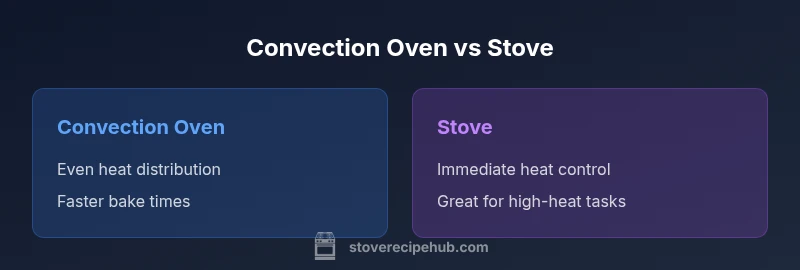
Convection ovens excel at even heat distribution due to circulating air, which reduces hot spots and promotes uniform browning on sheet pans, roasts, and pastries. On the stove, heat travels through direct contact with the pan and ambient air in the kitchen, making outcomes more dependent on pan material, flame control, and pan size. The same dish may require rack positioning and time adjustments when convection is active. Mastery comes from recognizing which method yields the best crust, color, and moisture balance for a given recipe.
Energy efficiency and running costs
Convection cooking can improve efficiency by shortening cooking times and allowing lower temperatures for the same results, but results vary by recipe and appliance quality. A high‑quality convection oven generally performs well for baking and roasting, whereas a stove’s immediate heat is advantageous for searing and quick tasks but can consume energy quickly if used for long simmering. When evaluating costs, compare energy labels, typical loads, and how often you bake or boil with each device to estimate long‑term impact.
Practical cooking scenarios: Baking, roasting, sautéing
Baking with convection often yields cookies with crisp edges and evenly colored pastries, plus sheet‑pan roasts with consistent browning. Sautéing or finishing on the stove remains essential for high‑risk, high‑heat tasks like rapid searing or deglazing. For braises and dishes demanding controlled moisture, the stove may outperform convection if you need precise moisture management away from direct heat. The key is mapping recipes to the heat regime that best preserves texture and flavor while meeting time targets.
Equipment compatibility: Pans, racks, and settings
Convection cooking favors shallow pans and metal trays that allow air to flow around food. Aluminum or light-coated pans heat quickly and promote uniform browning in a convection oven. For stove cooking, heavy‑bottom stainless or cast‑iron pans provide stable heat transfer. Rack placement matters in ovens: the middle rack is a solid default for many bakes, while upper positions can increase top browning when convection is on. Always verify cookware compatibility with high oven temperatures and airflow to maximize efficiency.
Preheating, timing, and temperature tips
Preheating times are often shorter with convection due to faster air circulation. Start with temperatures lower than non‑convection recipes and monitor color and internal doneness rather than relying on time alone. Use convection for roasts and baked goods that benefit from even browning, but consider switching off convection near the end to finish with a crisp crust if needed. On the stove, rely on preheated pans, appropriate flame control, and steady heat to reproduce convection‑style results when possible.
Maintenance and cleaning considerations
Convection ovens benefit from periodic cleaning of the fan housing, seals, and interior surfaces to prevent grease buildup that can impair airflow. Stoves require regular burner maintenance, cleaning burner heads, and ensuring gas flow or coil alignment remains unobstructed. Use non‑abrasive cleaners and follow manufacturer directions to preserve performance and safety over time. Routine checks help maintain even heat distribution and response.
Safety considerations for convection cooking
Ventilation matters: convection can brown foods more quickly, increasing the risk of over‑browning if you don’t monitor carefully. Keep oven doors closed to maintain consistent heat and prevent draft losses near the cooking chamber. On gas stoves, maintain appropriate flame height and avoid overheating pans. Ensure hot surfaces are protected from children and pets, and use high‑heat mitts for handling racks and trays. Regularly inspect seals and vents to reduce gas leaks or heat escape risks.
Decision framework: When to use convection oven vs stove
For even browning on baked goods or sheet‑pan meals, the convection oven is usually the preferred choice. For quick sautéing, deglazing, or high‑heat searing, the stove offers superior control and responsiveness. A hybrid workflow—using convection for baking portions and relying on the stove for finishing steps—often yields the best balance of texture, speed, and energy use. Consider your weekly menus, space, and preferred textures when designing a kitchen routine.
Real‑world recipes and outcomes
Developing a practice around convection typically yields more evenly baked cookies, crisper roasts, and efficient sheet‑pan dinners. Some delicate cakes or soufflés may require adjustments or non‑convection settings to preserve height and structure. Treat recipe testing as a scalable process: start with small batches, track adjustments, and build a personal reference library. The practical takeaway is that repetition and documentation translate to consistent results across meals.
Common pitfalls and how to avoid them
Avoid overcrowding convection trays; air needs space to circulate. Don’t rely solely on cooking times—use visual color cues and internal temperatures to judge doneness. When converting recipes, reduce temperature by about 25°F and adjust cooking times accordingly, then confirm results with your preferred tests. Ensure seals, gaskets, and fans are clean to prevent uneven heating. A little planning with airflow awareness goes a long way.
Expert tips from Stove Recipe Hub
Stove Recipe Hub emphasizes aligning recipes with appliance strengths, including maintaining a log of tested adjustments and cookware choices. Learn to map each dish to the appropriate heat regime, test frequently, and invest in compatible pans and racks. By building a library of successful variations, you’ll achieve reliable, high‑quality results without relying on guesswork.
Authority sources
For further reading and validation, consider credible sources from government, education, and major publications. These resources provide context about appliance efficiency, safe operation, and cooking science. See the links below for additional background and verification.
wordCount”:0}],
comparisonTableBumpedOnce?
Comparison
| Feature | Convection Oven | Stove (Conventional) |
|---|---|---|
| Heat distribution | Even airflow and browning | Direct heat with potential hot spots |
| Control and responsiveness | Precise control via convection settings | Immediate heat but manual adjustments required |
| Energy usage | Efficient for baking/roasting with proper load | Variable; depends on burner and duration |
| Preheat time | Often shorter due to airflow | Depends on burner and pan |
| Best for | Cookies, pastries, sheet-pan roasts | Searing, boiling, and quick sautéing |
| Recommended cookware | Shallow metal pans, racks, light coatings | Heavy-bottom pans for even contact |
Upsides
- More even cooking and browning
- Shorter cook times for many dishes
- Versatile for baking, roasting, and dehydrating
Downsides
- Requires compatible cookware and recipe adjustments
- Higher upfront cost and larger footprint
- May over-dry delicate baked goods if misused
Convection oven offers superior evenness and speed for many recipes; stove excels in speed, control, and high-heat tasks.
Choose convection for even browning and batch efficiency. Choose the stove for quick tasks, precise control, and high-heat searing; many kitchens benefit from a hybrid approach.
Common Questions
What is convection cooking and how does it differ from standard baking?
Convection cooking uses a fan to circulate hot air around food, speeding heat transfer and promoting even browning. Standard baking relies on radiant heat from the oven walls, which can create hot spots. In practice, convection is ideal for crispy edges, while some delicate items benefit from non-convection settings.
Convection circulates hot air for even browning; standard baking relies on radiant heat. It helps with crispy edges but may affect delicate cakes.
Can I use convection mode on a standard oven?
Many modern ovens include a convection option even if they are labeled as standard. If your oven has a convection setting, you can enable it for most recipes, keeping in mind adjustments to temperature and time.
If your oven has a convection setting, you can use it for many recipes with slight time and temperature tweaks.
Is a separate convection oven worth it if I already have a stove?
A separate convection oven can enhance baking performance and allow you to keep the stove free for other tasks. If your cooking focuses on baked goods or sheet-pan meals, the investment often pays off.
If you bake a lot, a convection oven can be worth it; it frees your stove for other tasks.
What cookware works best with convection ovens?
Use shallow, rimmed metal pans and aluminum or stainless trays that promote airflow. Avoid deep, non-perforated lids that trap air and moisture. Always check manufacturer guidance for temperature limits.
Choose shallow metal pans to maximize airflow; avoid deep, sealed lids.
How should I adjust recipes when using convection?
When using convection, reduce temperature by about 25 degrees Fahrenheit and monitor for doneness, since food browns faster. Shortened cooking times are common, so rely on color and internal temperature rather than time alone.
Lower the temperature and watch for doneness using color and internal temp.
Do gas stoves offer convection options?
Gas stoves provide immediate heat for sautéing and boiling, but convection requires an oven component. Some ranges may include a convection feature in the oven section but not on the cooktop.
Convection is an oven feature; some ranges include it in the oven portion, not on the cooktop.
Top Takeaways
- Assess your cooking style to decide on an investment
- Use convection for even browning and faster sheet-pan meals
- Reserve the stove for high-heat tasks and quick finishing steps
- Test and log recipe adjustments when switching between modes
- Ensure cookware compatibility and airflow for best results