Gas and Induction Cooktop: A Practical Side-by-Side Guide
Compare gas and induction cooktops to choose the right stove-top for your kitchen. Learn heat control, efficiency, cookware compatibility, safety, and maintenance considerations.


Induction cooktops heat faster, are more energy efficient, and stay cooler to the touch, improving safety. Gas cooktops offer instant flame control and broad cookware compatibility. The best choice depends on your cooking style and kitchen priorities.
Overview: gas vs induction cooktops
According to Stove Recipe Hub, the debate between a gas and induction cooktop is as much about cooking style as it is about kitchen safety and energy efficiency. In this comparison, we examine two popular stove-top technologies: gas and induction, often described as gas vs induction for short. The term gas and induction cooktop summarizes the broader category of fuel-powered gas stoves and electric-powered induction surfaces. The choice affects heat control, cookware requirements, cleaning, safety, and installation. For many households, the decision hinges on how you cook: do you need high-heat searing and wok work, or do you prioritize rapid heating, precise, repeatable temperatures, and effortless cleanup? The Stove Recipe Hub analysis notes that induction generally delivers faster heat-up and tighter control with a cooler surface, while gas offers immediate flame feedback and broad cookware compatibility. Every kitchen has different constraints: electricity availability, ventilation, budget, and cooking repertoire. This guide explains the core differences, practical trade-offs, and decision criteria to help you pick the right gas and induction cooktop configuration for your home. Ultimately, the best choice aligns with your cooking style, safety preferences, and maintenance expectations.
How induction works vs gas
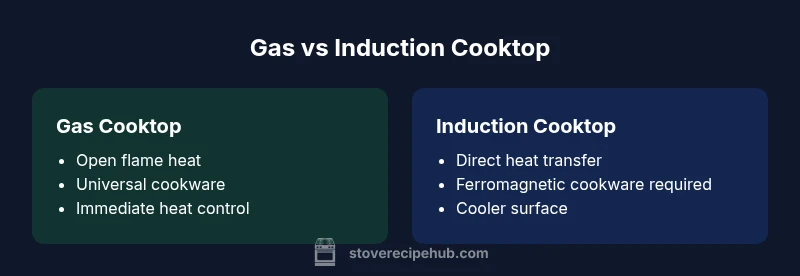
Induction cooking relies on electromagnetic fields generated by coils beneath a flat, glass-ceramic surface. When a ferromagnetic pan sits on the cooktop, an alternating current creates a rapidly changing magnetic field that directly heats the cookware. Since the heat is transferred through the pan, the surface stays relatively cool, reducing the risk of burns and making cleanup easier. Gas stoves, by contrast, use an open flame to heat the cookware directly. The burner flame heats the bottom of the pan and, depending on cookware design, can warm surrounding air. This fundamental difference influences heat up time, control style, and energy waste. Induction excels for precise, repeatable temperatures and rapid adjustments, while gas offers intuitive flame-based control that some cooks prefer for high-heat searing, wok throws, and certain delicate sauces.
Performance and efficiency
Performance is often framed in terms of heat-up speed, control granularity, and overall energy use. Induction typically provides very fast heat-up, with rapid response to changes in temperature, because energy is transferred directly to the pan. This direct transfer minimizes heat loss to the surrounding environment, contributing to higher energy efficiency in many cooking scenarios. Gas, while slower to heat up, offers tangible feedback through flame height, which some cooks use to gauge heat intuitively. In terms of energy use, induction can outperform gas in many household cooking tasks due to reduced idle heat and quicker cool-down when you remove the pan. However, the exact efficiency depends on pan compatibility, cookware mass, and how you cook.
Heat control and responsiveness
Heat control is a critical differentiator. Induction provides electronic, precise stepwise control with microsecond adjustments; you can set very small temperature changes, which is excellent for delicate sauces and simmering. Gas heat response is immediate but more variable, influenced by burner design and pan size. A large skillet can struggle to distribute heat evenly on some induction surfaces if the pan is not centered or properly sized. For high-heat searing, gas can deliver a powerful initial burst and allow quick adjustments with the flame, while induction might require moving to a different pan or adjusting power levels. The best approach depends on your typical cooking tasks and tolerance for learning a new control scheme.
Surface usability and cookware compatibility
Cookware compatibility heavily influences the user experience. Induction requires ferromagnetic cookware (cast iron, certain stainless steels, or magnetic-bottomed pans). Non-magnetic cookware such as copper, aluminum without a magnetic layer, or glass will not heat on induction. Gas stoves do not impose these cookware constraints; nearly any pot or pan can be used, including woks and copper pots, making them appealing to cooks with an existing assortment. The surface type also matters: induction uses a smooth glass-ceramic surface that wipes clean easily but can be scratched by abrasive tools, whereas gas stoves feature exposed burners that trap debris in grates and burner heads. Cleaning is typically quicker on induction due to the flat surface, but spills near controls may require a little extra care.
Installation, safety, ventilation, and electrical considerations
Induction cooktops require proper electrical supply—often a dedicated circuit and safe clearance from moisture sources. Some installations necessitate upgrading wiring or circuit breakers, depending on the model and the home’s electrical capacity. Gas cooktops require appropriate venting and a functioning exhaust system, with precautions for gas leaks and proper clearance from combustibles. In many homes, existing ranges can be replaced with limited ducting adjustments, but high-heat, multi-burner gas configurations may demand more robust ventilation. Safety features differ: induction reduces burn risk and eliminates flame exposure, while gas emphasizes direct flame control and manual shutoffs. When planning installation, confirm local codes and any required permits, and consider a professional inspection to verify gas lines, electrical panels, and ventilation adequacy.
Cleaning, maintenance, and safety considerations
Induction surfaces are generally easier to clean due to their flat, non-porous glass surface; simply wipe with a damp cloth after cooking. Avoid using abrasive cleaners that can scratch the surface. Induction units may include safety locks, auto power-off, and child-safety features. Gas stoves require routine cleaning around burner caps and grates to maintain even heat and efficiency, and burners should be checked for clogging to prevent uneven flames. Regularly inspect power cords, ventilation hoods, and electrical connections on induction units, and check gas lines for leaks on gas stoves using approved testing methods. Both types benefit from periodic calibration, professional service intervals, and safe handling practices to minimize accidents in the kitchen.
Cost of ownership and value proposition
Total cost of ownership includes purchase price, installation, energy use, and ongoing maintenance. Induction cooktops typically involve higher upfront costs, especially for premium models with smart features and built-in timers, but the long-term energy savings can offset the purchase price for many households. Gas stoves may have a lower upfront price, but ongoing costs include ventilation needs and potential maintenance of burners and gas lines. The energy efficiency gap between induction and gas depends on how you cook and your cookware. When considering replacement or new installation, balance upfront hardware costs with expected energy use, maintenance, and resale value. The right choice aligns with your cooking habits, electrical and venting infrastructure, and budget expectations.
Use-case scenarios and kitchen profiles
Apartment dwellers and small households often favor induction for its safety, compact footprint, and cleaner surfaces, especially when venting is plentiful or a downdraft system is present. Families who enjoy frequent high-heat searing, Asian-style wok cooking, or require compatibility with a broad set of pots may lean toward gas. Home chefs with existing cast iron collections or copper cookware might prefer gas for its seasoning, heat patterns, and pan responsiveness. Larger households or those converting from gas to electric should plan for variable energy costs, depending on usage patterns. The ideal kitchen setup balances cooking style, space, electrical access, and maintenance willingness.
Practical selection steps and decision framework
To choose between gas and induction, start with a self-audit of your cooking repertoire: Do you regularly use high-heat searing or delicate simmering? Review cookware inventory to see if you would need to replace pans for induction. Inspect your kitchen’s electrical capacity and venting, and confirm budget constraints for both upfront costs and long-term energy bills. Create a decision matrix with criteria such as heat control, safety, cookware compatibility, cleaning ease, and installation complexity. If your priority is efficiency and safety, induction is often the strongest overall choice; if you rely on traditional flame control and existing cookware, gas may be more practical. Finally, visit showrooms to try both interfaces, and request a side-by-side demonstration with a familiar recipe to gauge how each cooktop supports your workflow.
Comparison
| Feature | Gas Cooktop | Induction Cooktop |
|---|---|---|
| Heat source | Open flame and gas combustion | Electromagnetic induction |
| Heat control | Immediate, flame-based control | Electronic, precise temperature control |
| Cookware compatibility | Works with almost any pan | Requires ferromagnetic cookware |
| Energy efficiency | Moderate efficiency with potential heat loss | High efficiency with direct heat transfer |
| Surface and cleanup | Risers and grates can trap grime; cleanup slower | Smooth glass-ceramic surface; easy wipe-down |
| Ventilation needs | Vent hood often required for gas | Ventilation is still advisable; heat is lower |
| Cost range | Broad range depending on model | Broad range depending on model |
| Safety | Gas leaks risk; flame present | No flame, but electrical safety is essential |
| Best for | Traditional cooks; high-heat searing | Modern kitchens; efficiency-minded cooks |
Upsides
- Induction offers rapid heating and precise temperature control
- Induction surfaces stay cooler, reducing burn risk
- Gas provides instant heat control and broad cookware compatibility
- Gas stoves support a wide range of cookware and high-heat performance
- Modern induction models include advanced safety features and smart controls
Downsides
- Induction requires ferromagnetic cookware and may require new pots
- Induction may need electrical upgrades or dedicated circuits
- Gas involves open flame and ventilation needs with safety considerations
- Induction performance can be affected by pan size or misalignment
Induction is the generally preferred all-around choice for most homes; gas remains advantageous for traditional cooks and high-heat wok use.
Induction excels in safety, efficiency, and precise control. Gas offers tried-and-true flame-based cooking and broad cookware compatibility, making it a strong choice for certain recipes and cooks.
Common Questions
What is the key difference between gas and induction cooktops?
Gas uses an open flame to heat pots, giving immediate flame feedback and broad cookware compatibility. Induction uses electromagnetic fields to heat only the pan, offering rapid heating, precise control, and a cooler surface.
Gas uses a flame for heating, while induction heats the pan with magnets for precise, fast control and a cooler surface.
Is induction really safer than gas?
Induction reduces burn risk because the surface remains cooler and there is no open flame. However, electrical safety and proper installation are essential. Gas safety hinges on leak detection and good ventilation.
Induction is generally safer for casual contact due to the cool surface, but proper electrical and gas safety are essential.
Can I use any cookware on an induction cooktop?
Only ferromagnetic cookware works with induction. If a magnet sticks to the bottom, it will heat. Non-magnetic materials like aluminum or copper without a magnetic layer will not heat.
If a magnet sticks to your pan, it will heat on induction; otherwise, consider magnetic-bottom alternatives.
Do induction cooktops require special electrical wiring?
Some induction models require a dedicated circuit or upgraded wiring, depending on power draw and home electrical capacity. Check local codes and consult a licensed electrician for installation.
Most induction units need a dedicated circuit; verify your electrical panel capacity before buying.
Which is cheaper to operate long-term: gas or induction?
Operating costs vary with usage and local energy prices. Induction often saves energy due to direct heat transfer, but total costs depend on cooking habits and electrical rates.
Induction can save energy with direct heating, but actual costs depend on how you cook and local energy prices.
What is best for high-heat searing and wok cooking?
Gas is typically preferred for high-heat searing and wok cooking due to adjustable flame control and rapid heat delivery. Induction can handle it with the right pan and power settings but may feel different.
Gas is usually favored for high-heat searing; induction works with proper cookware and settings but feels different.
Top Takeaways
- Induction offers faster heating and safety advantages
- Gas provides flame feedback and universal cookware compatibility
- Your choice depends on cookware, electrical capacity, and cooking style
- Induction surfaces are easier to clean with fewer hot spots
- Always verify ventilation and electrical requirements before installation