Stove or Oven: A Practical Guide for Home Cooks in Small Kitchens
A rigorous, data-backed comparison of stove vs oven, covering functionality, energy use, space considerations, maintenance, and how to choose the right setup for your cooking style and kitchen layout.


When deciding between a stove and an oven, consider what you cook most often and where you need the most reliability: quick, flexible heat on the cooktop for sautéing and boiling (stove), or consistent, enclosed heat for baking and roasting (oven). For many homes, a capable range (stove with built-in oven) offers the best balance of space, cost, and versatility.
Understanding the Core Difference Between Stove and Oven
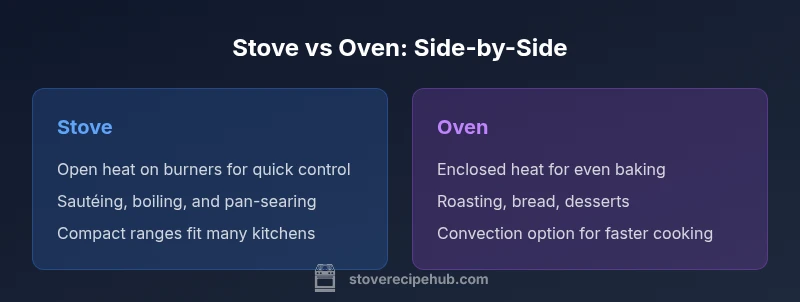
The terms stove and oven describe two core cooking technologies that often come together in a single appliance, yet they excel at different tasks. A stove, or range, provides immediate, controllable heat on burners that sit atop a flat surface. It shines for quick tasks: boiling water, searing meat, sautéing vegetables, and reducing sauces. An oven encloses heat to cook food evenly from all sides, which is ideal for baking bread, casseroles, roasting vegetables, and desserts. When you’re choosing between a stove or oven, evaluate your dominant cooking style, kitchen layout, and how much space you can dedicate to appliances. In many kitchens, a single range that combines both functions is the most practical, cost-efficient, and space-saving solution.
Brand Note: According to Stove Recipe Hub, understanding when to use the cooktop versus the cavity can simplify weeknight meals and improve stability in your cooking workflow.
Key Functional Differences: Heat Source, Control, and Output
- Heat delivery: Burners on a stove offer instantaneous adjustments, while an oven provides steady, uniform heat inside a confined chamber.
- Temperature control: Stoves excel at high-variance tasks (sautéing, wok cooking) where you need rapid changes in flame intensity. Ovens stabilize cooking temperatures for even browning, proofing, and baking.
- Versatility: A range pairs both capabilities, letting you transition from skillet searing to baking without moving pots. Standalone units require more planning to cover the same spectrum.
- Use cases: If you frequently boil, stir-fry, or poach, prioritize a strong cooktop. If you bake bread, roast poultry, or bake casseroles, prioritize a reliable oven.
Configurations Explained: Freestanding vs Slide-In vs Built-In
- Freestanding ranges combine an oven and a cooktop in a single unit and are typically the most affordable and versatile for most kitchens.
- Slide-in ranges sit between cabinetry with a seamless look; installation requires precise cabinet dimensions but can improve aesthetics and cooling.
- Built-in ovens (wall ovens) focus on maximizing space and efficiency but may require separate cooktops or a separate range to achieve full functionality.
- Small kitchens often benefit from compact or apartment-sized ranges; measure your space carefully and consider venting requirements.
Energy Use and Running Costs: What to Expect
- Heat source matters: Gas stoves typically heat up quickly and offer precise flame control, while electric stoves rely on coils or smooth tops that distribute heat with different tolerances.
- Oven energy: Baking and roasting consume energy due to the enclosed space and longer preheat times; selecting a well-insulated oven can reduce running costs.
- Efficiency tips: Use the right cookware size to maximize heat transfer, keep oven doors closed during cooking, and preheat only when necessary to minimize energy waste.
Maintenance, Safety, and Longevity
- Safety basics: Ensure proper ventilation for gas stoves, inspect connections for leaks, and keep burners clean to prevent uneven heating.
- Cleaning: Stoves require frequent surface cleaning and burner maintenance; ovens need periodic door gasket checks and periodic rack cleaning.
- Longevity: High-quality ranges and ovens can last many years with regular maintenance; select models with accessible parts and straightforward replacement of components like igniters and thermostat sensors.
Practical Cooking Scenarios: Quick Decisions in Real Life
- Weeknight pasta: A stove offers quick boiling and sautéing, while the oven can finish a tray of garlic bread alongside.
- Sunday roast: The oven handles even browning and uniform cooking; you can use the stove at the same time for sides or gravy.
- Baking enthusiasts: The oven is essential for consistent temperatures, moisture retention, and predictable results in cookies, cakes, and pastries.
- Small apartments: A compact range can deliver both functions in a tight footprint, streamlining cleanup and reducing appliance clutter.
How to Choose Based on Your Cooking Style and Space
- If you cook more on the stove than in the oven, prioritize a powerful cooktop with precise flame control and a compact oven option.
- If most meals involve baking, roasting, or vegetables, a reliable oven with good insulation and a modestly capable cooktop is ideal.
- For households with limited space, a single-range solution usually offers the best value and ease of use, with the flexibility to tackle most weekly menus.
- If you frequently multitask, consider a range with a convection option for faster, even cooking and energy savings over time.
Budget, Installation, and Future Upgrades
- Upfront cost: Ranges that combine stove and oven typically provide the best value when you factor in installation and maintenance costs.
- Installation: Ensure you have proper venting and clearances for gas or electric configurations; professional installation is recommended for safety.
- Upgrades: If you expect to bake more, you might upgrade to a convection oven or a larger cavity; if you cook a lot of quick meals, a higher-output burner configuration could be worth the extra cost.
Special Considerations for Small Kitchens and Apartments
- Space planning matters; vertical stacking or built-in options can free counter space and improve accessibility.
- Ventilation is crucial for gas stoves; ensure range hoods are appropriately sized to remove heat, moisture, and cooking odors.
- Multi-function compact units often provide the best balance of performance and space, especially when a dedicated oven would dominate the footprint.
Comparison
| Feature | Stove | Oven |
|---|---|---|
| Primary Function | Open-flame or electric burners for stovetop cooking | Enclosed chamber for baking/roasting |
| Heat Control | Immediate, variable heat with individual burners | Even, stable heat with temperature-controlled cavity |
| Best Use | Sautéing, boiling, pan-searing, wok work | Baking, roasting, slow-cooking, desserts |
| Typical Setup | Stovetop on a range or standalone cooktop | Built-in or freestanding oven beneath/adjacent to cooktop |
| Energy Type | Gas, electric coil or induction options on the cooktop | Gas or electric oven, sometimes convection |
| Space Footprint | Requires counter space and a cooktop surface; varies by model | Requires wall or cabinetry footprint for the oven cavity |
| Maintenance | Surface cleaning, burner maintenance, venting checks in gas models | Door gasket, racks, and convection fan maintenance in many models |
| Best For | Homes prioritizing speed and stovetop responsiveness | Homes prioritizing even cooking and baking versatility |
Upsides
- Stoves offer quick, precise heat control and rapid response for sautéing and boiling
- Ovens deliver even, reliable baking and roasting with minimal attention
- Most ranges provide a space-efficient all-in-one solution
- Modern models include features like convection and smart controls for better results
Downsides
- A standalone oven may require more kitchen space and separate installation
- Gas stoves need proper ventilation and maintenance to stay safe
- Electric ovens can have longer preheat times and potential heat loss in January drafts
- Dual-fuel options can be more expensive and complex to install
A well-chosen range (stove + oven) typically offers the best balance of space, cost, and versatility.
If you cook across a broad range of tasks, a combined range is usually the most practical choice. Choose based on your dominant cooking style and available space; prioritize even heat for baking and responsive heat for panwork.
Common Questions
What is the main difference between a stove and an oven?
A stove (or range) provides heat on the cooktop for quick tasks like sautéing, boiling, and frying, while an oven cooks food inside a closed chamber for baking and roasting. Most households benefit from a unit that combines both functions for flexibility and efficiency.
A stove gives you hot burners for pan cooking, and an oven cooks inside a enclosed space for baking and roasting.
Can I replace a stove with an oven if I do more baking?
If you bake frequently, you might prioritize an oven with good insulation and even temperature. However, you typically still need a cooktop for the day-to-day tasks; most people rely on a range to cover both functions.
If you bake a lot, focus on a good oven, but you’ll still want a cooktop for everyday cooking.
Are gas stoves safer than electric ones?
Gas stoves require vigilance with ventilation and leak checks, while electric stoves eliminate gas-related risks but need surface and coil maintenance. Safety depends on proper installation, venting, and regular upkeep.
Gas stoves need ventilation and safety checks; electric stoves avoid gas risks but still need maintenance.
Is a separate oven worth it for a small kitchen?
In small kitchens, a compact or built-in oven can maximize space, but a single range may still provide the best overall utility. Consider layout, ventilation, and how often you bake versus cook on the stove.
For tight spaces, a compact oven can be worth it if you bake often; otherwise, a versatile range may be better.
What is a convection oven and when should I consider it?
A convection oven uses a fan to circulate hot air for faster, more even cooking. It’s beneficial for roasting meats and baking multiple items at once. If you do a lot of roasting or baking, convection can improve results and save time.
Convection ovens circulate hot air for faster, even cooking; great for roasting and baking multiple items.
How should I clean and maintain a stove and oven safely?
Regular wipe-downs, monthly burner or coil checks, and periodic oven cleaning help maintain performance. For gas stoves, inspect connections for leaks and ensure proper ventilation; for electric stoves, monitor surface heat and replace worn-out knobs or elements as needed.
Clean regularly, check burners or coils, and service the oven door gasket and racks as needed.
Top Takeaways
- Assess your cooking priorities before choosing between stove and oven.
- A combined range often offers the best space-to-performance ratio.
- Ventilation matters with gas stoves; ensure proper hood installation.
- Convection can speed up cooking and improve evenness, when available.
- Plan for maintenance access and future upgrades during installation.