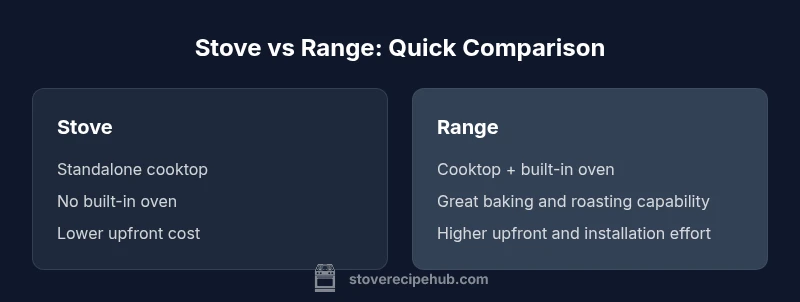
Stove versus Range: Which Appliance Fits Your Kitchen
An analytical comparison of stove versus range to help home cooks choose based on space, baking needs, cost, and long-term value.


Across most home kitchens, a range with an integrated oven delivers the best overall versatility, while a standalone stove shines in compact spaces. In the stove versus range comparison, ranges excel at baking and large-meal cooking, whereas standalone stoves save money and fit tighter layouts. According to Stove Recipe Hub, choose a range for maximum capability, but opt for a stove when space or budget is at a premium.
Understanding the stove versus range distinction
Stove and range are terms commonly used in kitchen conversations, but they describe different appliance configurations. A stove typically refers to a standalone cooktop, either gas or electric, that does not include a built-in oven in the same unit. A range combines a cooktop with an oven in a single enclosure, creating a centralized cooking hub. In the stove versus range comparison, the choice hinges on how you cook, the space you have, and your long-term goals. According to Stove Recipe Hub, most home cooks gain the greatest flexibility by opting for a range, because baked dishes, roasts, and sheet-pan meals can be prepared without switching appliances. However, if your kitchen is small or you already own a separate wall oven, a standalone stove can be a compelling, lower-cost alternative. The objective is to map your cooking patterns to the appliance’s core strengths, then weigh setup and ongoing costs accordingly.
Oven presence and baking capacity in the stove versus range decision
The oven is the defining feature separating ranges from standalone stoves. A range provides integrated baking and roasting capabilities, which makes it easier to plan weekly menus, bake multiple trays of cookies, or prepare a Sunday roast without cycling through appliances. For many households, this single difference translates into saving time and simplifying cleanup. A standalone stove, devoid of an oven, can still support a broad range of recipes on the stovetop, including sautéing, braising, and simmering. When you bake infrequently, the absence of an oven might not be a problem, and you can rely on a countertop or wall oven elsewhere in your kitchen. In practice, most households find that a range offers superior all-around versatility, while a stove shines when oven space is unnecessary or budget is tight.
Space, layout, and installation considerations in the stove versus range choice
Kitchen dimensions and workflow play a crucial role in deciding between stove and range. A range typically occupies a larger footprint than a freestanding stove because of the integrated oven, which means you must account for clearance, venting, and cabinet alignment. If your kitchen layout favors a single, centralized cooking zone, a range creates a neater look and can streamline venting and electrical/gas connections. Conversely, a standalone stove can be installed in tighter spaces or on a peninsula where a full oven cabinet would feel crowded. If you regularly reconfigure your kitchen or plan to upgrade cabinetry, factor in installation time, professional venting, and potential electrical or gas line adjustments. The central question is whether you want an all-in-one solution or a more modular setup that gives you space to reflow the kitchen later.
Fuel types, heat control, and safety considerations in stove versus range choices
Fuel type—gas or electric—shapes performance, control, and safety. Gas stoves provide instant flame response and dry heat for searing, while electric coils or smooth-top surfaces offer predictability and easy cleanup. Ranges with gas ovens deliver strong baking performance in many contexts, but electric ovens can offer precise, stable temperatures for delicate pastries. Electric outfitting may require careful ventilation planning in compact spaces. Safety features such as flame failure devices, auto-shutoff, and proper clearance to combustible materials matter for both configurations. In general, ranges with well-designed controls and convection features tend to deliver more consistent cooking results for varied recipes, while standalone stoves benefit from simpler maintenance routes and potentially lower repair costs when issues are limited to the stovetop.
Price, value, and long-term costs in stove versus range decisions
Price is a practical driver in any appliance purchase. Standalone stoves generally carry a lower upfront price than ranges with built-in ovens, but the long-term cost depends on usage, maintenance, and energy efficiency. An oven adds not only purchase cost but also potential repair expenses and higher energy consumption over time. To assess value, compare the total cost of ownership across five to seven years, including energy use, maintenance plans, and parts availability. For families that bake regularly or cook large meals, a range often provides better resale value and a more cohesive warranty, while a stove may win on initial price and the flexibility of choosing an external oven if future kitchen plans evolve.
Performance metrics: heating, temperature control, and recovery times
Performance is driven by burner power, heat distribution, and temperature stability. Ranges with multiple high-BTU burners and accurate oven thermostats typically outperform standalone stoves for high-heat searing and consistent baking. Cooking performance improves further with features like convection, precise simmer settings, and smart controls. Standalone stoves rely entirely on the stovetop performance; if your menus require frequent simmering or pan-frying, a robust primary burner is essential. When deciding, consider recovery time after a high-heat burst and how quickly the oven returns to target temperatures after door openings. These operational nuances often determine whether stove or range better matches your weekly cooking routine.
Installation, maintenance, and durability considerations for stove versus range
Installation complexity varies: ranges require venting, gas or electrical hookups, and sometimes cabinet adjustments, whereas standalone stoves can be simpler to place if you already have a wall oven. Maintenance patterns differ as well. A range adds oven cleaning and broiler upkeep, while a stove focuses maintenance on burners and control knobs. Durability expectations hinge on materials, build quality, and user care. Regular cleaning, inspection of gas connections or electrical cords, and timely servicing help extend the life of either option. If you anticipate heavy usage or frequent high-heat cooking, investing in a robust range with reliable convection and an efficient hood can yield longer-term satisfaction.
Real-world scenarios: families, renters, and gourmet cooks in the stove versus range debate
Families feeding a busy week will benefit from the baking and roasting capacity of a range, especially when planning large meals or holiday gatherings. Renters or apartment dwellers with limited space may prefer a standalone stove to maximize room layout flexibility and keep budgeting predictable. Gourmet cooks who bake regularly might lean toward a range for its integrated oven and advanced convection options, while casual cooks can achieve excellent results with either configuration if the stovetop is strong and comfortable to use. The best choice aligns with your cooking cadence, space constraints, and how you balance upfront cost with long-term value.
Measuring space and planning clearance for stove versus range installations
Accurate measurements are essential before purchase. Start with the overall width of the appliance footprint, then add clearance for doors, vents, and handle movement. Check for adjacent cabinetry and ensure there is adequate space for a potential oven door to open without contact. Ventilation matters too: ranges often require range hoods with adequate ducting, while standalone stoves may rely on wall-mounted hoods or window exhaust. If you live in a small apartment, confirm building codes and rental restrictions. A quick rule of thumb is to leave at least 1-2 inches of clearance on each side and more in tight spaces to prevent heat damage to nearby cabinets.
Quick decision framework and practical checklist before buying
Use a simple framework to compare options: (1) How often do you bake or roast? (2) What is your kitchen layout and space for a hood? (3) What is your upfront budget versus long-term costs? (4) Do you prefer the flexibility of a modular kitchen? (5) What fuel type is preferred or available in your home? This checklist helps steer you toward either a range or a stove based on your cooking profile. Remember, the right choice balances capability, space, and cost over the appliance’s expected lifespan.
Common myths about stove versus range decisions and how to separate fact from fiction
A common myth is that ranges are always more expensive to operate than stoves; in reality, energy efficiency and usage patterns determine operating costs more than the presence of an oven. Another misconception is that gas stoves are universally superior for performance; electric ovens with modern convection can equal or surpass gas in many scenarios. Debunking these myths helps you evaluate features like oven calibration, thermostat accuracy, and burner responsiveness objectively. By focusing on your actual cooking patterns, you avoid overpaying for features you don’t need and miss out on essential capabilities.
Practical next steps: how to plan your purchase and kitchen layout
Start with a space plan and a wishlist of must-have features. Compare models side by side, focusing on oven size, burner power, and available safety features. Check for warranties and service availability in your region. If possible, view demonstrations or take a hands-on test through local showrooms. Finally, set a realistic budget that includes installation costs, venting requirements, and potential electrical or gas upgrades. The goal is to align your decision with your kitchen’s layout and your cooking priorities, rather than chasing the newest trend.
Comparison
| Feature | Stove | Range |
|---|---|---|
| Oven presence | No oven included (stovetop only) | Built-in oven included (range) |
| Baking versatility | Limited to stovetop tasks | Full baking and roasting capabilities |
| Primary fuel type | Gas or electric stovetop only | Gas or electric stovetop with oven |
| Maintenance complexity | Lower (fewer features) | Higher (oven features and cleaning) |
| Space requirements | Can fit in smaller layouts, depending on model | Requires space for both cooktop and oven area |
| Price range | Typically lower upfront | Typically higher upfront due to oven inclusion |
| Best use case | Tight spaces, simple cooking needs | Families needing baking, roasting, and high-capacity cooking |
Upsides
- Versatile cooking with built-in oven (range)
- One-stop appliance for cooking needs
- Better resale value in many markets
- Cleaner kitchen workflow with fewer appliances
Downsides
- Higher upfront cost for ranges
- Installation may be more complex due to venting
- Oven maintenance adds potential repair costs
Ranges win for overall versatility; standalone stoves win on space and price
The Stove Recipe Hub Team recommends a range for most homes that bake regularly or cook large meals. If space, budget, or modularity is paramount, a standalone stove can be the smarter choice. The verdict favors ranges for versatility, but acknowledges the value of stoves in constrained kitchens.
Common Questions
What is the fundamental difference between a stove and a range?
A stove is typically a standalone cooktop without a built-in oven, while a range combines a cooktop and oven in one unit. The choice affects baking capability, kitchen layout, and overall versatility. For most homes, a range provides a more integrated cooking experience.
The main difference is that a stove is a top-only appliance, and a range includes an oven. This affects baking and overall versatility.
Is a range worth the extra cost if I bake regularly?
If you bake or roast often, a range is typically more convenient and time-saving because you can perform all tasks without moving between appliances. It also tends to simplify cleanup and meal planning. Consider your kitchen space and long-term usage to judge value.
Yes, if you bake frequently, a range is usually more convenient and efficient.
Can I install a range in a small kitchen?
Yes, but you should verify clearance, ventilation, and appliance dimensions. A compact range can fit in tighter spaces, but you may need to adjust cabinetry or venting. If space is severely limited, a standalone stove paired with a separate wall oven might be preferable.
It can fit in small kitchens with proper planning and ventilation.
Are gas stoves safer than electric stoves?
Safety largely depends on installation quality, ventilation, and proper use. Gas stoves offer precise control but require venting and gas line safety checks. Electric stoves can be simpler to use and clean but may have slower heat response depending on the model.
Safety depends on installation and use, not the fuel alone.
What maintenance tasks are common to both?
Regular cleaning of burners or hot plates, periodic thermostat calibration checks, and vent hood maintenance are typical for both configurations. Inspect gas connections or electrical cords annually and service any signs of wear promptly.
Keep burners clean, check thermostats, and service vents and gas lines as needed.
Should I upgrade to a convection oven in a range?
Convection ovens offer more even heat and faster cooking for many recipes. If you bake frequently or want more predictable results, a convection option is worth considering in a range. However, ensure you understand the energy implications and cookware requirements.
Convection can improve evenness and speed, worth considering if you bake often.
Top Takeaways
- Assess baking needs to guide the choice
- Consider space, venting, and installation costs
- A range adds oven functionality; a stove saves space and money
- Fuel type and thermostat accuracy impact performance
- Plan for long-term maintenance and ownership costs