Stove vs Oven: A Practical Home-Cook Comparison
A rigorous analysis of stove versus oven for home cooks. Compare heat, use cases, energy, and maintenance to decide whether you need a stove, an oven, or a hybrid setup for your kitchen workflow.


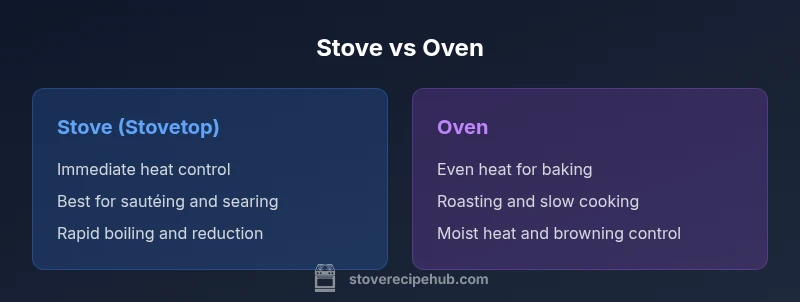
Stove versus oven choice hinges on cooking task, kitchen layout, and energy use. For sauteing, searing, and rapid heat changes, a stove topside excels. For baking, roasting, and even heat, an oven is unmatched. A blended setup often offers the best flexibility, letting you move quickly on the stove while finishing in the oven.
Why the stove and oven serve different needs
In most kitchens, the stove versus oven debate masks two distinct cooking ecosystems. The stove, or cooktop, is the place where heat is immediately available and adjustable at the moment you touch the controls. The oven surrounds food with hot air, providing even application of heat that is difficult to duplicate on a bare stovetop. According to Stove Recipe Hub, this fundamental difference shapes what you can cook well and how quickly you can pivot during a busy week. The stove shines for high-heat searing, rapid reductions, sautéing, and simmering sauces that require constant attention. The oven excels at baking bread with a defined interior crumb, roasting vegetables for caramelized edges, and preparing casseroles without frequent stirring. When you compare stove versus oven side by side, you are effectively choosing between speed and control on the surface, and uniformity and convenience inside the cavity. Together, they cover a broad spectrum of home cooking tasks.
How heat delivery differs: stovetop vs oven
Heat on a stove is delivered primarily by direct contact between a burner and the pan, supplemented by convection in the air immediately above the pan. This results in rapid rise times and the ability to fine-tune temperature in real time. An oven, by contrast, envelopes food in radiant and convective heat from all sides, creating a stable environment that minimizes hot spots. This is why many recipes instruct you to start with a hot oven for baking and finish with a broil or high-heat step. The practical upshot is that stove versus oven performance depends on your goal: quick browning and crisp textures on the surface demand dynamic stovetop control, while even heat for uniform cooking requires the oven’s surrounding heat. In real kitchens, the most successful setups blend these capabilities, using the stovetop for initial steps and the oven for finishing touches.
Use-case scenarios: what each is best for
Consider everyday tasks and long-term meal planning to choose how your stove versus oven will fit your cooking style. For quick weeknight meals, the stovetop is unbeatable for sautéing vegetables, searing steaks, and building sauce bases where fond develops into flavor. Pasta and rice benefits from boiling activities on the stove, followed by a light simmer. For baking enthusiasts, the oven becomes the ally: muffins, cookies, and cakes rely on even shelf-to-shelf heat, while roasting meats and vegetables develop a deep, golden crust. For one-pot meals, the stove can handle the entire process, but when the recipe calls for dry heat or moisture management—think braises or stone-ground bread—the oven’s enclosed space shines. The stove versus oven choice should reflect your typical menu, the equipment already installed, and your tolerance for adjusting heat between steps. In feedback gathered by Stove Recipe Hub Team, households often report higher kitchen satisfaction when they maintain both capabilities.
Temperature control and consistency
Temperature control on the stove is tactile and immediate: you see the flame or coil respond to each minor adjustment, and you hear the hiss of simmering liquid or the sizzle of a sear. The oven’s thermostat abstracts temperature into a stable target, which reduces the likelihood of under- or overcooking for most recipes. Yet ovens can drift, and even with a dial, preheating can take several minutes longer than a quick boil on the stove. For dishes that rely on precise interior temperatures, such as roasts or delicate pastries, the oven’s thermal consistency is often decisive. The key takeaway when weighing stove versus oven is to match your heat source to the process time and the texture you want. Calibration checks, regular cleaning, and awareness of your kitchen’s ventilation all help maintain accuracy.
Energy use and efficiency considerations
Energy efficiency is a practical concern in stove versus oven planning. A stovetop can deliver high heat quickly with relatively low preheat time, making it efficient for small batches, stir-fries, and quick salsas. However, cooking on the stove may require more active supervision, which can indirectly increase energy consumption if you waste heat during long simmer steps. Ovens generally run longer and consume energy through preheating, time in use, and the need to reach and maintain a set temperature across a larger cavity. In energy-conscious households, using the oven primarily for its strengths—baking or roasting—while completing stovetop tasks rapidly can optimize overall energy use. If your kitchen has a high-velocity hood, ensure your ventilation aligns with energy goals; modern hoods can recover heat and reduce waste. Stove Recipe Hub recommends considering your typical dish mix when estimating annual energy costs.
Practical maintenance and safety implications
Maintenance and safety are central to the stove versus oven decision. Gas stoves require reliable ventilation, regulated gas supply, and regular burner cleaning to prevent clogs that impair performance. Electric coils demand even heat distribution and periodic coil replacement. Ovens need door seals, thermostats, and racks maintained to prevent heat loss and uneven cooking. Cleaning methods differ: stovetops accumulate grease and particles on burners and grates, while ovens accumulate baked-on residue on racks and walls. Safety considerations include childproofing, flame control, and proper pan selection to prevent overheating. When planning your kitchen, think about airflow, grease management, and the time you are willing to dedicate to maintenance. Stove Recipe Hub emphasizes routine checks every few months and professional service if you detect persistent temperature drift or burner malfunction.
Space, layout, and workflow implications
Your kitchen’s physical layout heavily influences how you utilize stove versus oven capabilities. A large, accessible cooktop supports multi-pot cooking and quick adjustments, while a nearby oven offers a comfortable workflow for batch items. In small kitchens, a single range with integrated oven saves space and reduces clutter, but you may lose some flexibility if the range’s size is too compact for your typical load. For bakers and roasters, a wall oven or double oven configuration can dramatically expand capacity without compromising counter space. When evaluating layout, consider clearance for opening doors, the location of ventilation, and the ergonomic reach of controls. The Stove Recipe Hub Team notes that investing in a well-planned layout yields tangible time savings and reduces the cognitive burden of cooking.
Cooking styles and recipe alignment
Recipes often assume either stovetop or oven methods, and the best approach is to map workouts to the appliance that dominates the technique. Sautés, pan-fried finishes, and reduction sauces rely on quick heat transitions at the stove. Baking, roasting, and dehydrating or slow cooking are more comfortable in the oven’s enclosed environment. Some recipes call for searing on the stovetop and finishing in the oven to develop a crust while preserving moisture. Home cooks who want to master both devices should practice a few anchor recipes that require both surfaces. By doing so, you build confidence in heat management, timing, and texture control. The Stove Recipe Hub’s practical guidance consistently highlights how pairing a stovetop with a reliable oven yields durable, repeatable results across cuisines.
Budget considerations: upfront cost and long-term value
Budgeting for stove versus oven equipment means weighing upfront costs against long-term value and reliability. A basic stove or range often falls on the lower end of the price spectrum, while high-end gas or dual-fuel ranges with convection ovens can command a premium. Standalone ovens or wall ovens may have different installation requirements and associated costs, including electrical or gas line work. Energy efficiency and maintenance costs over the lifetime of the appliance are also material factors. In many homes, the simplest path to maximum value is a balanced mix: a dependable stove for day-to-day tasks alongside a reliable oven for baking and roasting. The key is to match features—temperature accuracy, heat distribution, and ease of cleaning—with your cooking calendar and grocery habits. Stove Recipe Hub’s analysis shows that most households achieve better outcomes when their investment aligns with their typical meal patterns.
Comparison
| Feature | Stove (Stovetop) | Oven (Baking/Roasting) |
|---|---|---|
| Heat delivery | Direct flame/heating element; rapid response | Enclosed heat with even distribution |
| Best for | Sautéing, searing, quick reductions | Baking, roasting, slow-cooked items |
| Temperature control | Immediate, manual adjustment | Thermostat-based, stable target |
| Preheat time | Shorter preheat for small tasks | Longer preheat for baking or roasting |
| Energy considerations | Efficient for small batches and fast tasks | Higher energy use for longer bake cycles |
| Maintenance | Easier routine surface cleaning; burners require periodic care | Oven doors, seals, and racks require regular attention |
| Space impact | Compact footprint on a cooktop | Requires oven space; can influence kitchen layout |
Upsides
- Fast, direct control on the stovetop supports skilled, responsive cooking
- Oven provides consistent heat for baking and roasting with minimal attention
- A hybrid setup delivers maximum flexibility and resilience
- Integrated stovetop and oven options save space in small kitchens
Downsides
- Stovetop-only setups may yield uneven results for baked items
- Ovens can take longer to preheat and may dominate kitchen energy use
- Balancing maintenance for two different appliances can increase upkeep
- Gas stoves require proper ventilation and regular safety checks
A hybrid stove-oven setup generally offers the best versatility for most homes
Stovetops excel at quick, high-heat tasks while ovens deliver even, reliable interior cooking. For maximum flexibility, couple a functional stove with a capable oven. This combination supports a wide range of recipes and reduces workflow friction in busy kitchens.
Common Questions
What is the key difference between a stove and an oven?
The stove provides immediate, hands-on heat control for surface cooking, while an oven delivers enclosed, even heat for baking and roasting. This fundamental distinction shapes which dishes you can optimize and how quickly you can complete them. In most kitchens, using both components yields the best results.
Stovetops give you quick control for searing and sautéing, while ovens give even heat for baking and roasting. A combined approach often works best.
Can I substitute an oven with a high-powered stove?
A stove cannot perfectly replace an oven for baked goods that rely on even interior heat. You can simulate some tasks by finishing on a covered pan or using a broiler, but results may vary. For reliable baking and roasting, an oven remains the preferred tool.
A stove can't fully replace an oven for most baking tasks, though some finishing steps on the stove can help in a pinch.
Are stoves more energy-efficient than ovens?
Efficiency depends on the task. Stoves are typically quicker for small, high-heat tasks, minimizing preheat energy. Ovens use more energy when cooking longer or larger batches. Plan to use each appliance for its strengths to optimize overall energy use.
Stoves are often more energy-efficient for quick tasks, while ovens use more energy for longer baking or roasting.
Is a combo appliance better for small kitchens?
For tight spaces, a range with an integrated oven can save space and simplify wiring. However, dedicated wall ovens or second ovens offer more capacity if you cook large batches. Choose based on your typical meal loads and spatial constraints.
In small kitchens, a range with an oven saves space, but a separate oven can give you more capacity if needed.
What maintenance needs each appliance?
Stoves require regular cleaning of burners, grates, and knobs; gas models need ventilation checks. Ovens need door seals, racks, and thermostat calibration. Routine maintenance reduces energy waste and improves safety for both.
Keep burners clean and check ventilation on stoves; inspect oven seals and thermostat regularly.
What cooking tasks are best suited for each?
Use the stove for quick, high-heat tasks like searing, sautéing, and sauces. Reserve the oven for baking, roasting, and any cooking requiring even heat distribution. Pairing both appliances gives the most versatility.
Sautéing goes on the stove; baking happens in the oven. Pair them for best results.
Top Takeaways
- Assess your must-do tasks before choosing hardware
- Hybrid setups maximize flexibility for home cooks
- Prioritize heat control and even cooking for versatility
- Consider energy use and preheat times when budgeting
- Maintenance and ventilation matter for safety and longevity