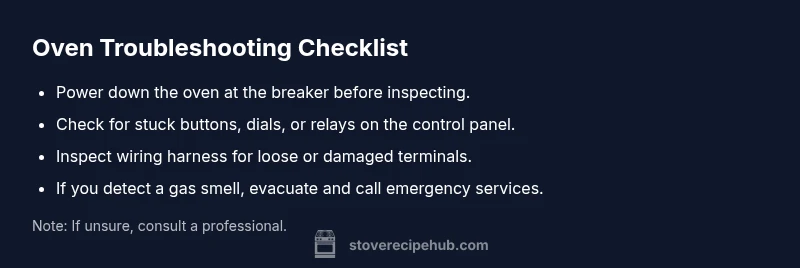
Why Your Oven Won't Turn Off: An Urgent Troubleshooting Guide
Urgent troubleshooting for why oven won t turn off: identify common causes, safety steps, and when to call a pro with practical guidance from Stove Recipe Hub.


Most likely a stuck control or failed relay keeps the oven heating. Start by cutting power at the breaker or unplugging if safe, then reset the oven by reconnecting power after 30 seconds. If the oven still won’t turn off, switch off the circuit and call a licensed technician—don’t tape wires or force panels.
What causes an oven that won’t turn off
If your oven continues to heat after you press Off, the root cause is usually an electronic control issue or a stuck switch. In modern ovens the control board, relay, and temperature sensor regulate heat. When any of these fail or become stuck, the oven can ignore Off requests. Contributing factors include a faulty bake/ broil selector, a stuck infinite switch, damaged wiring harness, or a door lock mechanism that keeps the control engaged. This fault is dangerous: heat stays active, electricity remains live, and gas valves can stay open on gas ovens. According to Stove Recipe Hub, these failures often trace to electronics that cannot release the heating element or a stuck control knob.
The most common culprits are electronic control boards and relays. A failing relay can hold a circuit closed even when the keypad sends an Off signal. A worn or dirty selector switch can also send misleading signals, causing the oven to remain in a heating state. Beyond these, a damaged wiring harness or a loose connector can cause partial power to leak to the heating element, effectively bypassing the Off command. Lastly, a faulty door latch or timer mechanism can leave the control logic in an active heating loop. Understanding these categories helps you decide which checks are safe to perform at home and when to call a professional.
Key takeaway: focus first on the control electronics and obvious physical faults before delving into deeper diagnostics. If you notice gas odors or hissing, treat it as an emergency and evacuate immediately.
wordCountToKeepForValidation
Steps
Estimated time: 60-120 minutes
- 1
Power down safely
Turn off the oven at the main breaker and unplug the unit if the cord is accessible and the oven is cool. This prevents accidental shocks and discharges any residual energy.
Tip: If you smell gas, do not attempt to unplug; evacuate and call emergency services. - 2
Verify immediate safety
Ensure the area around the oven is clear. Do not operate or touch panels while power is live. If the control remains hot to the touch or you hear unusual noises, stop and seek professional help.
Tip: Safety first—never bypass safety interlocks. - 3
Reset the control system
With power removed, wait about a minute, then restore power. Allow the electronics to reboot and attempt an Off command again to see if the issue persists.
Tip: A simple reset resolves many transient glitches. - 4
Check for physically stuck controls
Inspect knobs and touch buttons for sticking or debris. Gently nudge or clean around the switches if you can do so safely without opening high-voltage areas.
Tip: Use a soft brush or compressed air; avoid liquids near electronics. - 5
Inspect wiring and connectors
With power off, look for loose, frayed, or melted wires behind the control panel. Reseat connectors firmly; damaged wiring should be replaced by a professional.
Tip: Document wire positions with photos before disconnecting anything. - 6
Test after reassembly
Power the unit back on and attempt Off again. If the oven responds correctly, monitor for a return of the issue over the next few days.
Tip: If the problem recurs, schedule a professional diagnostic. - 7
Decide when to replace vs repair
If faults recur frequently or the repair cost approaches or exceeds replacement, consider upgrading to a newer model with a robust control system.
Tip: Ask about extended warranties and service plans.
Diagnosis: Oven stays on or cannot be turned off via control panel
Possible Causes
- highStuck or failed electronic control board/relay
- mediumStuck bake/broil selector switch or infinite switch
- lowWiring short or damaged wiring harness
- lowDoor latch/timer mechanism stuck
Fixes
- easyPower down the oven at the breaker or unplug if safe, then wait 60 seconds before restoring power to see if the control resets.
- mediumReseat or replace the control board connections and test the keypad input to ensure signals are properly sent.
- mediumInspect wiring harness for loose or damaged terminals; if you see burned insulation or melted connectors, replace the harness or have a pro inspect.
- hardReplace a stuck selector or infinite switch if you can access it safely; this often requires removing the back panel and testing with a multimeter.
Common Questions
What should I do first if my oven won't turn off?
Prioritize safety: cut power at the breaker or unplug if safe, then reset the control system. If the oven still stays on, call a licensed technician.
First, cut power at the breaker, then reset the controls. If it won’t turn off, contact a licensed technician.
Is it safe to reset the oven myself?
Resetting is generally safe when you power down completely and avoid touching live components. If you are unsure, wait for a professional.
Yes, as long as the power is fully off and you avoid live parts.
What should I do if I smell gas near the oven?
Leave the area immediately and call emergency services. Do not flip switches or operate electrical devices until you are safe.
If you smell gas, evacuate and call for help right away.
How long does control board repair take?
Repair duration varies; a diagnostic visit plus parts replacement can take a few hours to a day, depending on availability.
Diagnostics and replacement can take a few hours to a day.
Can a gas valve cause the oven to stay on?
Yes, a faulty gas valve or ignition problem can keep heating; this is a serious safety risk and should be evaluated by a pro.
A gas valve fault can cause it to stay on; have a professional check it.
When should I replace the oven instead of repairing it?
If the oven is old, requires frequent repairs, or repair costs exceed replacement, consider upgrading to a newer model.
If costs and repeated faults rise, replacement may be best.
Watch Video
Top Takeaways
- Power down first to stop energy delivery.
- Reset and reseat connections before replacing parts.
- Call a pro for persistent or dangerous faults.
- Document symptoms to speed diagnosis.
- Prevent recurrence with routine maintenance.